Department of Palliative Care, Policy and Rehabilitation, Faculty of Nursing, Midwifery and Palliative care, Cicely Saunders Institute, King's College London, London, UK (Drs Turner-Stokes and Dzingina); UK Rehabilitation Outcomes Collaborative, Regional/Hyper-acute Rehabilitation Unit, Northwick Park Hospital, Harrow, Middlesex, UK (Dr Turner-Stokes, Messrs Bill and Sephton, and Ms Williams); and Life Expectancy Project, San Francisco, California (Dr Shavelle). All UK authors are employed by the NHS and/or King's College London, which may cite this article as part of their research evaluation processes, including the UK Research Excellence Framework.
J Head Trauma Rehabil. 2019 Jul/Aug;34(4):205-214. doi: 10.1097/HTR.0000000000000473.
To evaluate cost-efficiency of rehabilitation following severe traumatic brain injury (TBI) and estimate the life-time savings in costs of care.
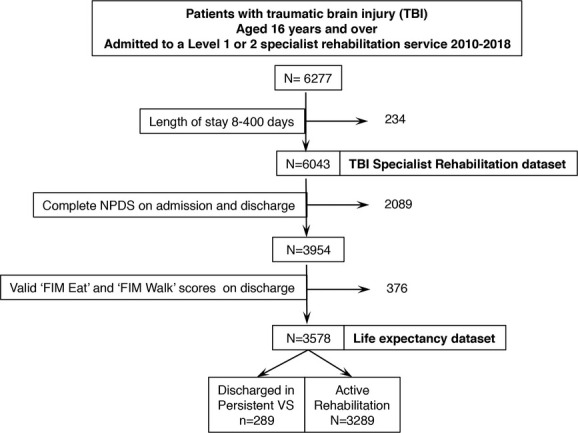
SETTING/PARTICIPANTS: TBI patients (n = 3578/6043) admitted to all 75 specialist rehabilitation services in England 2010-2018.
A multicenter cohort analysis of prospectively collated clinical data from the UK Rehabilitation Outcomes Collaborative national clinical database.
Primary outcomes: (a) reduction in dependency (UK Functional Assessment Measure), (b) cost-efficiency, measured in time taken to offset rehabilitation costs by savings in costs of ongoing care estimated by the Northwick Park Dependency Scale/Care Needs Assessment (NPDS/NPCNA), and (c) estimated life-time savings.
The mean age was 49 years (74% males). Including patients who remained in persistent vegetative state on discharge, the mean episode cost of rehabilitation was £42 894 (95% CI: £41 512, £44 235), which was offset within 18.2 months by NPCNA-estimated savings in ongoing care costs. The mean period life expectancy adjusted for TBI severity was 21.6 years, giving mean net life-time savings in care costs of £679 776/patient (95% CI: £635 972, £722 786).
Specialist rehabilitation proved highly cost-efficient for severely disabled patients with TBI, despite their reduced life-span, potentially generating over £4 billion savings in the cost of ongoing care for this 8-year national cohort.
评估严重创伤性脑损伤(TBI)后康复的成本效益,并估计护理成本的终身节省。
设置/参与者:2010 年至 2018 年期间,英格兰所有 75 家专业康复服务机构收治的 TBI 患者(n = 3578/6043)。
来自英国康复结果协作国家临床数据库的前瞻性收集的临床数据的多中心队列分析。
主要结局:(a)降低依赖性(英国功能评估量表),(b)成本效益,通过使用北威克公园依赖量表/护理需求评估(NPDS/NPCNA)估计的持续护理成本节省来衡量康复成本的时间,(c)估计的终身节省。
平均年龄为 49 岁(74%为男性)。包括出院时仍处于持续性植物状态的患者,康复的平均疗程费用为 42894 英镑(95%可信区间:41512 英镑,44235 英镑),通过 NPCNA 估计的持续护理成本节省,在 18.2 个月内得到弥补。根据 TBI 严重程度调整的平均预期寿命为 21.6 年,每位患者的平均净终身护理成本节省为 679776 英镑(95%可信区间:635972 英镑,722786 英镑)。
尽管严重残疾的 TBI 患者的预期寿命缩短,但专业康复对于他们来说仍然具有很高的成本效益,可能为这一 8 年的全国队列节省超过 40 亿英镑的持续护理费用。