Independent consultant, Madrid, Spain.
Communicable Diseases and Environmental Determinants of Health Department, Pan-American Health Organization/World Health Organization, Washington, DC, United States of the America.
PLoS Negl Trop Dis. 2019 Feb 25;13(2):e0007125. doi: 10.1371/journal.pntd.0007125. eCollection 2019 Feb.
Yaws is targeted for eradication by 2020 in the WHA66.12 resolution of the World Health Assembly. The objective of this study was to describe the occurrence of yaws in the Americas and to contribute to the compilation of evidence based on published data to undertake the certification of yaws eradication.
A systematic review of the epidemiological situation of yaws in the Americas was performed by searching in MEDLINE, Embase, LILACS, SCOPUS, Web of Science, DARE and Cochrane Database of Systematic Reviews. Experts on the topic were consulted, and institutional WHO/PAHO library databases were reviewed.
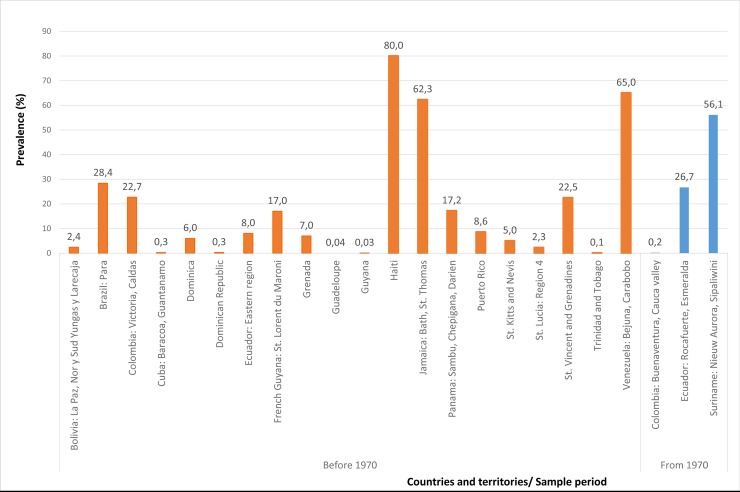
Seventy-five full-text articles published between 1839 and 2012 met the inclusion criteria. Haiti and Jamaica were the two countries with the highest number of papers (14.7% and 12.0%, respectively). Three-quarters of the studies were conducted before 1970. Thirty-three countries reported yaws case count or prevalence data. The largest foci in the history were described in Brazil and Haiti. The most recent cases reported were recorded in eight countries: Suriname, Guyana, Colombia, Haiti, Martinique, Dominica, Trinidad and Tobago, and Brazil. Gaps in information and heterogeneity were detected in the methodologies used and outcome reporting, making cross-national and chronological comparisons difficult.
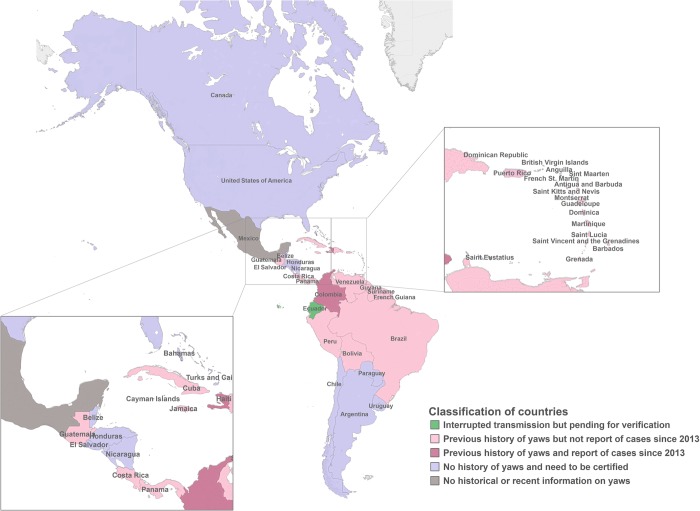
The lack of recent yaws publications may reflect, in the best-case scenario, the interruption of yaws transmission. It should be possible to reach the eradication goal in the region of the Americas, but it is necessary to collect more information. We suggest updating the epidemiological status of yaws, especially in two countries that need to assess ongoing transmission. Twenty-four countries need to demonstrate the interruption of transmission and declare its status of yaws endemicity, and sixteen countries should declare if they are yaws-free. It is necessary to formally verify the achievement of this goal in Ecuador.
世界卫生大会第 66.12 号决议将雅司病列为 2020 年消除的疾病。本研究的目的是描述美洲雅司病的发生情况,并根据已发表的数据编写证据,以认证雅司病的消除。
通过在 MEDLINE、Embase、LILACS、SCOPUS、Web of Science、DARE 和 Cochrane 系统评价数据库中检索,对美洲雅司病的流行病学情况进行了系统评价。咨询了该主题的专家,并查阅了世界卫生组织/泛美卫生组织机构图书馆数据库。
1839 年至 2012 年间发表的 75 篇全文文章符合纳入标准。海地和牙买加是发表论文数量最多的两个国家(分别为 14.7%和 12.0%)。四分之三的研究是在 1970 年之前进行的。有 33 个国家报告了雅司病病例数或流行率数据。历史上最大的流行地区是巴西和海地。最近报告的病例发生在 8 个国家:苏里南、圭亚那、哥伦比亚、海地、马提尼克岛、多米尼克、特立尼达和多巴哥以及巴西。在使用的方法和结果报告中发现了信息和异质性方面的差距,使得进行跨国和时间上的比较变得困难。
最近没有关于雅司病的出版物可能反映了在最好的情况下,雅司病传播的中断。在美洲地区实现消灭目标是有可能的,但需要收集更多信息。我们建议更新雅司病的流行病学状况,特别是在两个需要评估正在进行的传播的国家。24 个国家需要证明传播的中断,并宣布其雅司病流行状态,16 个国家应宣布是否无雅司病。有必要在厄瓜多尔正式核实这一目标的实现情况。