Pellestor Franck
Unit of Chromosomal Genetics, Department of Medical Genetics, Arnaud de Villeneuve Hospital, Montpellier CHRU, 371, avenue du Doyen Gaston Giraud, 34295 Montpellier cedex 5, France.
INSERM 1183 Unit «Genome and Stem Cell Plasticity in Development and Aging », Institute of Regenerative Medicine and Biotherapies, St Eloi Hospital, Montpellier, France.
Mol Cytogenet. 2019 Feb 11;12:6. doi: 10.1186/s13039-019-0415-7. eCollection 2019.
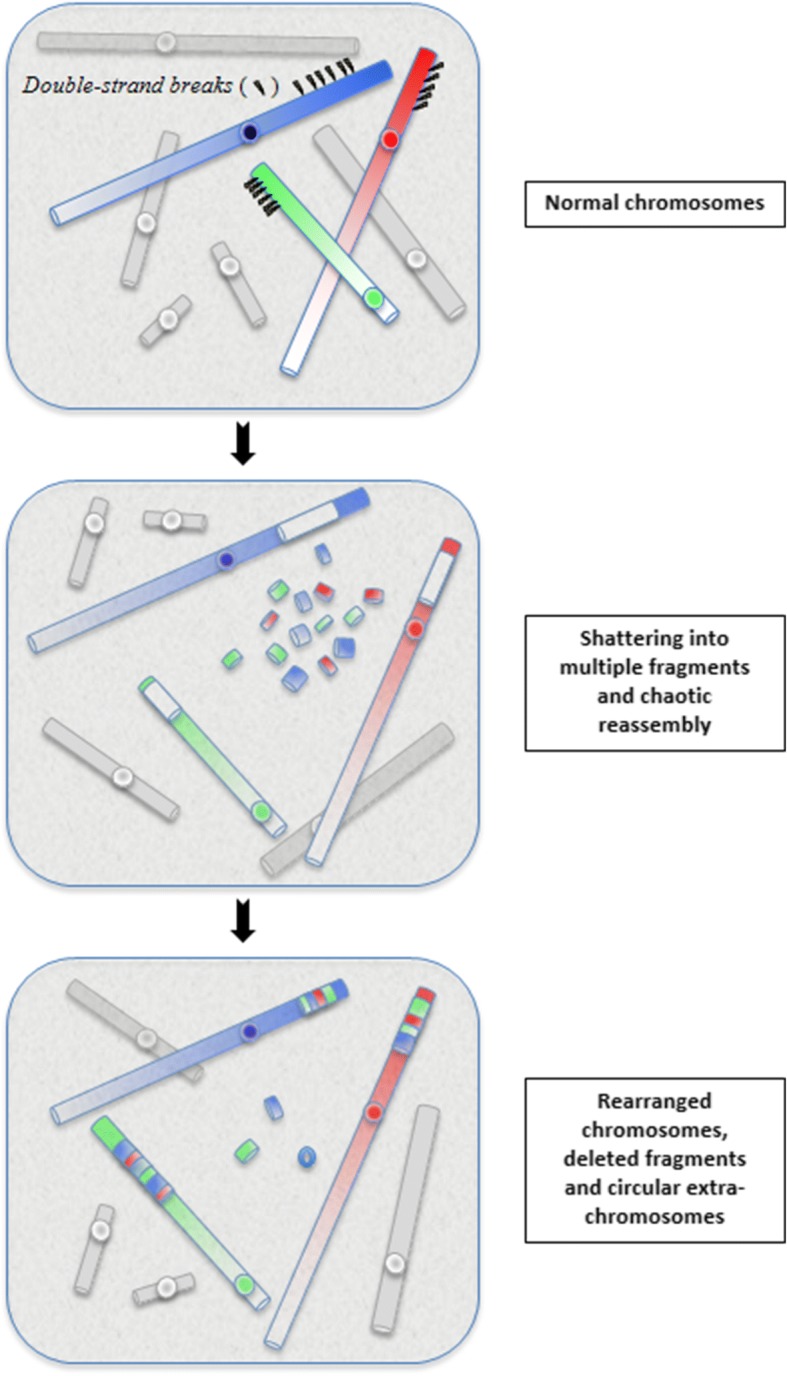
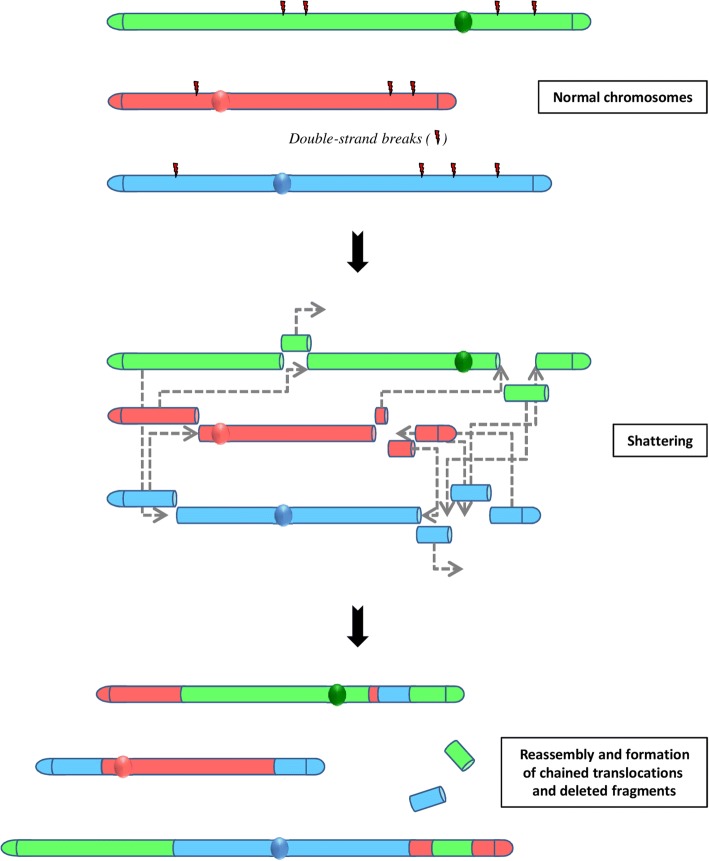
During the last decade, genome sequencing projects in cancer genomes as well as in patients with congenital diseases and healthy individuals have led to the identification of new types of massive chromosomal rearrangements arising during single chaotic cellular events. These unanticipated catastrophic phenomenon are termed chromothripsis, chromoanasynthesis and chromoplexis., and are grouped under the name of "chromoanagenesis".
For each process, several specific features have been described, allowing each phenomenon to be distinguished from each other and to understand its mechanism of formation and to better understand its aetiology. Thus, chromothripsis derives from chromosome shattering followed by the random restitching of chromosomal fragments with low copy-number change whereas chromoanasynthesis results from erroneous DNA replication of a chromosome through serial fork stalling and template switching with variable copy-number gains, and chromoplexy refers to the occurrence of multiple inter-and intra-chromosomal translocations and deletions with little or no copy-number alterations in prostate cancer. Cumulating data and experimental models have shown that chromothripsis and chromoanasynthesis may essentially result from lagging chromosome encapsulated in micronuclei or telomere attrition and end-to-end telomere fusion.
The concept of chromanagenesis has provided new insight into the aetiology of complex structural rearrangements, the connection between defective cell cycle progression and genomic instability, and the complexity of cancer evolution. Increasing reported chromoanagenesis events suggest that these chaotic mechanisms are probably much more frequent than anticipated.
在过去十年中,癌症基因组以及先天性疾病患者和健康个体的基因组测序项目已导致识别出在单个混乱细胞事件中出现的新型大规模染色体重排。这些意外的灾难性现象被称为染色体碎裂、染色体合成紊乱和染色体缠结,并被归为“染色体新生”这一名称之下。
对于每个过程,已经描述了几个特定特征,使得每种现象能够相互区分,理解其形成机制并更好地理解其病因。因此,染色体碎裂源于染色体破碎,随后是染色体片段的随机重新拼接,拷贝数变化较低;而染色体合成紊乱是由于染色体通过连续的复制叉停滞和模板切换进行错误的DNA复制,伴有可变的拷贝数增加;染色体缠结是指在前列腺癌中发生多个染色体间和染色体内的易位和缺失,拷贝数改变很少或没有。累积的数据和实验模型表明,染色体碎裂和染色体合成紊乱可能主要是由于包裹在微核中的滞后染色体或端粒磨损以及端粒端对端融合所致。
染色体新生的概念为复杂结构重排的病因、细胞周期进程缺陷与基因组不稳定之间的联系以及癌症进化的复杂性提供了新的见解。越来越多报道的染色体新生事件表明,这些混乱机制可能比预期的更为频繁。