Carter Mauricio J, Wilson Alastair J, Moore Allen J, Royle Nick J
Centre for Ecology and Conservation University of Exeter Penryn UK.
Present address: Departamento de Ecología y Biodiversidad, Facultad de Ciencias de la Vida Universidad Andrés Bello República 440 Santiago Chile.
Ecol Evol. 2019 Jan 18;9(3):998-1009. doi: 10.1002/ece3.4731. eCollection 2019 Feb.
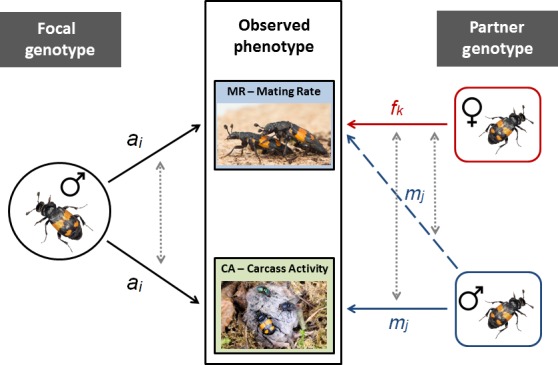
Social interactions can give rise to indirect genetic effects (IGEs), which occur when genes expressed in one individual affect the phenotype of another individual. The evolutionary dynamics of traits can be altered when there are IGEs. Sex often involves indirect effects arising from first-order (current) or second-order (prior) social interactions, yet IGEs are infrequently quantified for reproductive behaviors. Here, we use experimental populations of burying beetles that have experienced bidirectional selection on mating rate to test for social plasticity and IGEs associated with focal males mating with a female either without (first-order effect) or with (second-order effect) prior exposure to a competitor, and resource defense behavior (first-order effect). Additive IGEs were detected for mating rate arising from (first-order) interactions with females. For resource defense behavior, a standard variance partitioning analysis provided no evidence of additive genetic variance-either direct or indirect. However, behavior was predicted by focal size relative to that of the competitor, and size is also heritable. Assuming that behavior is causally dependent on relative size, this implies that both DGEs and IGEs do occur (and may potentially interact). The relative contribution of IGEs may differ among social behaviors related to mating which has consequences for the evolutionary trajectories of multivariate traits.
社会互动能够引发间接遗传效应(IGEs),当一个个体中表达的基因影响另一个个体的表型时,间接遗传效应就会出现。当存在间接遗传效应时,性状的进化动态可能会发生改变。性别常常涉及由一阶(当前)或二阶(先前)社会互动产生的间接效应,然而,对于生殖行为,间接遗传效应很少被量化。在这里,我们使用经历了交配率双向选择的埋葬甲虫实验种群,来测试社会可塑性以及与焦点雄性与雌性交配相关的间接遗传效应,交配情况分为焦点雄性在没有(一阶效应)或有(二阶效应)先前接触竞争对手的情况下与雌性交配,以及资源防御行为(一阶效应)。检测到由与雌性的(一阶)互动产生的交配率的加性间接遗传效应。对于资源防御行为,标准的方差分解分析没有提供加性遗传方差的证据——无论是直接的还是间接的。然而,行为是由焦点个体相对于竞争对手的大小预测的,而且大小也是可遗传的。假设行为因果依赖于相对大小,这意味着直接遗传效应和间接遗传效应都确实存在(并且可能潜在地相互作用)。间接遗传效应的相对贡献在与交配相关的社会行为中可能有所不同,这对多变量性状的进化轨迹有影响。