Department of Radiation Oncology, Leopoldina Hospital Schweinfurt, Schweinfurt, Germany.
Department of Radiation Oncology, University Hospital Jena, Jena, Germany.
BMC Cancer. 2019 Feb 26;19(1):173. doi: 10.1186/s12885-019-5362-5.
The aim of this analysis was to model the effect of local control (LC) on overall survival (OS) in patients treated with stereotactic body radiotherapy (SBRT) for liver or lung metastases from colorectal cancer.
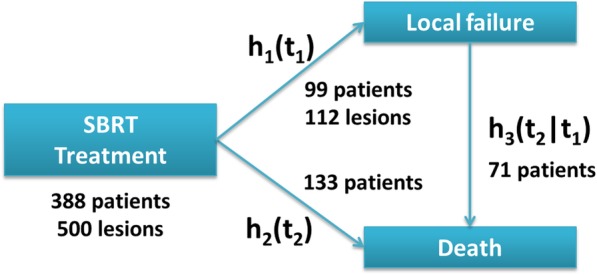
The analysis is based on pooled data from two retrospective SBRT databases for pulmonary and hepatic metastases from 27 centers from Germany and Switzerland. Only patients with metastases from colorectal cancer were considered to avoid histology as a confounding factor. An illness-death model was employed to model the relationship between LC and OS.
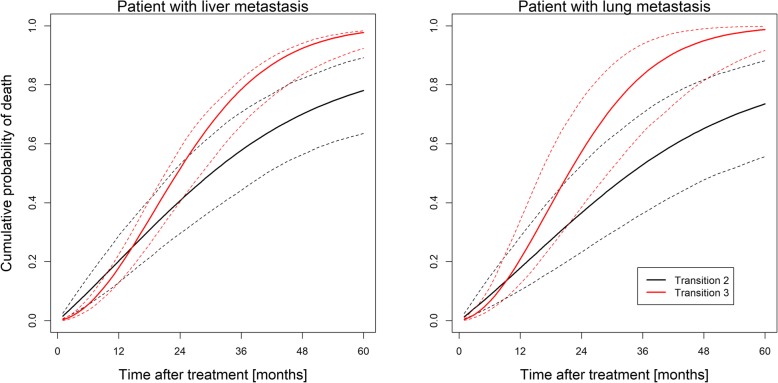
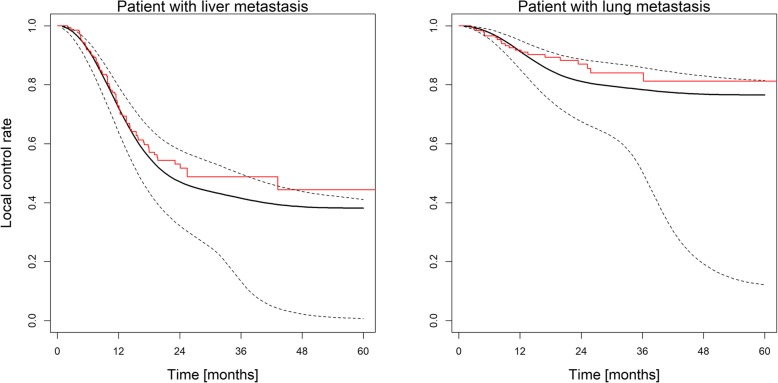
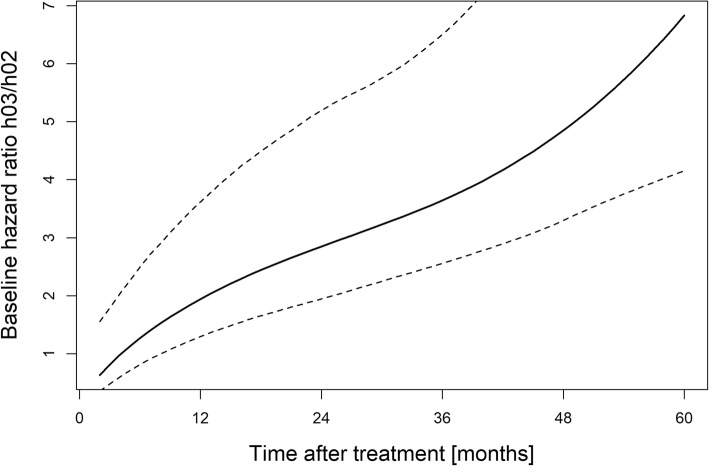
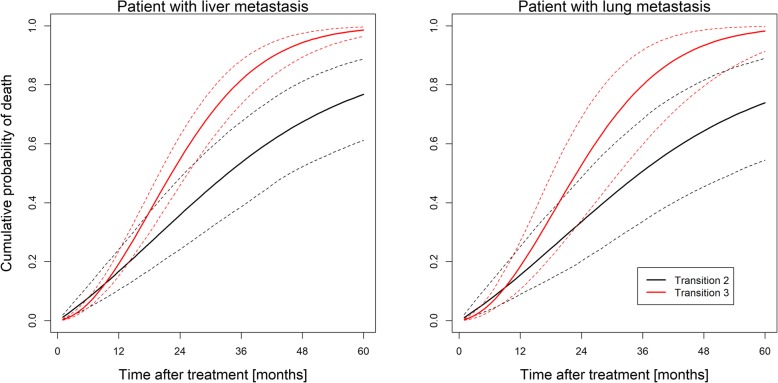
Three hundred eighty-eight patients with 500 metastatic lesions (lung n = 209, liver n = 291) were included and analyzed. Median follow-up time for local recurrence assessment was 12.1 months. Ninety-nine patients with 112 lesions experienced local failure. Seventy-one of these patients died after local failure. Median survival time was 27.9 months in all patients and 25.4 months versus 30.6 months in patients with and without local failure after SBRT. The baseline risk of death after local failure exceeds the baseline risk of death without local failure at 10 months indicating better survival with LC.
In CRC patients with lung or liver metastases, our findings suggest improved long-term OS by achieving metastatic disease control using SBRT in patients with a projected OS estimate of > 12 months.
本分析旨在通过对来自德国和瑞士 27 家中心的两个立体定向体放射治疗(SBRT)治疗结直肠癌肝或肺转移的回顾性 SBRT 数据库进行汇总分析,建立局部控制(LC)对总体生存(OS)的影响模型。
本分析仅考虑结直肠癌转移患者,以避免组织学作为混杂因素,基于该分析模型建立了一种疾病死亡模型,以评估 LC 与 OS 之间的关系。
共纳入 388 例 500 个转移病灶(肺部 n=209,肝脏 n=291)的患者,并进行了分析。局部复发评估的中位随访时间为 12.1 个月。99 例患者的 112 个病灶出现局部失败,其中 71 例在局部失败后死亡。所有患者的中位生存时间为 27.9 个月,SBRT 后有局部失败和无局部失败的患者的中位生存时间分别为 25.4 个月和 30.6 个月。局部失败后 10 个月死亡的基线风险超过无局部失败后 10 个月的基线风险,这表明 LC 可改善生存。
在患有肺或肝转移的结直肠癌患者中,我们的研究结果表明,通过 SBRT 控制转移性疾病,可提高预计 OS 超过 12 个月的患者的长期 OS。