Graduate School of Science, Technology and Innovation, Kobe University, 1-1 Rokkodaicho, Nada-ku, Kobe, Hyogo, 657-8501, Japan.
Department of Chemical Science and Engineering, Graduate School of Engineering, Kobe University, 1-1 Rokkodaicho, Nada-ku, Kobe, Hyogo, 657-8501, Japan.
Microb Cell Fact. 2019 Feb 26;18(1):40. doi: 10.1186/s12934-019-1088-y.
Due to various environmental problems, biodegradable polymers such as poly (3-hydroxybutyrate) (PHB) have gained much attention in recent years. Purple non-sulfur (PNS) bacteria have various attractive characteristics useful for environmentally harmless PHB production. However, production of PHB by PNS bacteria using genetic engineering has never been reported. This study is the first report of a genetically engineered PNS bacterial strain with a high PHB production.
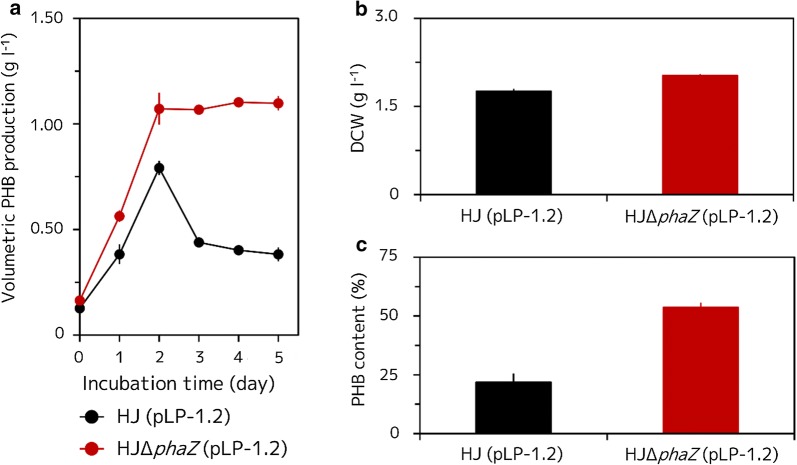
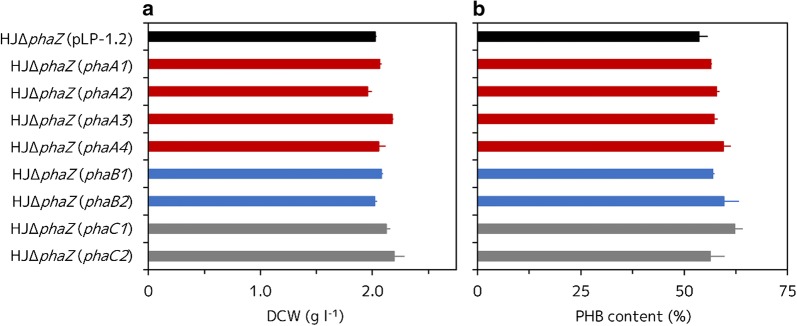
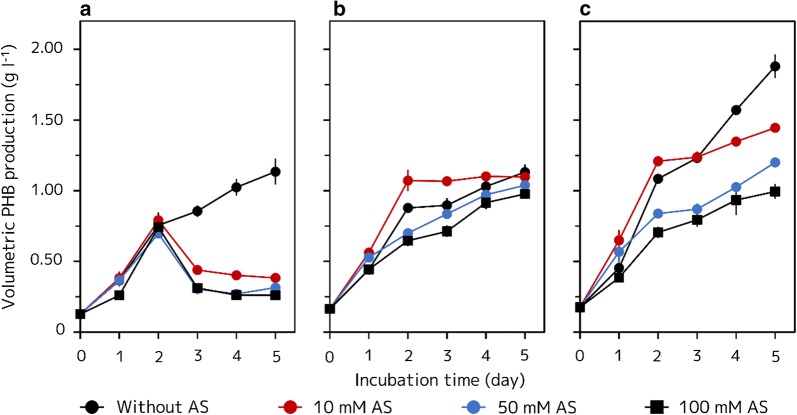
We constructed a poly (3-hydroxyalkanoate) depolymerase (phaZ) gene-disrupted Rhodobacter sphaeroides HJ strain. This R. sphaeroides HJΔphaZ (pLP-1.2) strain showed about 2.9-fold higher volumetric PHB production than that of the parent HJ (pLP-1.2) strain after 5 days of culture. The HJΔphaZ strain was further improved for PHB production by constructing strains overexpressing each of the eight genes including those newly found and annotated as PHB biosynthesis genes in the KEGG GENES Database. Among these constructed strains, all of gene products exhibited annotated enzyme activities in the recombinant strain cells, and HJΔphaZ (phaA3), HJΔphaZ (phaB2), and HJΔphaZ (phaC1) showed about 1.1-, 1.1-, and 1.2-fold higher volumetric PHB production than that of the parent HJΔphaZ (pLP-1.2) strain. Furthermore, we constructed a strain that simultaneously overexpresses all three phaA3, phaB2, and phaC1 genes; this HJΔphaZ (phaA3/phaB2/phaC1) strain showed about 1.7- to 3.9-fold higher volumetric PHB production (without ammonium sulfate; 1.88 ± 0.08 g l and with 100 mM ammonium sulfate; 0.99 ± 0.05 g l) than those of the parent HJ (pLP-1.2) strain grown under nitrogen limited and rich conditions, respectively.
In this study, we identified eight different genes involved in PHB biosynthesis in the genome of R. sphaeroides 2.4.1, and revealed that their overexpression increased PHB accumulation in an R. sphaeroides HJ strain. In addition, we demonstrated the effectiveness of a phaZ disruption for high PHB accumulation, especially under nitrogen rich conditions. Furthermore, we showed that PNS bacteria may have some unidentified genes involved in poly (3-hydroxyalkanoates) (PHA) biosynthesis. Our findings could lead to further improvement of environmentally harmless PHA production techniques using PNS bacteria.
由于各种环境问题,可生物降解聚合物如聚 3-羟基丁酸酯(PHB)近年来受到了广泛关注。紫色非硫(PNS)细菌具有各种有用的环境无害 PHB 生产的诱人特性。然而,利用遗传工程生产 PHB 的 PNS 细菌从未有过报道。本研究首次报道了一株具有高产 PHB 能力的遗传工程 PNS 细菌菌株。
我们构建了一个聚 3-羟基烷酸酯(PHA)解聚酶(phaZ)基因敲除的红假单胞菌 HJ 菌株。与亲本 HJ(pLP-1.2)菌株相比,经过 5 天培养,R. sphaeroides HJΔphaZ(pLP-1.2)菌株的 PHB 产量增加了约 2.9 倍。通过构建过表达包括新发现和 KEGG GENES 数据库中注释为 PHB 生物合成基因的 8 个基因的菌株,进一步提高了 HJΔphaZ 菌株的 PHB 生产能力。在这些构建的菌株中,所有基因产物在重组菌细胞中均表现出注释酶活性,而 HJΔphaZ(phaA3)、HJΔphaZ(phaB2)和 HJΔphaZ(phaC1)菌株的 PHB 产量分别比亲本 HJΔphaZ(pLP-1.2)菌株增加了约 1.1、1.1 和 1.2 倍。此外,我们构建了一株同时过表达所有三个 phaA3、phaB2 和 phaC1 基因的菌株;与在氮限制和丰富条件下生长的亲本 HJ(pLP-1.2)菌株相比,该 HJΔphaZ(phaA3/phaB2/phaC1)菌株的 PHB 产量分别增加了约 1.7-3.9 倍(无硫酸铵时为 1.88±0.08 g/L,含 100 mM 硫酸铵时为 0.99±0.05 g/L)。
本研究在红假单胞菌 2.4.1 的基因组中鉴定了 8 个不同的 PHB 生物合成基因,并表明它们的过表达增加了红假单胞菌 HJ 菌株中 PHB 的积累。此外,我们证明了 phaZ 敲除对于高产 PHB 积累的有效性,尤其是在氮丰富的条件下。此外,我们表明 PNS 细菌可能具有一些未被识别的参与多(3-羟基烷酸酯)(PHA)生物合成的基因。我们的发现可能会进一步改进利用 PNS 细菌进行环境无害 PHA 生产的技术。