Department of Biochemistry and Molecular Biology, University of Texas Medical Branch at Galveston, Galveston, Texas 77555, USA.
Genes Dev. 2019 Mar 1;33(5-6):282-287. doi: 10.1101/gad.320531.118. Epub 2019 Feb 26.
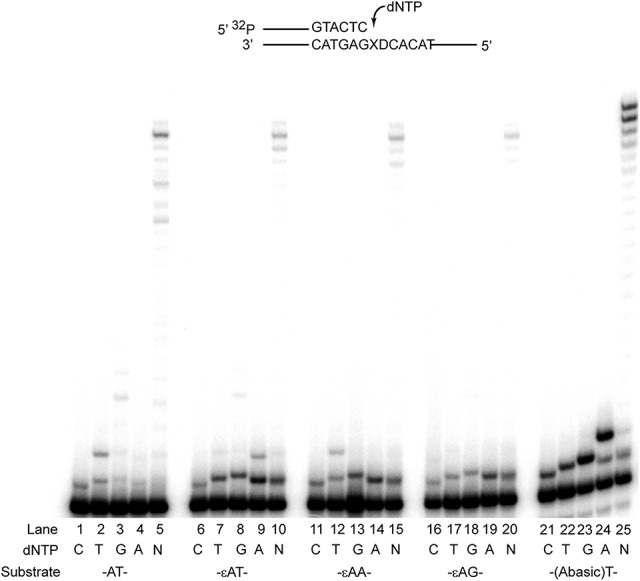
Here we show that translesion synthesis (TLS) opposite 1,N-ethenodeoxyadenosine (εdA), which disrupts Watson-Crick base pairing, occurs via Polι/Polζ-, Rev1-, and Polθ-dependent pathways. The requirement of Polι/Polζ is consistent with the ability of Polι to incorporate nucleotide opposite εdA by Hoogsteen base pairing and of Polζ to extend synthesis. Rev1 polymerase and Polθ conduct TLS opposite εdA via alternative error-prone pathways. Strikingly, in contrast to extremely error-prone TLS opposite εdA by purified Polθ, it performs predominantly error-free TLS in human cells. Reconfiguration of the active site opposite εdA would provide Polθ the proficiency for error-free TLS in human cells.
在这里,我们表明,跨损伤合成(TLS)在 1,N-亚乙基脱氧腺嘌呤(εdA)的对面发生,这破坏了 Watson-Crick 碱基配对,通过 Polι/Polζ-、Rev1-和 Polθ-依赖的途径发生。对 Polι/Polζ的需求与 Polι通过 Hoogsteen 碱基配对掺入与 εdA 相对的核苷酸以及 Polζ延伸合成的能力一致。Rev1 聚合酶和 Polθ 通过替代易错途径进行 TLS 对面的 εdA。引人注目的是,与纯化的 Polθ 对面的 εdA 极其易错的 TLS 相反,它在人细胞中主要进行无错误的 TLS。对面的 εdA 活性位点的重新配置将为 Polθ 在人细胞中进行无错误的 TLS 提供能力。