School of Population Health, National Institute for Health Innovation, The University of Auckland, Auckland, New Zealand.
Tilburg University, Tilburg, The Netherlands.
BMJ Open. 2019 Feb 25;9(2):e023659. doi: 10.1136/bmjopen-2018-023659.
Evidence indicates e-cigarettes can help people quit smoking; however, more confirmatory trials are needed. To date, no trials have evaluated the effectiveness and safety of combining nicotine patches with e-cigarettes (with and without nicotine) for smoking cessation.
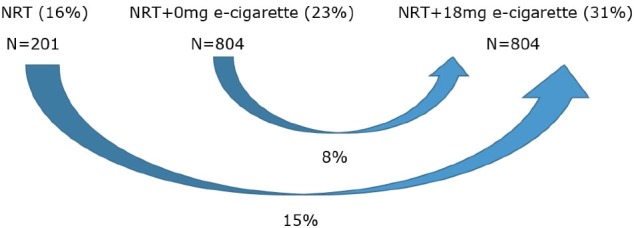
This study is a pragmatic, three-arm, community-based, single-blind, randomised trial undertaken in New Zealand. Eligible participants are daily/non-daily smokers, aged ≥18 years, naive e-cigarette users and motivated to quit smoking in the next 2 weeks. Participants (n=1809), recruited using multi-media advertising, are randomised to 14 weeks of (1) 21 mg nicotine patches (n=201); (2) 21 mg nicotine patches+18 mg/mL nicotine e-cigarette (n=804); or (3) 21 mg nicotine patches+nicotine free e-cigarette (n=804). Participants receive weekly withdrawal-oriented behavioural support calls for 6 weeks post-randomisation. The primary outcome is self-reported biochemically verified continuous abstinence (CA) at 6 months post quit-date. The primary comparison is nicotine patch + nicotine e-cigarette versus nicotine patch + nicotine free e-cigarette, and the secondary comparison is nicotine patch versus nicotine patch +nicotine e-cigarette (90% power, p=0.05, to detect an absolute difference in 6 month CA rates of 8% and 15% respectively). Secondary outcomes, collected by phone interview at quit date, then 1, 3, 6 and 12 months post-quit date, include self-reported CA, 7 day point prevalence abstinence, cigarettes per day (if smoking, or when smoking for non-daily smokers), time to relapse (if returned to smoking), belief in ability to quit, use of other cessation support, side effects/serious adverse events, treatment compliance, seeking additional support around e-cigarette use, daily use of both e-cigarettes and cigarettes, use of treatment past 14 weeks, views on treatment and recommendation to others, weight and cost-per-quitter.
The Northern A Health and Disability Ethics Committee approved the trial. Findings will be disseminated through publication, conference/meeting presentations, and media.
NCT02521662; Pre-results.
有证据表明电子烟可帮助人们戒烟,但仍需更多确证性试验。迄今为止,尚无试验评估尼古丁贴片联合电子烟(含尼古丁和不含尼古丁)戒烟的有效性和安全性。
这是一项在新西兰开展的基于社区、实用性、三臂、单盲、随机试验。符合条件的参与者为每天/非每天吸烟、年龄≥18 岁、初次使用电子烟且在未来 2 周内有戒烟意愿的烟民。通过多媒体广告招募参与者(n=1809),并将其随机分配至 14 周的(1)21mg 尼古丁贴片(n=201);(2)21mg 尼古丁贴片+18mg/ml 尼古丁电子烟(n=804);或(3)21mg 尼古丁贴片+不含尼古丁电子烟(n=804)。参与者在随机分组后 6 周内每周接受一次以戒断为导向的行为支持电话。主要结局为戒烟后 6 个月时经生物化学验证的自我报告连续戒烟(CA)。主要比较为尼古丁贴片+尼古丁电子烟与尼古丁贴片+不含尼古丁电子烟,次要比较为尼古丁贴片与尼古丁贴片+尼古丁电子烟(90%效力,p=0.05,以检测 6 个月 CA 率的绝对差异分别为 8%和 15%)。次要结局通过在戒烟日、随后 1、3、6 和 12 个月的电话访谈收集,包括自我报告的 CA、7 天点患病率戒烟、每天吸烟量(若吸烟或非吸烟者吸烟时)、复吸时间(若复吸)、戒烟能力信念、其他戒烟支持的使用、副作用/严重不良事件、治疗依从性、电子烟使用方面寻求额外支持、同时使用电子烟和香烟的频率、使用治疗药物超过 14 周、对治疗的看法和对他人的推荐、体重和每个戒烟者的成本。
北部 A 健康和残疾伦理委员会批准了该试验。研究结果将通过发表文章、会议/会议报告和媒体进行传播。
NCT02521662;预结果。