Department of Molecular Genetics and Microbiology, School of Medicine, Stony Brook University, Stony Brook, New York, USA.
Department of Molecular Genetics and Microbiology, School of Medicine, Stony Brook University, Stony Brook, New York, USA
mBio. 2019 Feb 26;10(1):e00022-19. doi: 10.1128/mBio.00022-19.
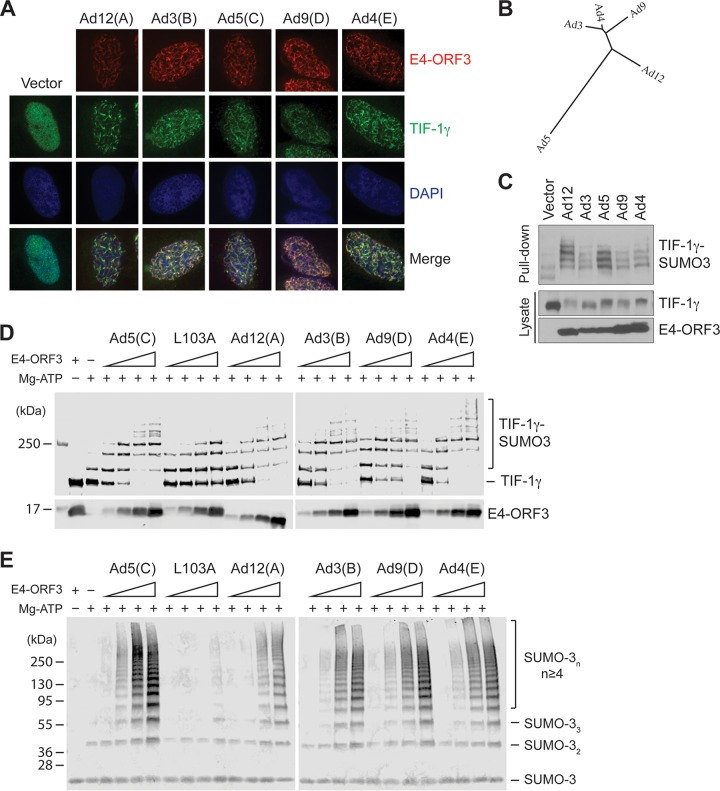
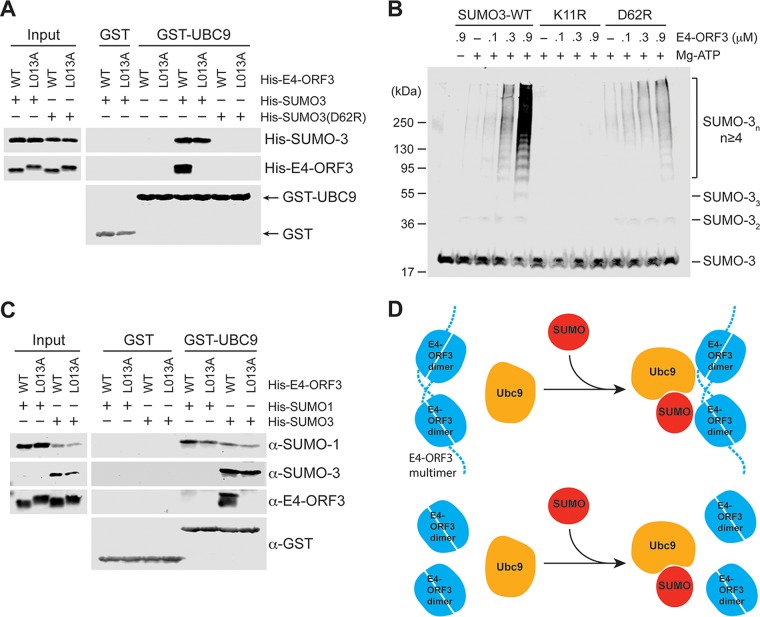
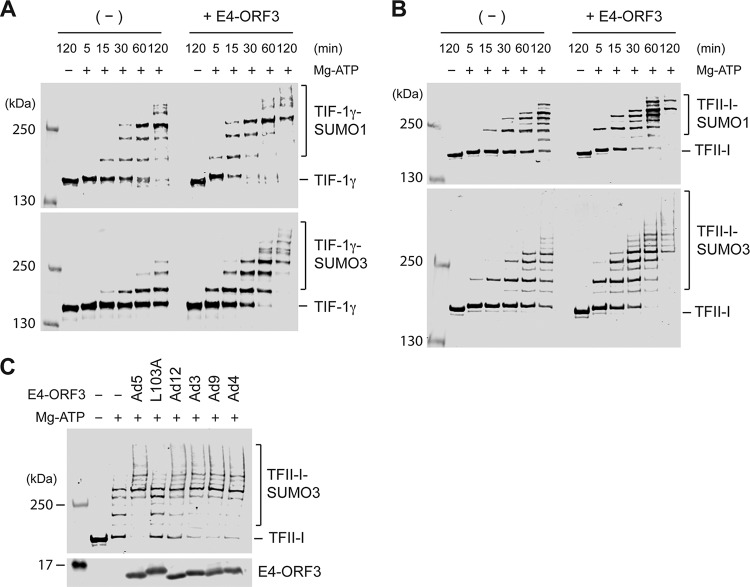
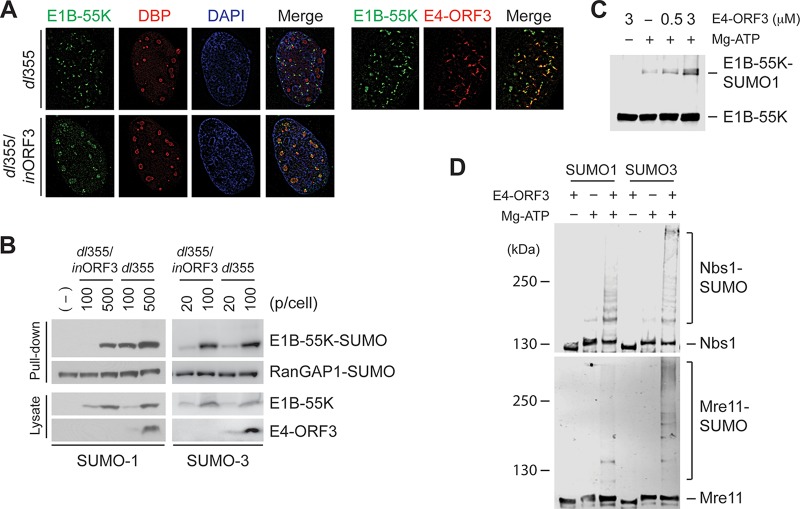
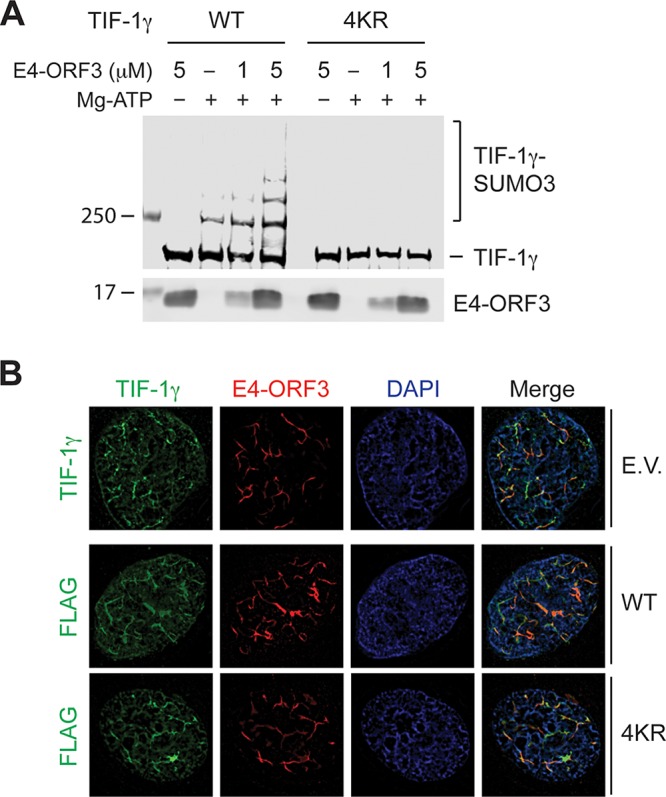
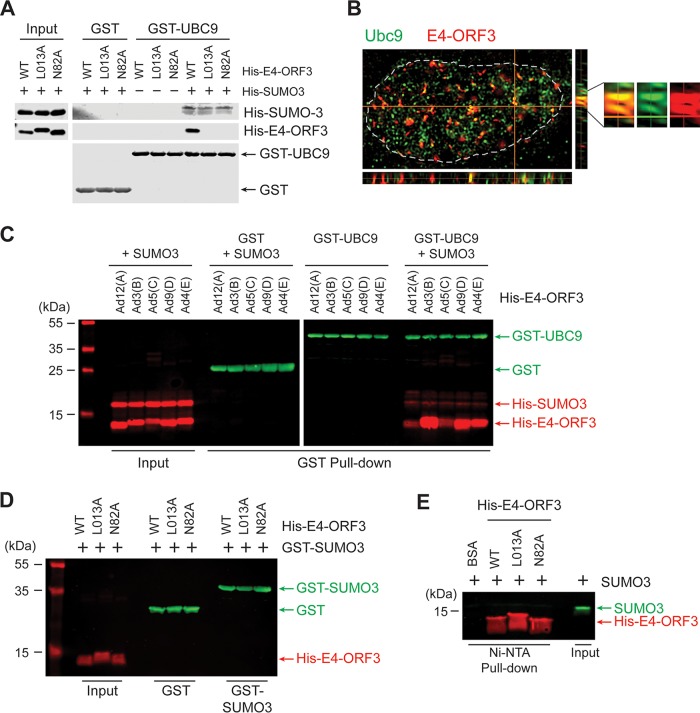
Regulation of a variety of different cellular processes, including posttranslational modifications, is critical for the ability of many viruses to replicate efficiently within host cells. The adenovirus (Ad) E4-ORF3 protein assembles into polymers and forms a unique nuclear scaffold that leads to the relocalization and sequestration of cellular proteins, including small ubiquitin-like modifiers (SUMOs). Previously, we showed that E4-ORF3 functions as a SUMO E3 ligase of transcriptional intermediary factor-1 gamma (TIF-1γ) and promotes poly-SUMO chain formation. Here, we present cellular and biochemical data to further understand E4-ORF3 SUMO ligase activity. E4-ORF3 proteins from five different Ad species were found to possess SUMO E3 ligase activities In infected cells, SUMO modifications of target proteins occurred only when the proteins were recruited into E4-ORF3 polymeric structures. By analyzing SUMO-deficient TIF-1γ, we demonstrated that SUMO conjugations are not required for E4-ORF3-mediated relocalization of target proteins in infected cells, implying that sequestration is followed by SUMO modification. SUMO conjugation assays revealed the Ad E1B-55K oncoprotein as a new viral target of E4-ORF3-mediated SUMOylation. We also verified a direct function of E4-ORF3 as a SUMO ligase for multiple cellular proteins, including transcription factor II-I (TFII-I), Nbs1, and Mre11. Moreover, we discovered that E4-ORF3 associates with SUMO-bound UBC9, and E4-ORF3 polymerization is crucial for this ternary interaction. Together, our findings characterize E4-ORF3 as a novel polymer-type SUMO E3 ligase and provide mechanistic insights into the role of E4-ORF3 in SUMO conjugation. Viruses interplay with the host SUMOylation system to manipulate diverse cellular responses. The Ad E4-ORF3 protein forms a dynamic nuclear network to interfere with and exploit different host processes, including the DNA damage and interferon responses. We previously reported that E4-ORF3 is a SUMO E3 ligase. Here, we demonstrate that this activity is a conserved function of evolutionarily diverse human Ad E4-ORF3 proteins and that E4-ORF3 functions directly to promote SUMO conjugations to multiple cellular proteins. Recruitment of cellular substrates into E4-ORF3 nuclear inclusions is required for SUMO conjugation to occur We probed the mechanism by which E4-ORF3 functions as a SUMO E3 ligase. Only multimeric, but not dimeric, E4-ORF3 binds to the SUMO E2 conjugation enzyme UBC9 only in a trimeric complex with SUMO. These results reveal a novel mechanism by which a conserved viral protein usurps the cellular SUMO conjugation machinery.
多种不同的细胞过程的调节,包括翻译后修饰,对于许多病毒在宿主细胞内有效复制至关重要。腺病毒(Ad)E4-ORF3 蛋白组装成聚合物,并形成独特的核支架,导致细胞蛋白的重定位和隔离,包括小泛素样修饰物(SUMO)。以前,我们表明 E4-ORF3 作为转录中介因子-1 伽马(TIF-1γ)的 SUMO E3 连接酶发挥作用,并促进多-SUMO 链形成。在这里,我们提供细胞和生化数据来进一步了解 E4-ORF3 SUMO 连接酶活性。发现来自五种不同 Ad 物种的 E4-ORF3 蛋白具有 SUMO E3 连接酶活性。在感染细胞中,只有当靶蛋白被招募到 E4-ORF3 聚合物结构中时,靶蛋白才会发生 SUMO 修饰。通过分析 SUMO 缺陷型 TIF-1γ,我们证明 E4-ORF3 介导的靶蛋白在感染细胞中的重定位不需要 SUMO 缀合,这意味着隔离后发生 SUMO 修饰。SUMO 缀合测定显示腺病毒 E1B-55K 癌蛋白是 E4-ORF3 介导的 SUMO 化的新病毒靶标。我们还验证了 E4-ORF3 作为 SUMO 连接酶对多种细胞蛋白(包括转录因子 II-I(TFII-I)、Nbs1 和 Mre11)的直接功能。此外,我们发现 E4-ORF3 与 SUMO 结合的 UBC9 结合,并且 E4-ORF3 聚合对于这种三元相互作用至关重要。总之,我们的研究结果将 E4-ORF3 描绘为一种新型聚合物型 SUMO E3 连接酶,并为 E4-ORF3 在 SUMO 缀合中的作用提供了机制见解。病毒与宿主 SUMOylation 系统相互作用以操纵多种细胞反应。Ad E4-ORF3 蛋白形成动态核网络,以干扰和利用不同的宿主过程,包括 DNA 损伤和干扰素反应。我们之前报道 E4-ORF3 是一种 SUMO E3 连接酶。在这里,我们证明这种活性是进化上不同的人类 Ad E4-ORF3 蛋白的保守功能,并且 E4-ORF3 直接促进多种细胞蛋白的 SUMO 缀合。细胞底物募集到 E4-ORF3 核包含物中是 SUMO 缀合发生所必需的。我们探讨了 E4-ORF3 作为 SUMO E3 连接酶发挥作用的机制。只有多聚体,而不是二聚体,E4-ORF3 与 SUMO E2 缀合酶 UBC9 结合,并且仅在与 SUMO 的三聚体复合物中结合。这些结果揭示了一种新的机制,即保守的病毒蛋白篡夺了细胞 SUMO 缀合机制。