Department of Gastroenterology and Hepatology, Kindai University Faculty of Medicine, Osaka 589-8511, Japan.
World J Gastroenterol. 2019 Feb 21;25(7):789-807. doi: 10.3748/wjg.v25.i7.789.
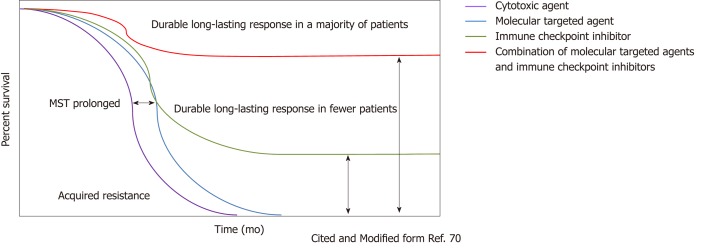
Systemic therapy for hepatocellular carcinoma (HCC) has markedly advanced since the survival benefit of a molecular targeted agent, sorafenib, were demonstrated in the SHARP and Asia Pacific trials in 2007. Treatment options for patients with advanced HCC increased by sorafenib, and long-term survival for patients with advanced stage HCC has become possible to some extent. However, development of a more potent first-line novel molecular targeted agent replacing sorafenib and a potent second-line agent after disease progression on or intolerant to sorafenib has been warranted because sorafenib lacks tumor shrinking/necrotizing effects and induces relatively severe adverse events such as hand foot skin reaction. Many agents in the 1st line and 2nd line setting were attempted to develop between 2007 and 2016, but all of these clinical trials failed. On the other hand, clinical trials of 4 agents (regorafenib, lenvatinib, cabozantinib, and ramucirumab) succeeded in succession in 2017 and 2018, and their use in clinical practice is possible (regorafenib and lenvatinib) or underway (cabozantinib and ramucirumab). Furthermore, all of 5 clinical trials of combination therapy with transcatheter chemoembolization (TACE) plus a molecular targeted agent failed to date, however, the combination of TACE and sorafenib (TACTICS trials) was reported to be successful and presented at ASCO in 2018. Phase 3 clinical trials of immune checkpoint inhibitors and a combination therapy of immune checkpoint inhibitors and molecular targeted agents are also ongoing, which suggests treatment paradigm of HCC in all stages from early, intermediate and advanced stage, is expected to be changed drastically in the very near future.
自 2007 年 SHARP 和亚太地区试验证明分子靶向药物索拉非尼可提高肝癌患者的生存率以来,肝癌的系统治疗有了显著进展。索拉非尼的出现增加了晚期 HCC 患者的治疗选择,在一定程度上使晚期 HCC 患者的长期生存成为可能。然而,由于索拉非尼缺乏肿瘤缩小/坏死作用,并引起相对严重的不良反应,如手足皮肤反应,因此需要开发一种更有效的一线新型分子靶向药物替代索拉非尼,以及在索拉非尼耐药或不耐受时的二线强效药物。2007 年至 2016 年间尝试开发了许多一线和二线药物,但所有这些临床试验均以失败告终。另一方面,2017 年和 2018 年有 4 种药物(regorafenib、lenvatinib、cabozantinib 和 ramucirumab)的临床试验相继成功,它们在临床实践中的应用(regorafenib 和 lenvatinib)或正在进行中(cabozantinib 和 ramucirumab)。此外,迄今为止,所有 5 项经导管化疗栓塞(TACE)联合分子靶向药物的联合治疗临床试验均告失败,然而,TACE 联合索拉非尼(TACTICS 试验)的组合被报道是成功的,并在 2018 年 ASCO 会议上展示。免疫检查点抑制剂的 3 期临床试验以及免疫检查点抑制剂与分子靶向药物联合治疗的临床试验也正在进行中,这表明在不久的将来,从早期、中期和晚期所有阶段的 HCC 的治疗模式有望发生重大变化。