Department of Oncology, Shengjing Hospital of China Medical University, Shenyang, China.
Department of Oncology, North War Zone General Hospital, Shenyang, China.
Front Immunol. 2021 Nov 26;12:783236. doi: 10.3389/fimmu.2021.783236. eCollection 2021.
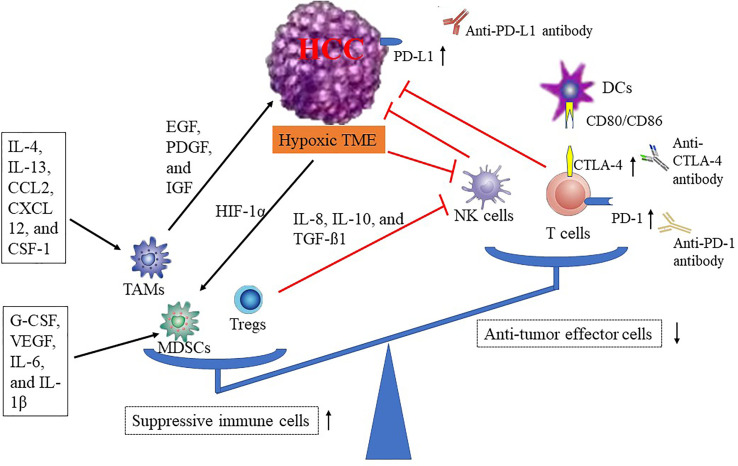
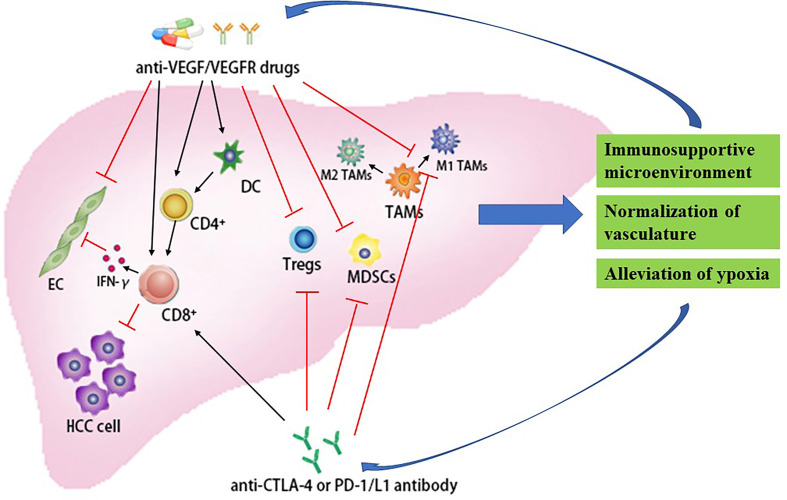
Hepatocellular carcinoma (HCC), one of the most fatal malignancies in the world, is usually diagnosed in advanced stages due to late symptom manifestation with very limited therapeutic options, which leads to ineffective intervention and dismal prognosis. For a decade, tyrosine kinase inhibitors (TKIs) have offered an overall survival (OS) benefit when used in a first-line (sorafenib and lenvatinib) and second-line setting (regorafenib and cabozantinib) in advanced HCC, while long-term response remains unsatisfactory due to the onset of primary or acquired resistance. Recently, immunotherapy has emerged as a promising therapy in the treatment of several solid tumors, such as melanoma and non-small cell lung cancer. Moreover, as the occurrence of HCC is associated with immune tolerance and immunosurveillance escape, there is a potent rationale for employing immunotherapy in HCC. However, immunotherapy monotherapy, mainly including immune checkpoint inhibitors (ICIs) that target checkpoints programmed death-1 (PD-1), programmed death-ligand 1 (PD-L1), and the cytotoxic T lymphocyte antigen-4 (CTLA-4), has a relatively low response rate. Thus, the multi-ICIs or the combination of immunotherapy with other therapies, like antiangiogenic drugs and locoregional therapies, has become a novel strategy to treat HCC. Combining different ICIs may have a synergistical effect attributed to the complementary effects of the two immune checkpoint pathways (CTLA-4 and PD-1/PD-L1 pathways). The incorporation of antiangiogenic drugs in ICIs can enhance antitumor immune responses synergistically regulating the vasculature and the immune microenvironment of tumor. In addition, locoregional treatments can improve antitumor immunity by releasing the neoplasm antigens from killed tumor cells; in turn, this antitumor immune response can be intensified by immunotherapy. Therefore, the combination of locoregional treatments and immunotherapy may achieve greater efficacy through further synergistic effects for advanced HCC. This review aims to summarize the currently reported results and ongoing trials of the ICIs-based combination therapies for HCC to explore the rational combination strategies and further improve the survival of patients with HCC.
肝细胞癌(HCC)是世界上最致命的恶性肿瘤之一,由于症状表现较晚,治疗选择非常有限,通常在晚期诊断,导致干预无效和预后不佳。十年来,酪氨酸激酶抑制剂(TKI)在晚期 HCC 的一线(索拉非尼和仑伐替尼)和二线(regorafenib 和 cabozantinib)治疗中提供了总生存(OS)获益,而由于原发性或获得性耐药的出现,长期反应仍不理想。最近,免疫疗法在治疗黑色素瘤和非小细胞肺癌等几种实体瘤方面显示出良好的疗效。此外,由于 HCC 的发生与免疫耐受和免疫逃避有关,因此在 HCC 中使用免疫疗法具有很强的理论依据。然而,免疫疗法单药治疗,主要包括针对检查点程序性死亡受体 1(PD-1)、程序性死亡配体 1(PD-L1)和细胞毒性 T 淋巴细胞抗原 4(CTLA-4)的免疫检查点抑制剂(ICI),其反应率相对较低。因此,多ICI 或免疫疗法与其他疗法(如抗血管生成药物和局部区域治疗)联合成为治疗 HCC 的新策略。联合使用不同的 ICI 可能具有协同作用,这归因于两种免疫检查点途径(CTLA-4 和 PD-1/PD-L1 途径)的互补作用。将抗血管生成药物纳入 ICI 可以通过协同调节血管和肿瘤的免疫微环境来增强抗肿瘤免疫反应。此外,局部区域治疗可以通过从被杀肿瘤细胞中释放肿瘤抗原来改善抗肿瘤免疫;反过来,这种抗肿瘤免疫反应可以通过免疫疗法得到加强。因此,局部区域治疗和免疫疗法的联合可能通过进一步的协同作用为晚期 HCC 实现更大的疗效。本综述旨在总结目前报道的 HCC 基于 ICI 的联合治疗结果和正在进行的试验,以探索合理的联合策略,进一步提高 HCC 患者的生存率。