Gundavarapu Anila, Chakravarthy V Srinivasa, Soman Karthik
Department of Biotechnology, Bhupat and Jyoti Mehta School of Biosciences, Indian Institute of Technology Madras, Chennai, India.
Department of Bioengineering, University of California, Berkeley, Berkeley, CA, United States.
Front Neurosci. 2019 Feb 12;13:67. doi: 10.3389/fnins.2019.00067. eCollection 2019.
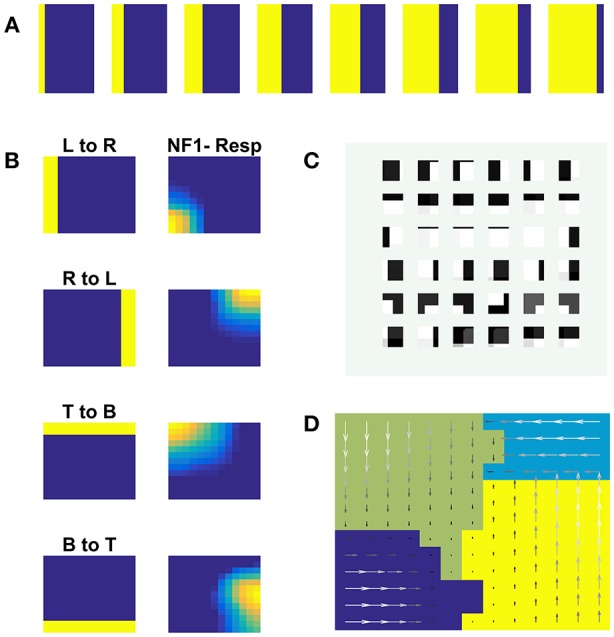
Neurons in the dorsal pathway of the visual cortex are thought to be involved in motion processing. The first site of motion processing is the primary visual cortex (V1), encoding the direction of motion in local receptive fields, with higher order motion processing happening in the middle temporal area (MT). Complex motion properties like optic flow are processed in higher cortical areas of the Medial Superior Temporal area (MST). In this study, a hierarchical neural field network model of motion processing is presented. The model architecture has an input layer followed by either one or cascade of two neural fields (NF): the first of these, NF1, represents V1, while the second, NF2, represents MT. A special feature of the model is that lateral connections used in the neural fields are trained by asymmetric Hebbian learning, imparting to the neural field the ability to process sequential information in motion stimuli. The model was trained using various traditional moving patterns such as bars, squares, gratings, plaids, and random dot stimulus. In the case of bar stimuli, the model had only a single NF, the neurons of which developed a direction map of the moving bar stimuli. Training a network with two NFs on moving square and moving plaids stimuli, we show that, while the neurons in NF1 respond to the direction of the component (such as gratings and edges) motion, the neurons in NF2 (analogous to MT) responding to the direction of the pattern (plaids, square object) motion. In the third study, a network with 2 NFs was simulated using random dot stimuli (RDS) with translational motion, and show that the NF2 neurons can encode the direction of the concurrent dot motion (also called translational flow motion), independent of the dot configuration. This translational RDS flow motion is decoded by a simple perceptron network (a layer above NF2) with an accuracy of 100% on train set and 90% on the test set, thereby demonstrating that the proposed network can generalize to new dot configurations. Also, the response properties of the model on different input stimuli closely resembled many of the known features of the neurons found in electrophysiological studies.
视觉皮层背侧通路中的神经元被认为参与运动处理。运动处理的第一个部位是初级视觉皮层(V1),它在局部感受野中编码运动方向,而更高阶的运动处理则发生在颞中区(MT)。诸如光流等复杂运动特性在颞上内侧区(MST)的更高皮层区域进行处理。在本研究中,提出了一种运动处理的分层神经场网络模型。该模型架构有一个输入层,后面跟着一个或两个神经场(NF)的级联:其中第一个NF1代表V1,而第二个NF2代表MT。该模型的一个特殊之处在于,神经场中使用的侧向连接通过不对称赫布学习进行训练,赋予神经场处理运动刺激中顺序信息的能力。该模型使用各种传统运动模式进行训练,如条形、方形、光栅、方格和随机点刺激。在条形刺激的情况下,模型只有一个NF,其神经元形成了移动条形刺激的方向图。在用移动方形和移动方格刺激训练具有两个NF的网络时,我们表明,虽然NF1中的神经元对组件(如光栅和边缘)运动的方向做出反应,但NF2中的神经元(类似于MT)对图案(方格、方形物体)运动的方向做出反应。在第三个研究中,使用具有平移运动的随机点刺激(RDS)对具有2个NF的网络进行模拟,并表明NF2神经元可以编码并发点运动的方向(也称为平移流运动),而与点配置无关。这种平移RDS流运动由一个简单的感知器网络(NF2上方的一层)解码,在训练集上的准确率为100%,在测试集上的准确率为90%,从而证明所提出的网络可以推广到新的点配置。此外,该模型在不同输入刺激下的响应特性与电生理研究中发现的许多神经元已知特征非常相似。