Huang Xuena, Li Shiguo, Zhan Aibin
Key Laboratory of Environmental Biotechnology, Research Center for Eco-Environmental Sciences, Chinese Academy of Sciences, Beijing, China.
University of Chinese Academy of Sciences, Chinese Academy of Sciences, Beijing, China.
Front Genet. 2019 Feb 12;10:71. doi: 10.3389/fgene.2019.00071. eCollection 2019.
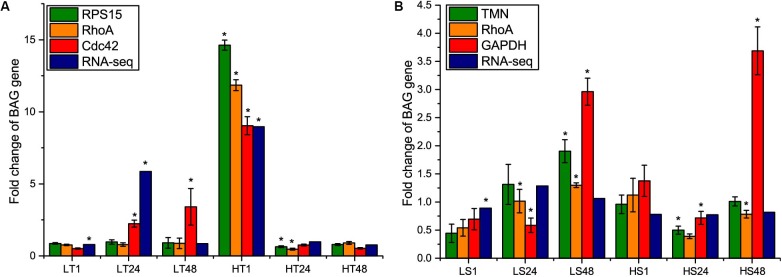
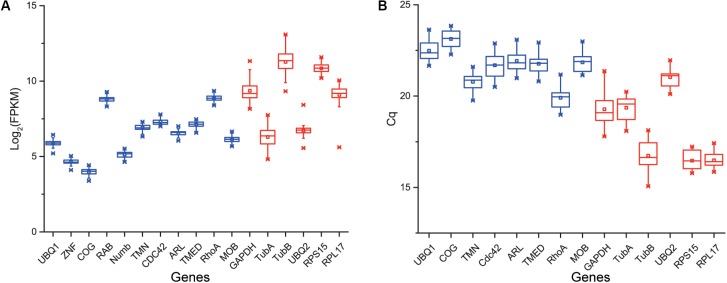
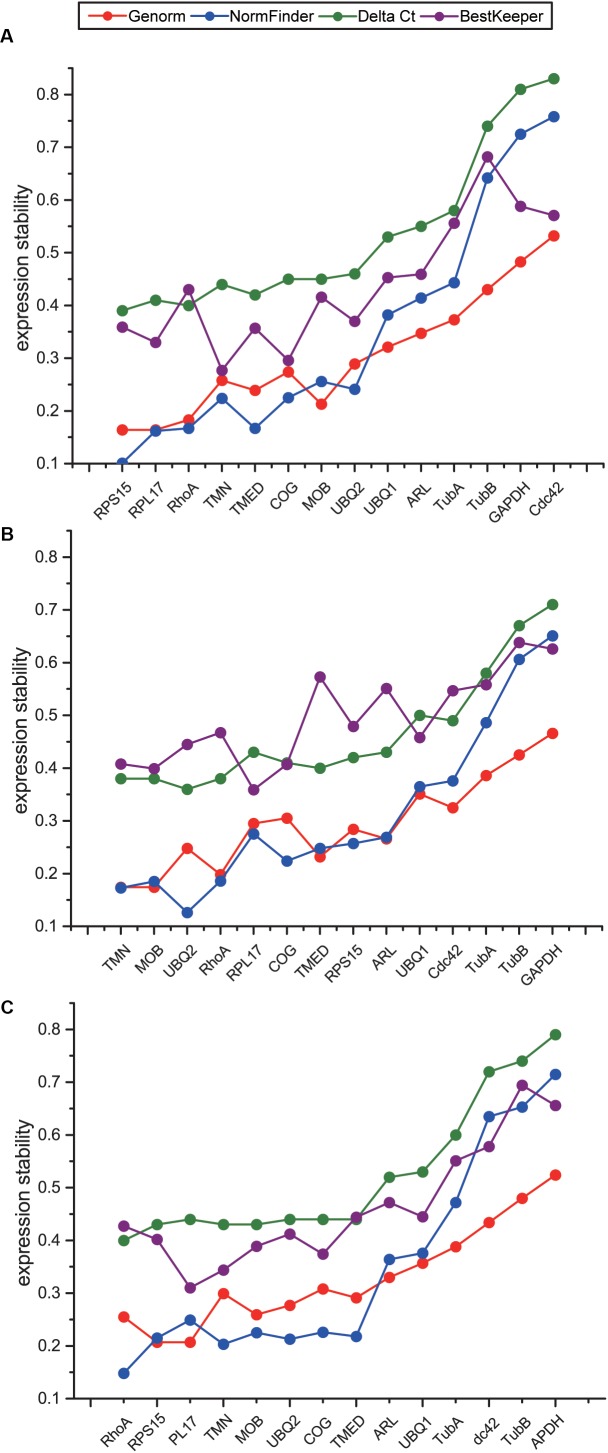
Rapid adaptation/accommodation to changing environments largely contributes to maximal survival of invaders during biological invasions, usually leading to success in crossing multiple barriers and finally in varied environments in recipient habitats. Gene expression is one of the most important and rapid ways during responses to environmental stresses. Selection of proper reference genes is the crucial prerequisite for gene expression analysis using the common approach, real-time quantitative PCR (RT-qPCR). Here we identified eight candidate novel reference genes from the RNA-Seq data in an invasive model ascidian under temperature and salinity stresses. Subsequently, the expression stability of these eight novel reference genes, as well as other six traditionally used reference genes, was evaluated using RT-qPCR and comprehensive tool RefFinder. Under the temperature stress, two traditional reference genes, ribosomal proteins S15 and L17 (), and one novel gene Ras homolog A (), were recommended as the top three stable genes, which can be used to normalize target genes with a high and moderate expression level, respectively. Under the salinity stress, transmembrane 9 superfamily member (), MOB kinase activator 1A-like gene () and ubiquitin-conjugating enzyme () were suggested as the top three stable genes. On the other hand, several commonly used reference genes such as α-tubulin (), β-tubulin () and glyceraldehyde-3-phosphate dehydrogenase () showed unstable expressions, thus these genes should not be used as internal controls for gene expression analysis. We also tested the expression level of an important stress response gene, large proline-rich protein bag6-like gene () using different reference genes. As expected, we observed different results and conclusions when using different normalization methods, thus suggesting the importance of selection of proper reference genes and associated normalization methods. Our results provide a valuable reference gene resource for the normalization of gene expression in the study of environmental adaptation/accommodation during biological invasions using as a model.
快速适应/顺应不断变化的环境在很大程度上有助于入侵生物在生物入侵过程中实现最大程度的生存,通常会使其成功跨越多个障碍并最终在受体栖息地的各种环境中生存。基因表达是对环境压力作出反应时最重要且最迅速的方式之一。选择合适的内参基因是使用常用方法——实时定量PCR(RT-qPCR)进行基因表达分析的关键前提。在此,我们从一种入侵性海鞘的RNA测序数据中鉴定出八个候选新内参基因,这些海鞘处于温度和盐度胁迫之下。随后,使用RT-qPCR和综合工具RefFinder评估了这八个新内参基因以及其他六个传统使用的内参基因的表达稳定性。在温度胁迫下,两个传统内参基因核糖体蛋白S15和L17,以及一个新基因Ras同源物A被推荐为最稳定的三个基因,它们可分别用于标准化高表达水平和中等表达水平的靶基因。在盐度胁迫下,跨膜9超家族成员、MOB激酶激活剂1A样基因和泛素结合酶被认为是最稳定的三个基因。另一方面,一些常用的内参基因,如α-微管蛋白、β-微管蛋白和甘油醛-3-磷酸脱氢酶,表现出不稳定的表达,因此这些基因不应用作基因表达分析的内对照。我们还使用不同的内参基因测试了一个重要的应激反应基因——富含脯氨酸的大蛋白bag6样基因的表达水平。正如预期的那样,当使用不同的标准化方法时,我们观察到了不同的结果和结论,这表明选择合适的内参基因和相关标准化方法的重要性。我们的研究结果为以海鞘为模型研究生物入侵过程中环境适应/顺应时基因表达的标准化提供了宝贵的内参基因资源。