Affiliated Cancer Hospital & Institute of Guangzhou Medical University; Key Laboratory of Protein Modification and Degradation; State Key Laboratory of Respiratory Disease, School of Basic Medical Sciences, Guangzhou Medical University, Guangzhou 511436, China.
Guangdong Key Laboratory for Genome Stability and Human Disease Prevention, Department of Biochemistry and Molecular Biology, Health Science Center, Shenzhen University, Shenzhen, 518060, China.
Theranostics. 2019 Jan 1;9(2):449-465. doi: 10.7150/thno.29055. eCollection 2019.
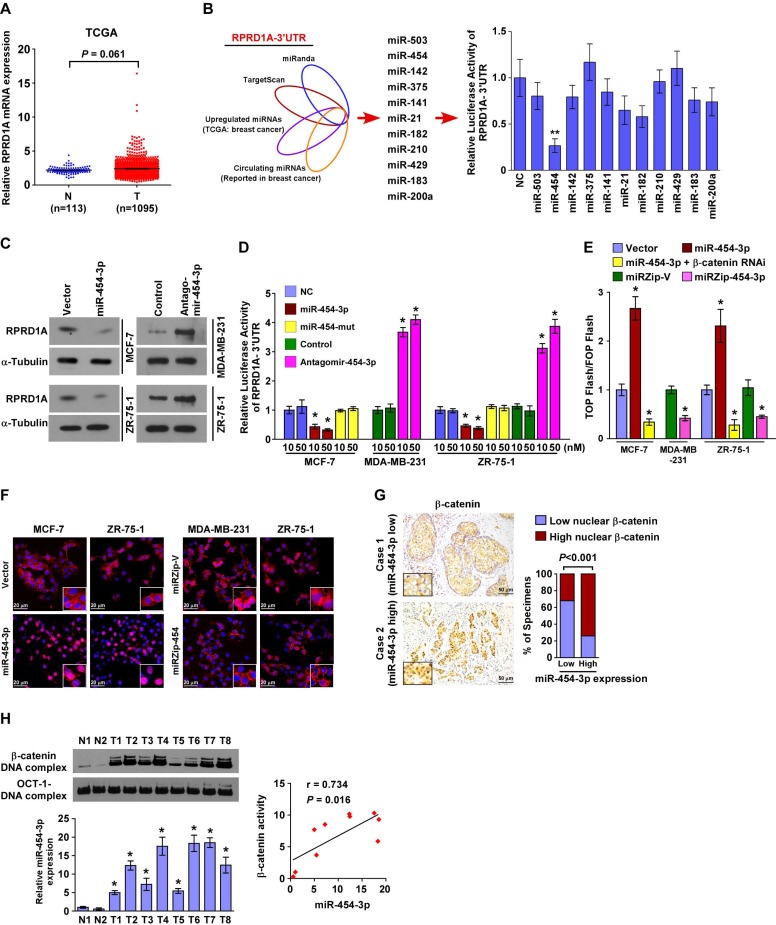
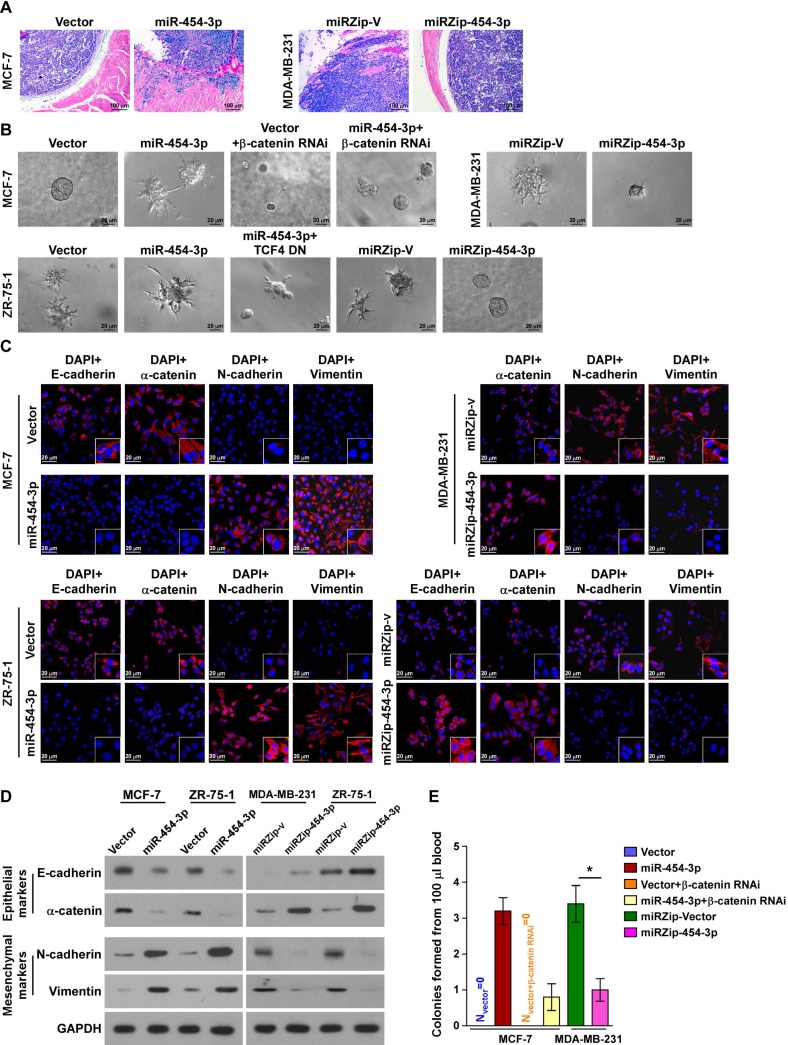
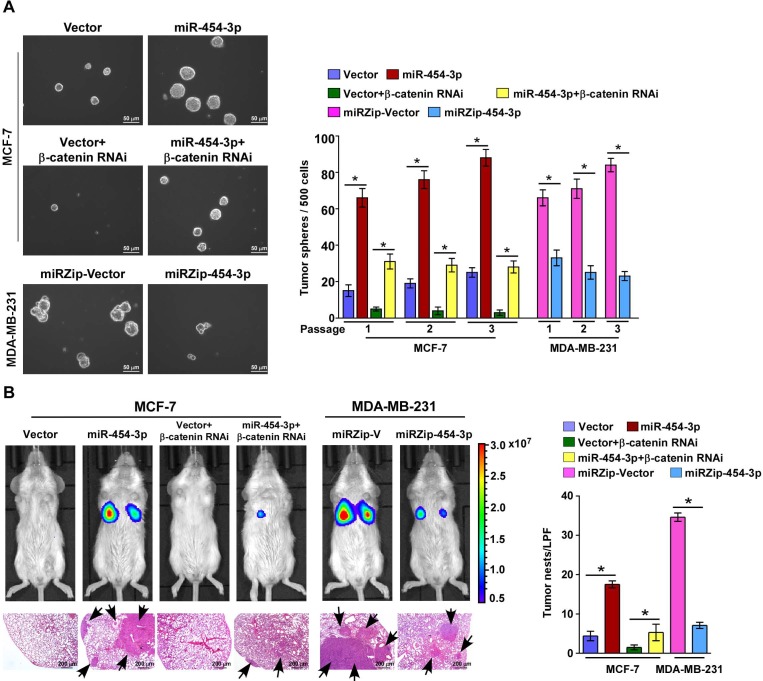
The Wnt/β-catenin pathway is constitutively active and promotes multiple tumor processes, including breast cancer metastasis. However, the underlying mechanism by which the Wnt/β-catenin pathway is constitutively activated in breast cancer metastasis remains unclear. Inhibition of Wnt antagonists is important for Wnt/β-catenin signaling activation, and post-transcriptional regulation of these antagonists by microRNAs (miRNAs) might be a possible mechanism underlying signaling activation. Regulation of nuclear pre-mRNA domain-containing 1A (RPRD1A) is a known inhibitor of cell growth and Wnt/β-catenin signaling activity, but the function and regulatory mechanism of RPRD1A in breast cancer have not been clarified. The aim of this study was to understand how regulators of the Wnt/β-catenin pathway may play a role in the metastasis of this cancer. RPRD1A expression and its association with multiple clinicopathological characteristics was analyzed immunohistochemically in human breast cancer specimens. miR-454-3p expression was analyzed using real-time PCR. RPRD1A or miR-454-3p knockdown and overexpression were used to determine the underlying mechanism of their functions in breast cancer cells. Xenografted tumor model, 3D invasive culture, cell migration and invasion assays and sphere formation assay were used to determine the biofunction of RPRD1A and miR-454-3p in breast cancer. Electrophoretic mobility shift assay (EMSA), luciferase reporter assay, and RNA immunoprecipitation (RIP) were performed to study the regulation and underlying mechanisms of RPRD1A and miR-454-3p expression and their correlation with the Wnt/β-catenin pathway in breast cancer. The Wnt/β-catenin signaling antagonist RPRD1A was downregulated and its upstream regulator miR-454-3p was amplified and overexpressed in metastatic breast cancer, and both were correlated with overall and relapse-free survival in breast cancer patients. The suppression by miR-454-3p on RPRD1A was found to activate Wnt/β-catenin signaling, thereby promoting metastasis. Simultaneously, three other negative regulators of the Wnt/β-catenin pathway, namely, AXIN2, dickkopf WNT signaling pathway inhibitor (DKK) 3 and secreted frizzled related protein (SFRP) 1, were also found to be targets of miR-454-3p and were involved in the signaling activation. miR-454-3p was found to be involved in early metastatic processes and to promote the stemness of breast cancer cells and early relapse under both and conditions. The findings indicate that miR-454-3p-mediated suppression of Wnt/β-catenin antagonist RPRD1A, as well as AXIN2, DKK3 and SFRP1, sustains the constitutive activation of Wnt/β-catenin signaling; thus, miR-454-3p and RPRD1A might be potential diagnostic and therapeutic targets for breast cancer metastasis.
Wnt/β-连环蛋白途径持续激活并促进多种肿瘤过程,包括乳腺癌转移。然而,Wnt/β-连环蛋白途径在乳腺癌转移中持续激活的潜在机制仍不清楚。Wnt 拮抗剂的抑制对于 Wnt/β-连环蛋白信号的激活很重要,并且这些拮抗剂的转录后调节可能是信号激活的一种可能机制。核前体 RNA 结构域包含蛋白 1A(RPRD1A)的调节是细胞生长和 Wnt/β-连环蛋白信号活性的已知抑制剂,但 RPRD1A 在乳腺癌中的功能和调节机制尚未阐明。本研究旨在了解 Wnt/β-连环蛋白途径的调节剂如何在这种癌症的转移中发挥作用。
使用免疫组织化学分析人乳腺癌标本中 RPRD1A 的表达及其与多种临床病理特征的相关性。使用实时 PCR 分析 miR-454-3p 的表达。使用 RPRD1A 或 miR-454-3p 的敲低和过表达来确定它们在乳腺癌细胞中的功能的潜在机制。异种移植肿瘤模型、3D 侵袭培养、细胞迁移和侵袭测定以及球体形成测定用于确定 RPRD1A 和 miR-454-3p 在乳腺癌中的生物功能。电泳迁移率变动分析(EMSA)、荧光素酶报告基因测定和 RNA 免疫沉淀(RIP)用于研究 RPRD1A 和 miR-454-3p 的表达及其与乳腺癌中 Wnt/β-连环蛋白途径的调节和潜在机制及其相关性。
在转移性乳腺癌中,Wnt/β-连环蛋白信号拮抗剂 RPRD1A 下调,其上游调节剂 miR-454-3p 扩增和过表达,并且均与乳腺癌患者的总生存期和无复发生存期相关。发现 miR-454-3p 对 RPRD1A 的抑制作用激活了 Wnt/β-连环蛋白信号,从而促进了转移。同时,还发现另外三个 Wnt/β-连环蛋白途径的负调节剂,即 AXIN2、dickkopf WNT 信号通路抑制剂(DKK)3 和分泌卷曲相关蛋白(SFRP)1,也是 miR-454-3p 的靶标,并参与了信号激活。发现 miR-454-3p 参与早期转移过程,并在和条件下促进乳腺癌细胞的干性和早期复发。
研究结果表明,miR-454-3p 介导的 Wnt/β-连环蛋白拮抗剂 RPRD1A 的抑制,以及 AXIN2、DKK3 和 SFRP1,维持 Wnt/β-连环蛋白信号的持续激活;因此,miR-454-3p 和 RPRD1A 可能是乳腺癌转移的潜在诊断和治疗靶点。