Ali Aesha I, Oliver Amanda J, Samiei Tinaz, Chan Jack D, Kershaw Michael H, Slaney Clare Y
Cancer Immunology Program, Peter MacCallum Cancer Centre, Melbourne, VIC, Australia.
Sir Peter MacCallum Department of Oncology, University of Melbourne, Melbourne, VIC, Australia.
Front Oncol. 2019 Feb 12;9:56. doi: 10.3389/fonc.2019.00056. eCollection 2019.
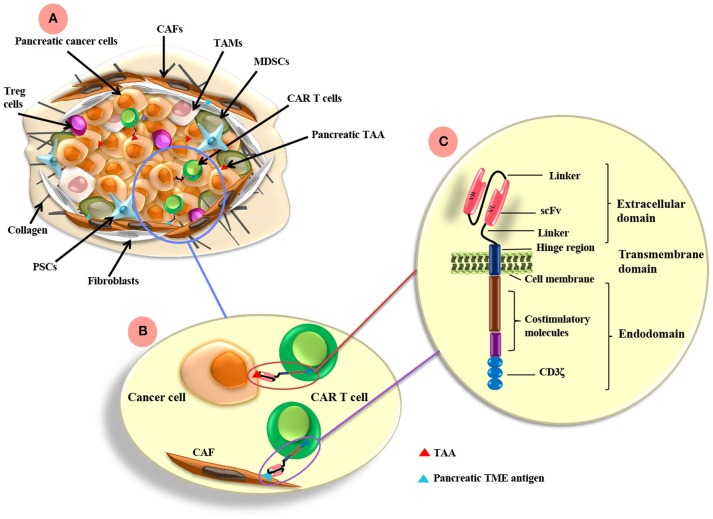
Conventional treatments for pancreatic cancer are largely ineffective, and the prognosis for the vast majority of patients is poor. Clearly, new treatment options are desperately needed. Immunotherapy offers hope for the development of treatments for pancreatic cancer. A central requirement for the efficacy of this approach is the existence of cancer antigen-specific T cells, but these are often not present or difficult to isolate for most pancreatic tumors. Nevertheless, specific T cells can be generated using genetic modification to express chimeric antigen receptors (CAR), which can enable T cell responses against pancreatic tumor cells. CAR T cells can be produced and expanded for infusion into patients. Remarkable responses have been documented using CAR T cells against several malignancies, including leukemias and lymphomas. Based on these successes, the extension of CAR T cell therapy for pancreatic cancer holds great promise. However, there are a number of challenges that limit the full potential of CAR T cell therapies for pancreatic cancer, including the highly immunosuppressive tumor microenvironment (TME). In this article, we will review the recent progress in using CAR T cells in pancreatic cancer preclinical and clinical settings, discuss hurdles for utilizing the full potential of CAR T cell therapy and propose research strategies and future perspectives. Research into the use of CAR T cell therapy in pancreatic cancer setting is rapidly gaining momentum and understanding strategies to overcome the current challenges in the pancreatic cancer setting will allow the development of effective CAR T cell therapies, either alone or in combination with other treatments to benefit pancreatic cancer patients.
胰腺癌的传统治疗方法大多无效,绝大多数患者的预后很差。显然,迫切需要新的治疗选择。免疫疗法为胰腺癌治疗的发展带来了希望。这种方法有效的一个核心要求是存在癌症抗原特异性T细胞,但对于大多数胰腺肿瘤来说,这些细胞往往不存在或难以分离。然而,可以通过基因改造来表达嵌合抗原受体(CAR)来产生特异性T细胞,这可以使T细胞对胰腺肿瘤细胞产生反应。CAR T细胞可以产生并扩增,用于输注到患者体内。使用CAR T细胞治疗包括白血病和淋巴瘤在内的多种恶性肿瘤已取得显著疗效。基于这些成功案例,CAR T细胞疗法在胰腺癌治疗中的应用前景广阔。然而,仍有许多挑战限制了CAR T细胞疗法在胰腺癌治疗中的全部潜力,包括高度免疫抑制的肿瘤微环境(TME)。在本文中,我们将回顾CAR T细胞在胰腺癌临床前和临床应用中的最新进展,讨论充分发挥CAR T细胞疗法潜力所面临的障碍,并提出研究策略和未来展望。在胰腺癌治疗中使用CAR T细胞疗法的研究正在迅速发展,了解克服当前胰腺癌治疗挑战的策略将有助于开发有效的CAR T细胞疗法,无论是单独使用还是与其他治疗方法联合使用,都能使胰腺癌患者受益。