Sanrattana Wariya, Maas Coen, de Maat Steven
Department of Clinical Chemistry and Haematology, University Medical Center Utrecht, Utrecht University, Utrecht, Netherlands.
Front Med (Lausanne). 2019 Feb 12;6:25. doi: 10.3389/fmed.2019.00025. eCollection 2019.
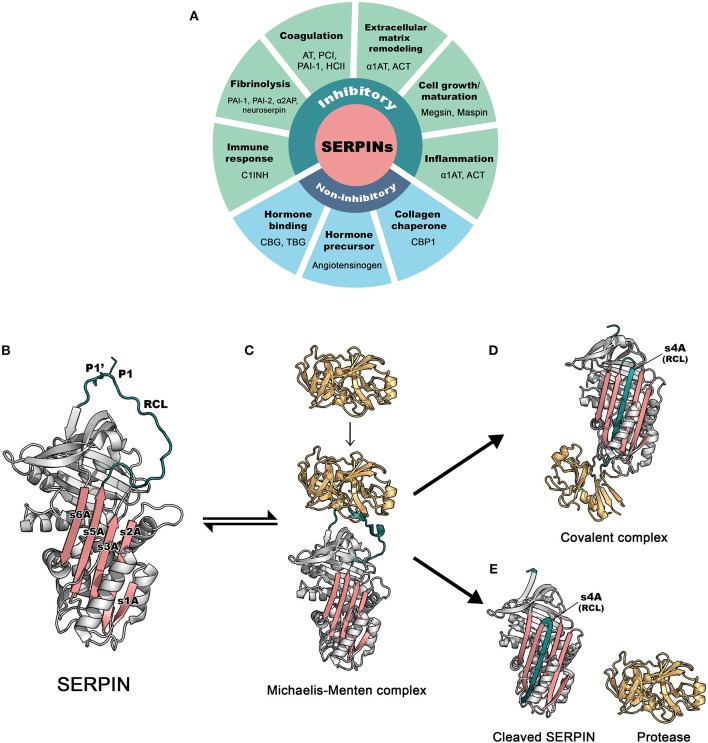
Excessive enzyme activity often has pathological consequences. This for example is the case in thrombosis and hereditary angioedema, where serine proteases of the coagulation system and kallikrein-kinin system are excessively active. Serine proteases are controlled by SERPINs (serine protease inhibitors). We here describe the basic biochemical mechanisms behind SERPIN activity and identify key determinants that influence their function. We explore the clinical phenotypes of several SERPIN deficiencies and review studies where SERPINs are being used beyond replacement therapy. Excitingly, rare human SERPIN mutations have led us and others to believe that it is possible to refine SERPINs toward desired behavior for the treatment of enzyme-driven pathology.
酶活性过高往往会产生病理后果。例如,在血栓形成和遗传性血管性水肿中就是这种情况,凝血系统和激肽释放酶 - 激肽系统的丝氨酸蛋白酶活性过高。丝氨酸蛋白酶受丝氨酸蛋白酶抑制剂(SERPINs)的控制。我们在此描述SERPIN活性背后的基本生化机制,并确定影响其功能的关键决定因素。我们探讨了几种SERPIN缺乏症的临床表型,并回顾了SERPINs在替代疗法之外的应用研究。令人兴奋的是,罕见的人类SERPIN突变使我们和其他人相信,有可能对SERPINs进行优化,使其表现出理想的行为,用于治疗酶驱动的病理状况。