
北美洲西北海岸 3500 年的贝类养殖史。
3500 years of shellfish mariculture on the Northwest Coast of North America.
机构信息
Hakai Institute, Heriot Bay, BC, Canada.
Independent Archaeologist, Victoria, BC, Canada.
出版信息
PLoS One. 2019 Feb 27;14(2):e0211194. doi: 10.1371/journal.pone.0211194. eCollection 2019.
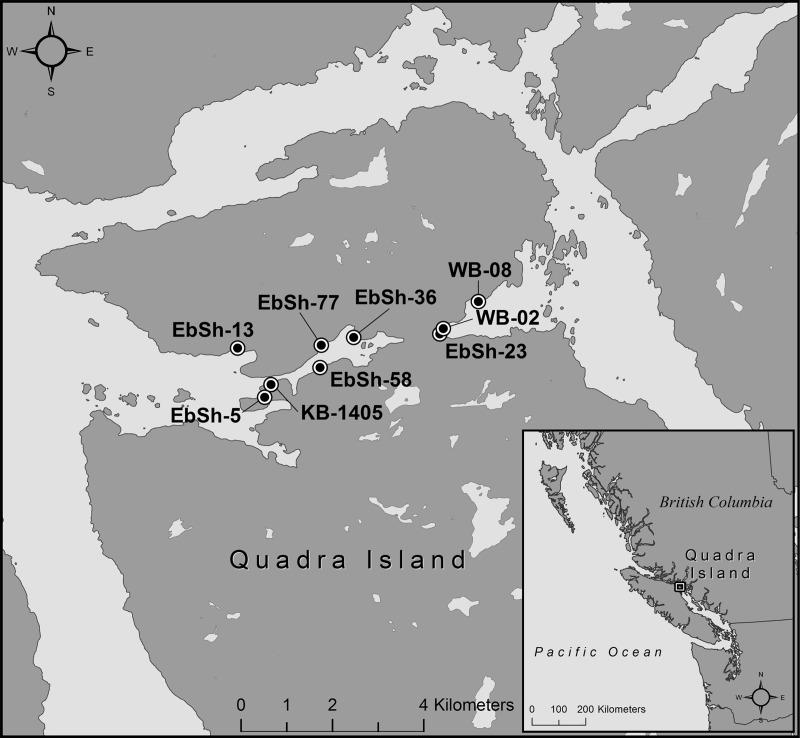
Ancient systems of mariculture were foundations of social-ecological systems of many coastal Indigenous Peoples. However, since such systems either do not leave tangible remains in the archaeological record, and/or are hard to date, we know little about their development and use. Clam gardens, traditional mariculture features located within the intertidal zone along the Northwest Coast of North America, are composed of a rock wall positioned at the low tide mark and a flattened terrace on the landward side of the wall. Because these features are largely composed of rock and sediment, and have complex formation histories, they can be difficult to age. On northern Quadra Island, British Columbia, we identify three variations in clam garden form, constructed in different geomorphological settings, each of which require different sampling approaches to obtain ages on construction and ongoing use. To age the clam gardens, we consider radiocarbon dating of invertebrates that inhabit beach deposits (both pre- and post-garden construction), and the relationship of the gardens and clam samples to the local sea level history and taphonomic processes. Within our study area, we find clam gardens have been in use for 3500 years, likely corresponding to other social and ecological changes of the time. These data allow us to formulate guidelines on samples most suitable to constrain the age of initial and on-going wall construction and use of clam gardens, which can be extrapolated to dating other ancient mariculture features in other regions. Such dating programs are the foundation for understanding the long-term development of traditional marine management practices and how they are situated in broader social-ecological systems.
古代水产养殖系统是许多北美西北海岸沿海原住民社会生态系统的基础。然而,由于这些系统要么在考古记录中没有留下有形的痕迹,要么很难确定其年代,因此我们对它们的发展和使用知之甚少。位于北美洲西北海岸潮间带的传统水产养殖特征——蛤蜊花园,由位于低潮线的石墙和墙内陆侧的平坦梯田组成。由于这些特征主要由岩石和沉积物组成,且具有复杂的形成历史,因此它们的年代很难确定。在不列颠哥伦比亚省的夸德拉岛北部,我们确定了三种不同形式的蛤蜊花园,它们建在不同的地貌环境中,每种都需要不同的采样方法来获取建造和持续使用的年代。为了确定蛤蜊花园的年代,我们考虑对栖息在海滩沉积物中的无脊椎动物进行放射性碳测年(包括花园建造前后的沉积物),并将花园和蛤蜊样本与当地的海平面历史和埋藏学过程联系起来。在我们的研究区域内,我们发现蛤蜊花园已经使用了 3500 年,这可能与当时的其他社会和生态变化相对应。这些数据使我们能够制定关于最适合约束初始和持续墙体建造以及蛤蜊花园使用年代的样本的准则,这些准则可以推广到其他地区其他古代水产养殖特征的年代测定。这种年代测定方案是理解传统海洋管理实践的长期发展以及它们在更广泛的社会生态系统中所处位置的基础。



 Zotero 插件