Cappellani Daniele, Urbani Claudio, Sardella Chiara, Scattina Ilaria, Marconcini Giulia, Lupi Isabella, Manetti Luca, Marcocci Claudio, Bogazzi Fausto
Unit of Endocrinology Department of Clinical and Experimental Medicine University of Pisa Pisa Italy.
Endocrinol Diabetes Metab. 2018 Oct 5;2(1):e00033. doi: 10.1002/edm2.33. eCollection 2019 Jan.
Therapy with somatostatin analogues (SSAs) may have deleterious effects on glucose metabolism in patients with acromegaly, often leading to the development of diabetes mellitus (DM).
The aim of the study was to evaluate whether DM, developed during therapy with SSAs, may revert after drug withdrawal and cure of acromegaly with pituitary adenomectomy.
Retrospective cohort study, in a tertiary referral centre.
Eighteen acromegalic patients without DM at the diagnosis of acromegaly treated with SSAs as a primary therapy, and then cured by pituitary adenomectomy.
Endocrine status and glucose homeostasis were evaluated at diagnosis of acromegaly and at least every 6 months during SSA therapy. At each visit, patients were classified into one of the following classes: normal glucose tolerance, prediabetes, overt diabetes.
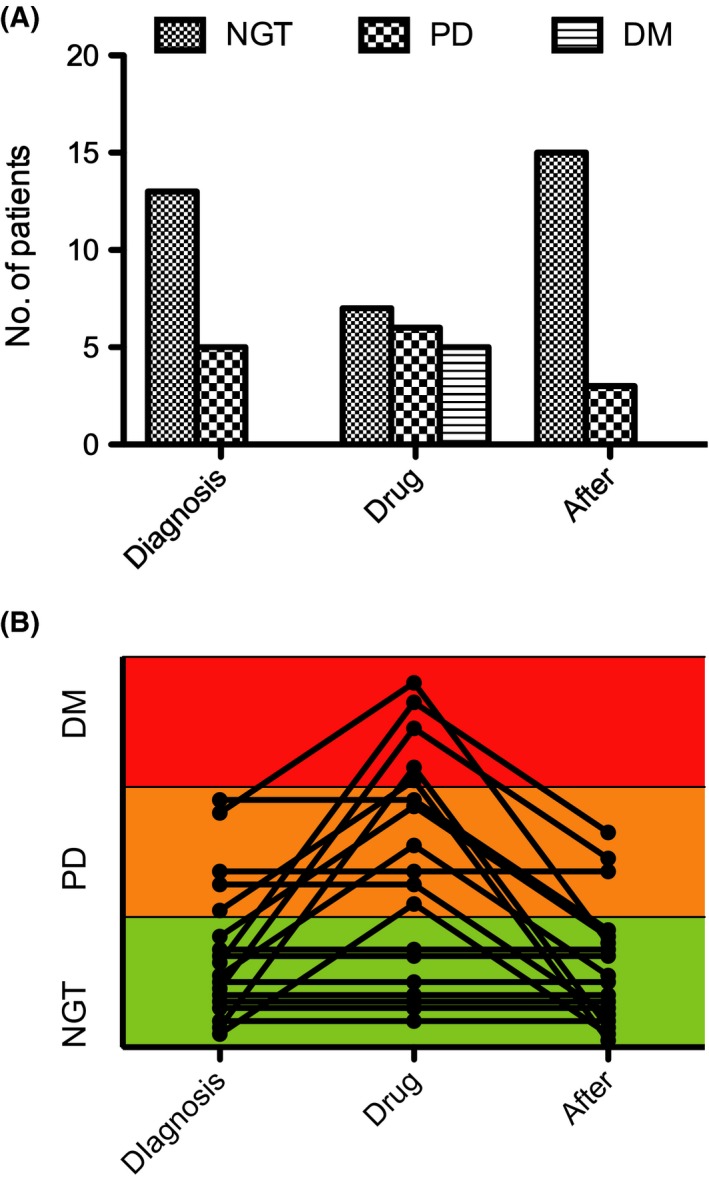
Median follow-up after starting SSAs therapy was 69 months (IQR 54.75-132.25). During SSA therapy, all patients had controlled acromegaly defined by normal serum IGF1 concentrations for the age. Of the 13 euglycaemic patients at diagnosis, three developed prediabetes and three diabetes, whereas, of the five prediabetic patients at diagnosis, two worsened to overt diabetes and three remained in the prediabetic range ( = 0.04). After curing acromegaly with pituitary adenomectomy and subsequent SSA withdrawal, prediabetes reverted in five of six patients, and diabetes in all five patients (three reverted to euglycaemia, while two reverted to prediabetes) ( = 0.01).
In acromegalic patients with controlled disease, changes in glycaemic status induced by SSAs are not permanent.
生长抑素类似物(SSAs)治疗可能对肢端肥大症患者的糖代谢产生有害影响,常导致糖尿病(DM)的发生。
本研究的目的是评估SSAs治疗期间发生的糖尿病在停药及垂体腺瘤切除治愈肢端肥大症后是否会恢复。
在一家三级转诊中心进行的回顾性队列研究。
18例肢端肥大症患者,诊断时无糖尿病,以SSAs作为主要治疗方法,随后通过垂体腺瘤切除术治愈。
在肢端肥大症诊断时以及SSA治疗期间至少每6个月评估一次内分泌状态和葡萄糖稳态。每次就诊时,患者被分为以下类别之一:正常糖耐量、糖尿病前期、显性糖尿病。
开始SSA治疗后的中位随访时间为69个月(四分位间距54.75 - 132.25)。在SSA治疗期间,所有患者的肢端肥大症得到控制,根据年龄,血清IGF1浓度正常。诊断时血糖正常的13例患者中,3例发展为糖尿病前期,3例发展为糖尿病;而诊断时5例糖尿病前期患者中,2例病情恶化至显性糖尿病,3例仍处于糖尿病前期范围(P = 0.04)。垂体腺瘤切除治愈肢端肥大症并随后停用SSA后,6例糖尿病前期患者中有5例恢复正常,5例糖尿病患者全部恢复(3例恢复至血糖正常,2例恢复至糖尿病前期)(P = 0.01)。
在疾病得到控制的肢端肥大症患者中,SSAs引起的血糖状态变化不是永久性的。