Yin Hua-Lei, Fu Yao
National Laboratory of Solid State Microstructures and School of Physics, Nanjing University, Nanjing, 210093, China.
Department of Physics, Zhejiang Institute of Modern Physics and ZJU-Phoenix Synergetic Innovation Center in Quantum Technology, Zhejiang University, Hangzhou, 310027, China.
Sci Rep. 2019 Feb 28;9(1):3045. doi: 10.1038/s41598-019-39454-1.
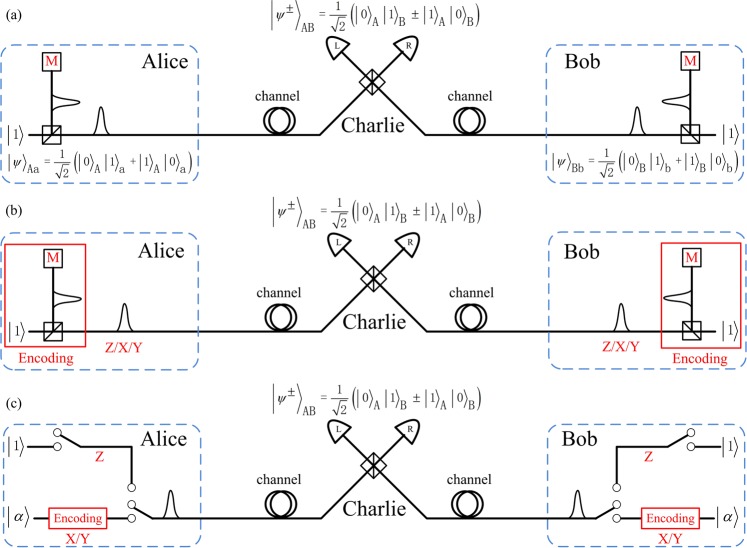
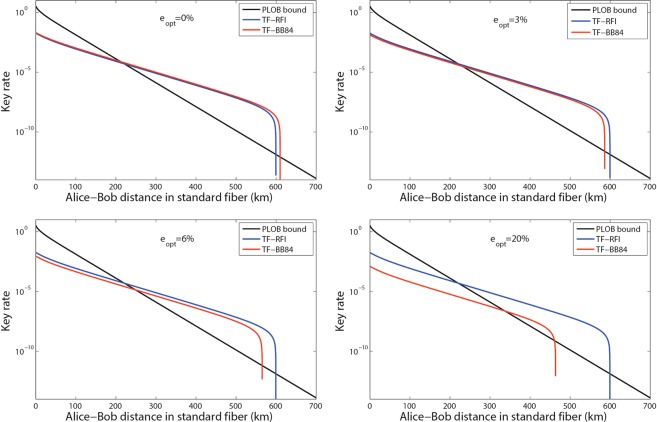
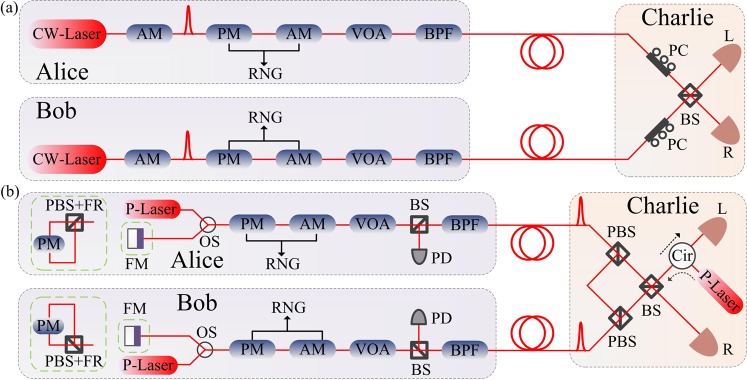
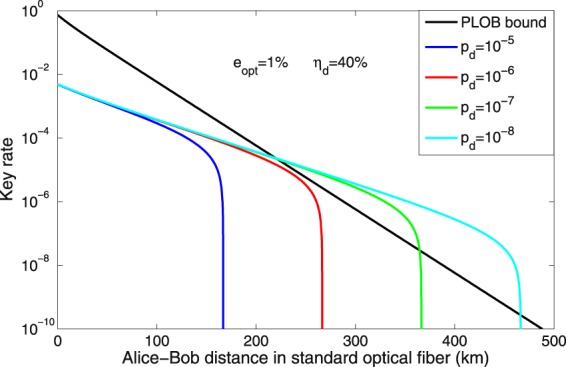
The ultimate aim of quantum key distribution (QKD) is improving the transmission distance and key generation speed. Unfortunately, it is believed to be limited by the secret-key capacity of quantum channel without quantum repeater. Recently, a novel twin-field QKD (TF-QKD) is proposed to break through the limit, where the key rate is proportional to the square-root of channel transmittance. Here, by using the vacuum and one-photon state as a qubit, we show that the TF-QKD can be regarded as a measurement-device-independent QKD (MDI-QKD) with single-photon Bell state measurement. Therefore, the MDI property of TF-QKD can be understood clearly. Importantly, the universal security proof theories can be directly used for TF-QKD, such as BB84 encoding, six-state encoding and reference-frame-independent scheme. Furthermore, we propose a feasible experimental scheme for the proof-of-principle experimental demonstration.
量子密钥分发(QKD)的最终目标是提高传输距离和密钥生成速度。遗憾的是,人们认为在没有量子中继器的情况下,它受到量子信道密钥容量的限制。最近,一种新型的双场QKD(TF-QKD)被提出来突破这一限制,其中密钥率与信道透射率的平方根成正比。在此,通过将真空和单光子态用作量子比特,我们表明TF-QKD可被视为具有单光子贝尔态测量的测量设备无关QKD(MDI-QKD)。因此,可以清楚地理解TF-QKD的MDI特性。重要的是,通用安全证明理论可直接用于TF-QKD,如BB84编码、六态编码和与参考系无关的方案。此外,我们提出了一个用于原理验证实验演示的可行实验方案。