Department of Neurology, The Fifth Hospital of Zhengzhou University, Zhengzhou, Henan 450052, P.R. China.
Department of Neurosurgery, The First Hospital of Zhengzhou University, Zhengzhou, Henan 450052, P.R. China.
Mol Med Rep. 2019 Apr;19(4):3045-3052. doi: 10.3892/mmr.2019.9950. Epub 2019 Feb 12.
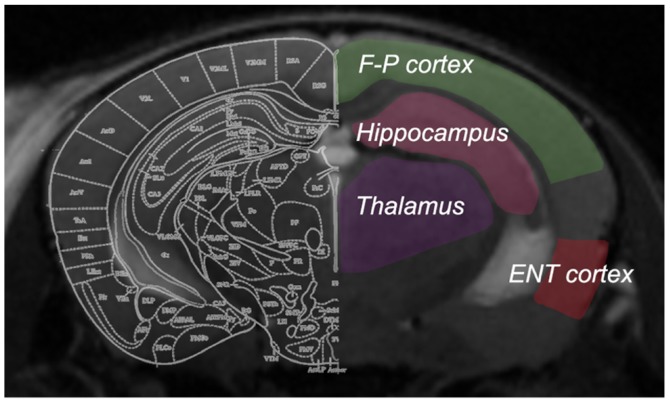
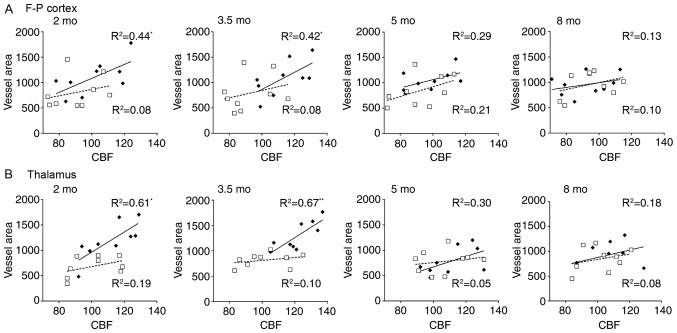
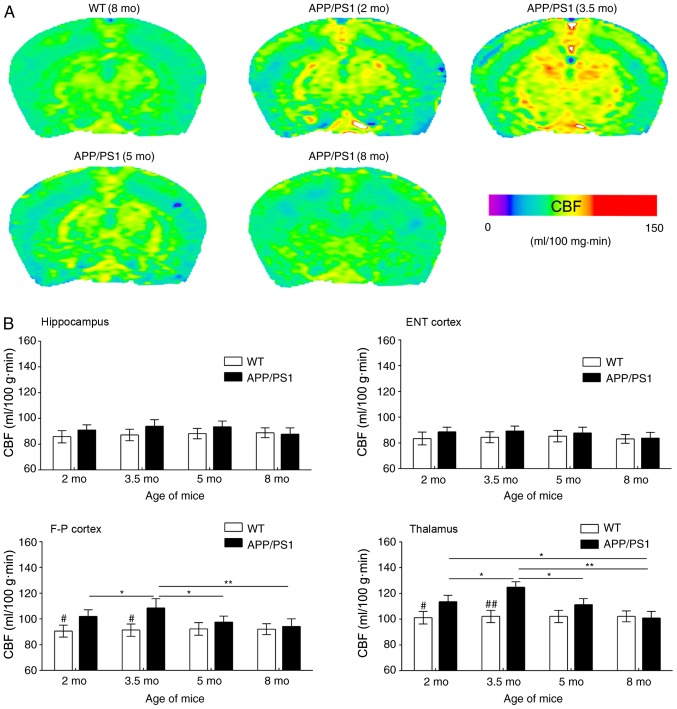
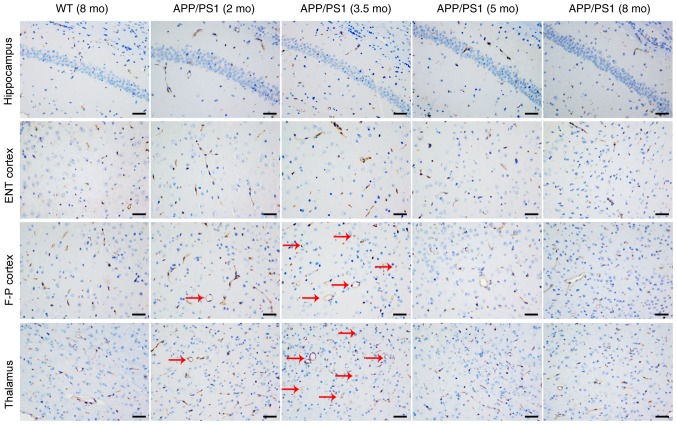
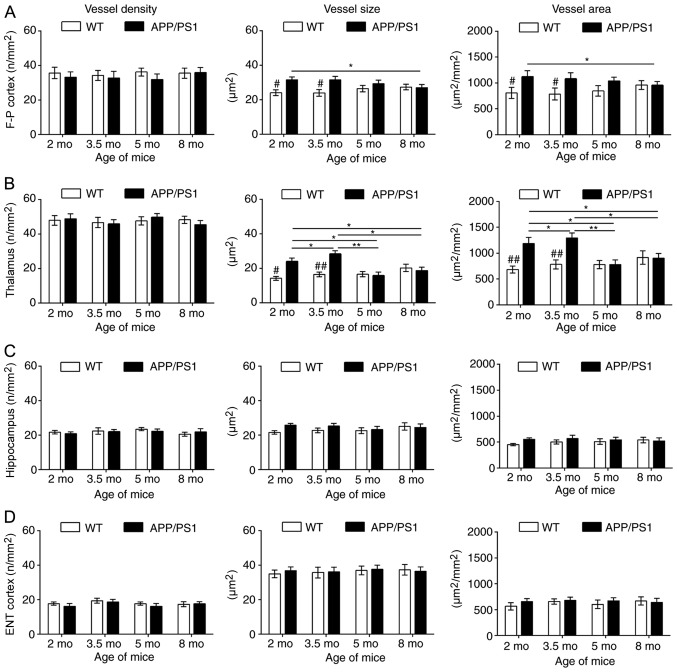
It has been suggested that cerebral blood flow (CBF) alterations may be involved in the pathogenesis of Alzheimer's disease (AD). However, how CBF changes with age has not been detailed in AD, particularly in its early stages. The objective of the present study was to evaluate CBF in four brain regions (the hippocampus, entorhinal cortex, frontoparietal cortex and thalamus) of mice in four age groups, to mimic the respective stages of AD in humans [2 months (pre‑clinical), 3.5 months (sub‑clinical), 5 months (early‑clinical) and 8 months (mid‑clinical)], to understand the age‑associated changes in selected brain regions and to elucidate the underlying vascular mechanisms. CBF was measured using magnetic resonance imaging‑arterial spin labelling (ASL) under identical conditions across the age groups of AβPPSWE/PS1ΔE9 (APP/PS1) transgenic mice with AD. The results indicated age‑ and brain region‑associated changes in CBF were associated with early AD. More precisely, an age‑dependent increase in CBF (in the pre‑ and sub‑clinical AD groups) was observed in the frontoparietal cortex and thalamus. Conversely, increased CBF demonstrated an age‑dependent decline (in the early‑ and mid‑clinical AD groups) in all examined brain regions. Among the regions, the thalamus had the greatest increase in CBF in the 2 and 3.5 months age groups, which was substantially different compared with the age‑matched controls. An extension of vessel area was also noted to be age‑ and brain region‑dependent. In particular, correlation analysis revealed significant associations of CBF with vessel area in the frontoparietal cortex and thalamus of APP/PS1 mice at ages 2 and 3.5 months, indicating that CBF increase may arise from vessel extension. The results of the present study suggested that ASL can detect age‑ and brain region‑associated changes in CBF in mice with AD, and that ASL‑measured CBF increase may be a potential diagnostic biomarker for early AD. The observation that CBF increase resulted from vessel extension may aid in the understanding of the vascular role in age‑associated development of AD pathology, and provide preclinical evidence for AD patient management.
有人提出,脑血流(CBF)的改变可能与阿尔茨海默病(AD)的发病机制有关。然而,AD 患者的 CBF 如何随年龄变化尚未详细描述,尤其是在疾病早期阶段。本研究的目的是评估四个年龄组(2 个月(临床前)、3.5 个月(亚临床)、5 个月(早期临床)和 8 个月(中期临床))的 AD 小鼠四个脑区(海马体、内嗅皮层、额顶叶皮层和丘脑)的 CBF,以模拟人类 AD 的相应阶段,了解选定脑区与年龄相关的变化,并阐明潜在的血管机制。在 AD 转基因 AβPPSWE/PS1ΔE9(APP/PS1)小鼠的四个年龄组中,使用磁共振成像动脉自旋标记(ASL)在相同条件下测量 CBF。结果表明,与 AD 相关的 CBF 随年龄和脑区变化与早期 AD 有关。更准确地说,在额顶叶皮层和丘脑观察到与年龄相关的 CBF 增加(在临床前和亚临床 AD 组中)。相反,在所有检查的脑区中,增加的 CBF 表现出与年龄相关的下降(在早期和中期临床 AD 组中)。在这些区域中,丘脑在 2 个月和 3.5 个月龄组的 CBF 增加最大,与年龄匹配的对照组有显著差异。还注意到血管面积的扩展也与年龄和脑区有关。特别是,相关性分析显示,在 2 个月和 3.5 个月龄的 APP/PS1 小鼠的额顶叶皮层和丘脑,CBF 与血管面积之间存在显著相关性,表明 CBF 的增加可能源于血管的扩展。本研究结果表明,ASL 可检测 AD 小鼠的 CBF 与年龄和脑区相关的变化,ASL 测量的 CBF 增加可能是早期 AD 的潜在诊断生物标志物。观察到 CBF 的增加是由于血管的扩展,这可能有助于了解血管在与年龄相关的 AD 病理发展中的作用,并为 AD 患者的管理提供临床前证据。