Department of Hematology, Medical University, Lodz, Poland.
Department of Hematology, Institute of Hematology and Transfusion Medicine, Warsaw, Poland.
Arch Immunol Ther Exp (Warsz). 2019 Apr;67(2):109-123. doi: 10.1007/s00005-019-00535-8. Epub 2019 Feb 28.
SLIT-ROBO is a ligand-receptor family of neuronal guidance cues that has been involved in pathological and physiological angiogenesis. SLIT-ROBO expression is altered in many tumours. However, no data exist about the role of the whole family in acute myelogenous myeloid leukemia (AML).
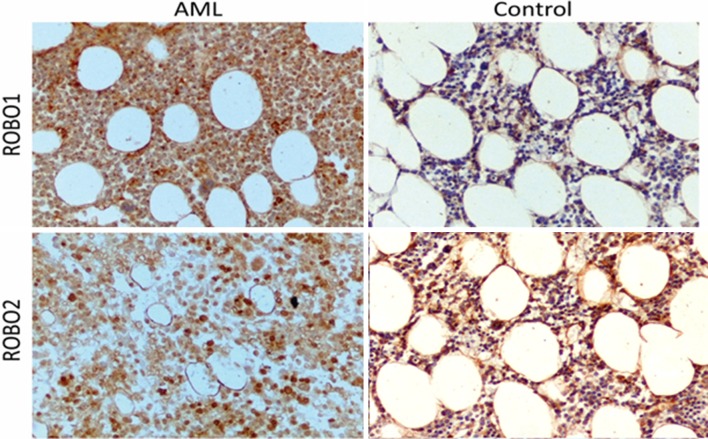
Herein, we assessed the expression of all SLIT-ROBO family in bone marrow (BM) biopsy of AML patients and control group on both protein and RNA levels.
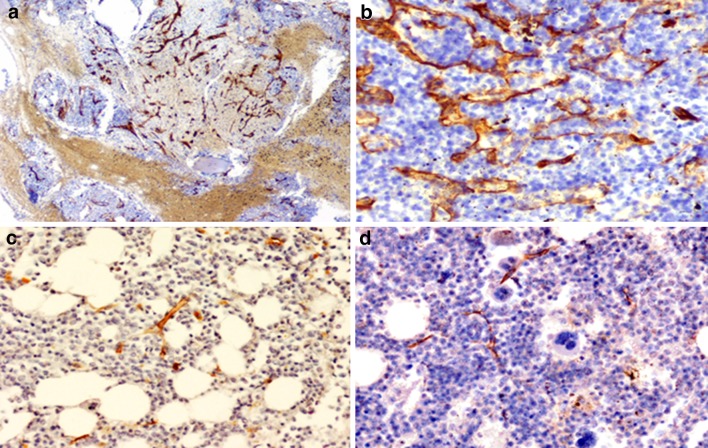
The paraffin-embedded tissue blocks were subjected to immunohistochemistry for SLIT1, SLIT2, SLIT3, ROBO1, ROBO2, ROBO3, and ROBO4. Microvessel density (MVD) was evaluated by CD34 immunohistochemistry. An in silico analysis using The Cancer Genome Atlas data repository was conducted for assessment of RNA level.
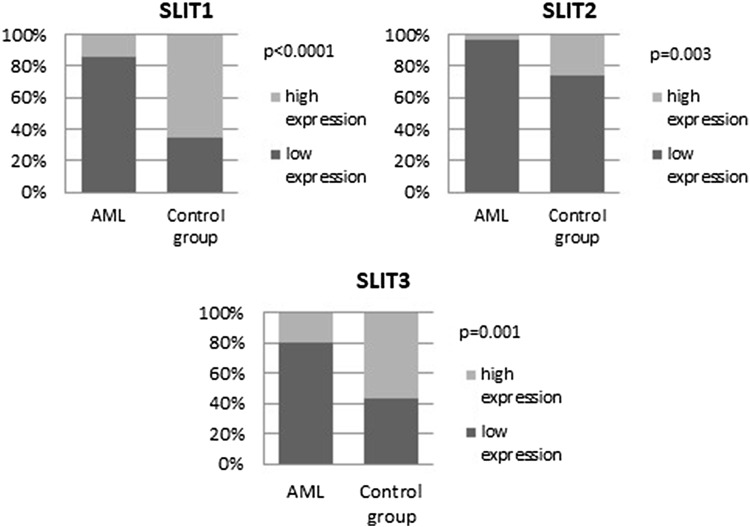
Acute myeloid leukemia patients were generally high expressers of ROBO1 and ROBO2 compared to the controls (p < 0.0001, p < 0.001, respectively). In contrast, low expression of SLIT1, SLIT2, and SLIT3 ligands has been noted more commonly in AML than in control BM samples (p < 0.0001, p = 0.003, and p = 0.001, respectively). ROBO4 expression correlated with MVD. The in silico analysis showed a poor prognostic value of high ROBO3 and low SLIT2 RNA levels (p = 0.0003 and p = 0.0008, respectively), as well as high ROBO3 and ROBO4 RNA levels in cytogenetic poor risk groups of patients (p = 0.0029 and p = 0.0003, respectively).
These data indicate that SLIT-ROBO family members play a role in the biology of AML. Low expression of SLIT in BM of AML patients may suggest its expression alterations in AML. Increased expression of ROBO1 and ROBO2 in AML patients suggests their participation in AML pathogenesis.
SLIT-ROBO 是神经元导向线索的配体-受体家族,已参与病理性和生理性血管生成。SLIT-ROBO 的表达在许多肿瘤中发生改变。然而,尚无关于整个家族在急性髓系白血病(AML)中的作用的数据。
在此,我们评估了 AML 患者和对照组骨髓活检中 SLIT-ROBO 家族所有成员的蛋白和 RNA 水平表达。
对石蜡包埋组织块进行 SLIT1、SLIT2、SLIT3、ROBO1、ROBO2、ROBO3 和 ROBO4 的免疫组织化学检测。通过 CD34 免疫组织化学评估微血管密度(MVD)。使用 The Cancer Genome Atlas 数据存储库进行了一项计算机分析,以评估 RNA 水平。
与对照组相比,急性髓系白血病患者普遍高表达 ROBO1 和 ROBO2(p<0.0001,p<0.001)。相反,在 AML 中,SLIT1、SLIT2 和 SLIT3 配体的低表达更为常见(p<0.0001,p=0.003 和 p=0.001)。ROBO4 表达与 MVD 相关。计算机分析显示高 ROBO3 和低 SLIT2 RNA 水平具有不良预后价值(p=0.0003 和 p=0.0008),以及细胞遗传学高危组患者中高 ROBO3 和 ROBO4 RNA 水平(p=0.0029 和 p=0.0003)。
这些数据表明 SLIT-ROBO 家族成员在 AML 的生物学中发挥作用。AML 患者骨髓中 SLIT 的低表达可能表明其在 AML 中的表达改变。AML 患者中 ROBO1 和 ROBO2 的高表达表明其参与 AML 的发病机制。