Ishiwata Kiichi
Southern TOHOKU Drug Discovery and Cyclotron Research Center, Southern TOHOKU Research Institute for Neuroscience, 7-61-2 Yatsuyamada, Koriyama, 963-8052, Japan.
Department of Biofunctional Imaging, Fukushima Medical University, Fukushima, Japan.
Ann Nucl Med. 2019 Apr;33(4):223-236. doi: 10.1007/s12149-019-01347-8. Epub 2019 Feb 28.
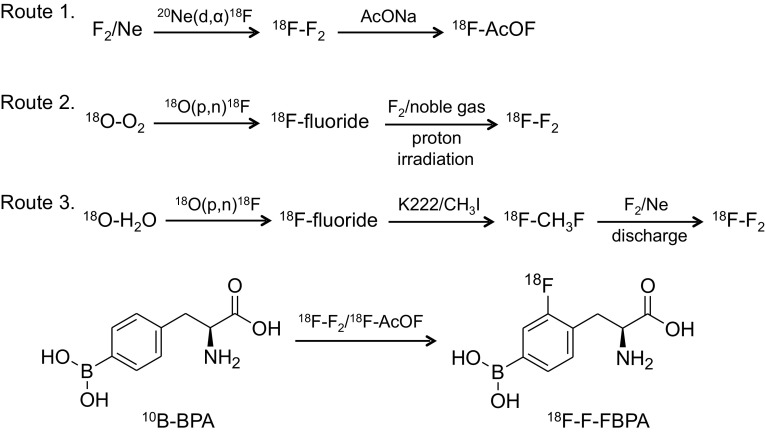
4-B-Borono-2-F-fluoro-L-phenylalanine (F-FBPA) was developed for monitoring the pharmacokinetics of 4-B-borono-L-phenylalanine (B-BPA) used in boron neutron capture therapy (BNCT) with positron emission tomography (PET). The tumor-imaging potential of F-FBPA was demonstrated in various animal models. Accumulation of F-FBPA was higher in melanomas than in non-melanoma tumors in animal models and cell cultures. F-FBPA was incorporated into tumors mediated mainly by L-type amino acid transporters in in vitro and in vivo models. Tumoral distribution of F-FBPA was primarily related to the activity of DNA synthesis. F-FBPA is metabolically stable but is incorporated into melanogenesis non-enzymatically. These in vitro and in vivo characteristics of F-FBPA corresponded well to those of B-BPA. Nuclear magnetic resonance and other studies using non-radioactive F-B-FBPA also contributed to characterization. The validity and reliability of F-FBPA as an in vivo probe of B-BPA were confirmed by comparison of the pharmacokinetics of F-FBPA and B-BPA and direct measurement of both F and B in tumors with various doses of both probes administered by different routes and methods. Clinically, based on the kinetic parameters of dynamic F-FBPA PET, the estimated B-concentrations in tumors with continuous B-BPA infusion were similar to those measured directly in surgical specimens. The significance of F-FBPA PET was verified for the estimation of B-concentration and planning of BNCT. Later F-FBPA PET has been involved in B-BPA BNCT of patients with intractable tumors such as malignant brain tumors, head and neck tumors, and melanoma. Usually a static PET scan is used for screening patients for BNCT, prediction of the distribution and accumulation of B-BPA, and evaluation of treatment after BNCT. In some clinical trials, a tumor-to-normal tissue ratio of F-FBPA > 2.5 was an inclusion criterion for BNCT. Apart from BNCT, F-FBPA was demonstrated to be a useful PET probe for tumor diagnosis in nuclear medicine: better tumor-to-normal brain contrast compared with C-methionine, differentiation of recurrent and radiation necrosis after radiotherapy, and melanoma-preferential uptake. Further progress in F-FBPA studies is expected for more elaborate evaluation of B-concentrations in tumors and normal tissues for successful B-BPA BNCT and for radiosynthesis of F-FBPA to enable higher F-activity amounts and higher molar activities.
4-硼-2-氟-L-苯丙氨酸(F-FBPA)是为了利用正电子发射断层扫描(PET)监测硼中子俘获疗法(BNCT)中所用的4-硼-L-苯丙氨酸(B-BPA)的药代动力学而研发的。F-FBPA在多种动物模型中展现出肿瘤成像潜力。在动物模型和细胞培养中,黑色素瘤中F-FBPA的蓄积高于非黑色素瘤肿瘤。在体外和体内模型中,F-FBPA主要通过L型氨基酸转运体进入肿瘤。F-FBPA的肿瘤分布主要与DNA合成活性相关。F-FBPA代谢稳定,但可非酶促地参与黑色素生成。F-FBPA的这些体外和体内特性与B-BPA的特性非常吻合。使用非放射性F-B-FBPA的核磁共振及其他研究也有助于其特性表征。通过比较F-FBPA和B-BPA的药代动力学,并直接测量不同给药途径和方法给予不同剂量两种探针后肿瘤中的F和B,证实了F-FBPA作为B-BPA体内探针的有效性和可靠性。临床上,基于动态F-FBPA PET的动力学参数,持续输注B-BPA时肿瘤中B浓度的估计值与手术标本中直接测量的值相似。F-FBPA PET在估计B浓度和BNCT治疗规划方面的意义得到了验证。后来,F-FBPA PET已应用于恶性脑肿瘤、头颈部肿瘤和黑色素瘤等难治性肿瘤患者的B-BPA BNCT。通常,静态PET扫描用于筛选BNCT患者、预测B-BPA的分布和蓄积以及评估BNCT后的治疗效果。在一些临床试验中,F-FBPA的肿瘤与正常组织比值>2.5是BNCT的纳入标准。除了BNCT,F-FBPA还被证明是核医学中一种用于肿瘤诊断的有用PET探针:与C-蛋氨酸相比,肿瘤与正常脑的对比度更好,可区分放疗后复发和放射性坏死,且对黑色素瘤有优先摄取。预计F-FBPA研究将取得进一步进展,以便更精确地评估肿瘤和正常组织中的B浓度,从而成功实施B-BPA BNCT,并实现F-FBPA的放射性合成,以获得更高的F活度和更高的摩尔活度。