Department of Radiology, Division of Radiology, Showa University Graduate School of Medicine, 1-5-8 Hatanodai, Shinagawa-ku, Tokyo, Japan.
Department of Radiology, National Defense Medical College, 3-2 Namiki, Tokorozawa, Saitama, Japan.
Breast Cancer. 2019 Sep;26(5):552-561. doi: 10.1007/s12282-019-00955-6. Epub 2019 Feb 28.
There is no consensus on the appropriate surveillance for high-risk women with breast cancer in Japan. We investigated their imaging features and pathological characteristics to build a proper surveillance system for asymptomatic high-risk individuals in the future.
We retrospectively reviewed 93 female (median age 43 years) BRCA1 and BRCA2 mutation carriers from our institutional clinical database from 2011 to 2017. The study population was composed of 112 breast cancers. Mammography and MRI were reviewed by examiners blinded to patients' clinical history. Final surgical or biopsy histopathology served as the reference standard in all the patients.
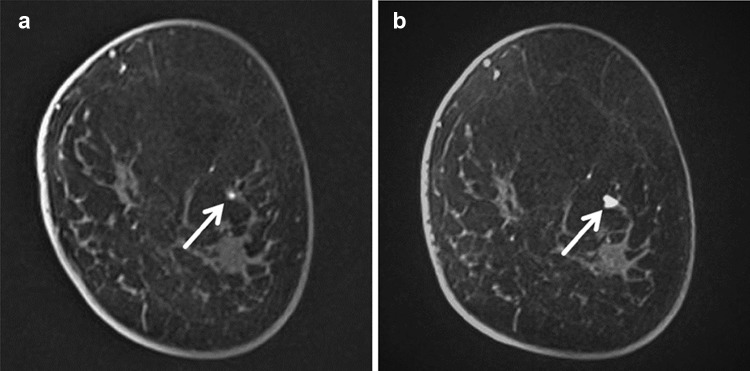
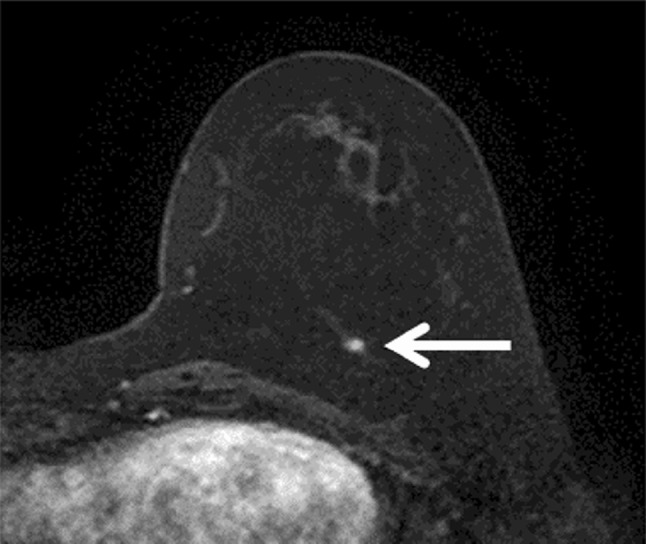
Fifty-nine breast cancers met selection criteria; of these, 30 were BRCA1-associated tumors, and 29 were BRCA2-associated tumors. Invasive ductal carcinoma was the most prevalent type in both BRCA1 and BRCA2. There were statistically significant differences in phenotype, nuclear grade, and Ki-67 labeling index between BRCA1 and BRCA2 mutation carriers. Additionally, imaging findings on mammography and MRI were statistically different. Tumors in BRCA2 carriers demonstrated mammographic calcifications more frequently, while those in BRCA1 carriers demonstrated a mass or architectural distortion (P < 0.001). Enhancement pattern on MRI also significantly differed between the two subgroups (P = 0.006). The size of MRI-detected lesions was statistically smaller than the size of those detected by other modalities (P = 0.004).
The imaging and histological characteristics of BRCA1/2 mutation carriers were consistent with other countries' studies. MRI-detected lesions were significantly smaller than lesions detected by non-MRI modality. All lesions in BRCA1 mutation carriers could be detected by MRI.
日本对于乳腺癌高危女性的适当监测尚无共识。我们研究了她们的影像学特征和病理特征,以期为未来无症状高危人群建立适当的监测系统。
我们回顾性分析了 2011 年至 2017 年期间来自机构临床数据库的 93 名 BRCA1 和 BRCA2 突变携带者的女性(中位年龄 43 岁)。研究人群由 112 例乳腺癌组成。对乳腺 X 线摄影和 MRI 进行了评估,评估人员对患者的临床病史不知情。所有患者均以最终的手术或活检组织病理学作为参考标准。
59 例乳腺癌符合入选标准;其中 30 例为 BRCA1 相关肿瘤,29 例为 BRCA2 相关肿瘤。BRCA1 和 BRCA2 突变携带者中最常见的类型均为浸润性导管癌。BRCA1 和 BRCA2 突变携带者的表型、核分级和 Ki-67 标记指数存在统计学差异。此外,乳腺 X 线摄影和 MRI 的影像学表现也存在统计学差异。BRCA2 携带者的肿瘤更常表现为乳腺钙化,而 BRCA1 携带者的肿瘤则表现为肿块或结构扭曲(P<0.001)。两组亚组之间 MRI 增强模式也存在显著差异(P=0.006)。MRI 检测到的病变大小明显小于其他检测方式(P=0.004)。
BRCA1/2 突变携带者的影像学和组织学特征与其他国家的研究一致。MRI 检测到的病变明显小于非 MRI 检测到的病变。BRCA1 突变携带者的所有病变均能被 MRI 检测到。