Department of Respiratory Medicine, Kitasato University School of Medicine, Sagamihara-City, Japan.
Research and Development Center for New Medical Frontiers, Kitasato University School of Medicine, Sagamihara-City, Japan.
Thorac Cancer. 2019 Apr;10(4):880-889. doi: 10.1111/1759-7714.13018. Epub 2019 Feb 28.
Osimertinib is recommended for non-small cell lung cancer (NSCLC) patients with EGFR mutation; however, it is unclear whether body size variables affect the efficacy of osimertinib in such patients. This study assessed the potential effect of body surface area (BSA) and body mass index (BMI) on osimertinib chemotherapy in patients with T790M-positive advanced NSCLC who progress on prior EGFR-tyrosine kinase inhibitors (TKIs).
We conducted a prospective observational cohort study. Median BSA and BMI were used as cut-off values to evaluate the impact of body size variables on osimertinib chemotherapy.
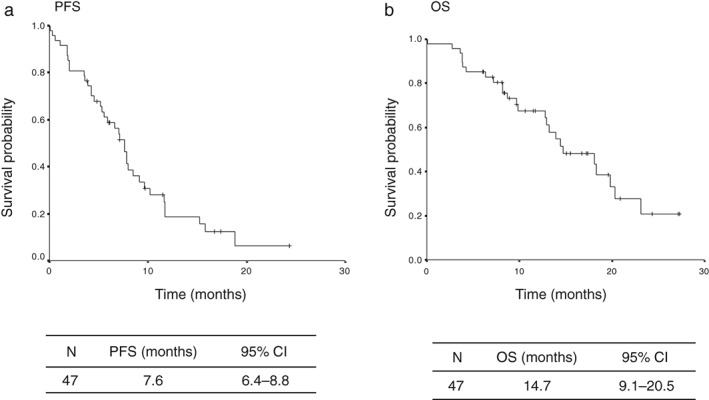
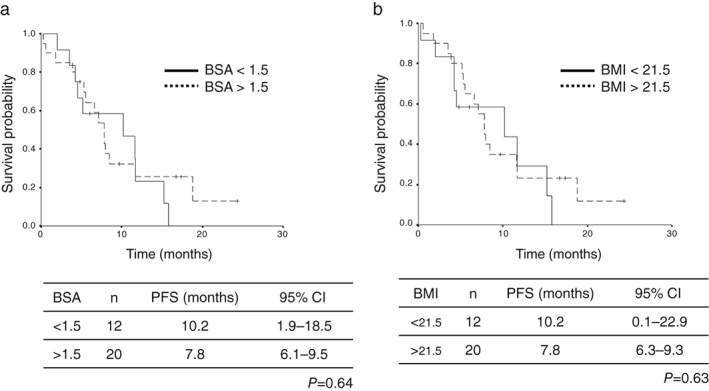
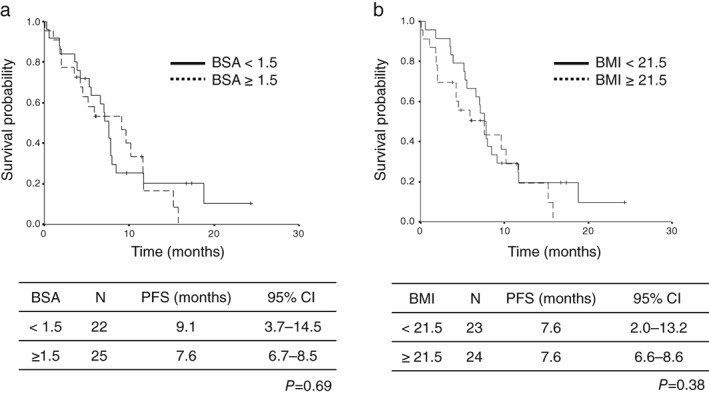
The median BSA and BMI of 47 patients were 1.50 m and 21.5 kg/m , respectively. Clinical outcomes did not significantly differ between the high and low BSA groups, with response rates of 59.1% and 56.0% (P = 0.83) and progression-free survival (PFS) of 7.6 and 9.1 months (P = 0.69), respectively. Similarly, there were no significant differences between the high and low BMI groups relative to response rates, which were 60.8% and 54.1% (P = 0.64), respectively, and PFS, which was 7.6 months in both groups (P = 0.38). No significant differences were observed among toxicity profiles in relation to BSA or BMI. Multivariate analysis identified better performance status, young age, and EGFR exon 19 deletion as independent favorable predictors of PFS.
The efficacy of osimertinib does not significantly vary relative to body size variables of patients with T790M-positive NSCLC who progress on prior EGFR-TKIs.
奥希替尼被推荐用于 EGFR 突变的非小细胞肺癌(NSCLC)患者;然而,尚不清楚体型变量是否会影响此类患者奥希替尼的疗效。本研究评估了体表面积(BSA)和体重指数(BMI)对先前 EGFR-酪氨酸激酶抑制剂(TKI)治疗进展的 T790M 阳性晚期 NSCLC 患者奥希替尼化疗的潜在影响。
我们进行了一项前瞻性观察性队列研究。使用中位数 BSA 和 BMI 作为截断值来评估体型变量对奥希替尼化疗的影响。
47 例患者的中位数 BSA 和 BMI 分别为 1.50m 和 21.5kg/m2。BSA 高、低组之间的临床结局无显著差异,缓解率分别为 59.1%和 56.0%(P=0.83),无进展生存期(PFS)分别为 7.6 和 9.1 个月(P=0.69)。同样,BMI 高、低组之间的缓解率也无显著差异,分别为 60.8%和 54.1%(P=0.64),PFS 分别为 7.6 个月(P=0.38)。BSA 或 BMI 与毒性特征之间无显著差异。多变量分析确定更好的表现状态、年龄较小和 EGFR 外显子 19 缺失是 PFS 的独立有利预测因素。
BSA 或 BMI 对先前 EGFR-TKI 治疗进展的 T790M 阳性 NSCLC 患者奥希替尼的疗效无显著影响。