Department of Paediatric Oncology, Great North Children's Hospital, Royal Victoria Infirmary, Newcastle, NE1 4LP, UK.
Institute of Health & Society, Newcastle University, Sir James Spence Institute, Royal Victoria Infirmary, Queen Victoria Road, Newcastle upon Tyne, NE1 4LP, United Kingdom.
Eur J Cancer. 2019 Apr;111:50-58. doi: 10.1016/j.ejca.2018.12.032. Epub 2019 Feb 26.
Despite aggressive multimodal therapy, >50% of children with high-risk neuroblastoma (HRNB) relapse. Survival after relapse is rare, and no consensus currently exists on the most effective therapy.
To conduct a systematic review of the literature on effectiveness of re-induction chemotherapy in children with relapsed HRNB.
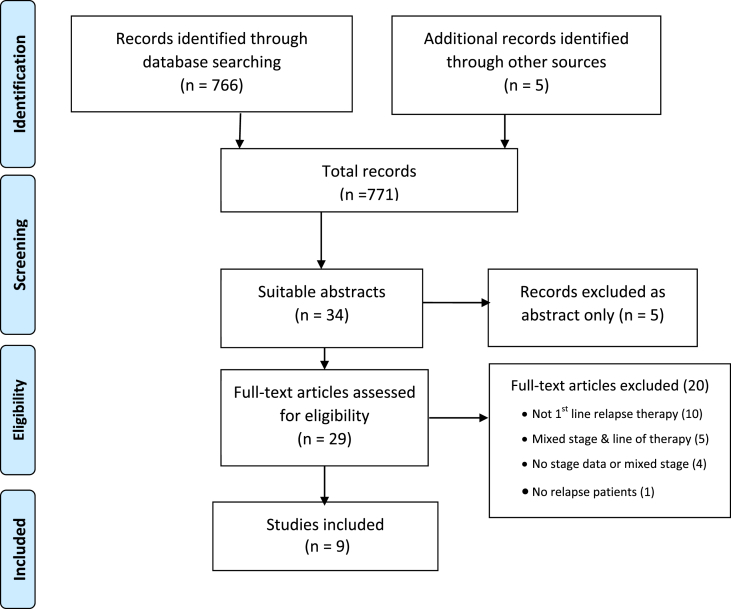
Database searches were performed to identify studies looking at response to 1st line chemotherapy for children >12 months at diagnosis with first relapse of HRNB. Studies not reporting separate outcomes for HRNB patients or of refractory patients only were excluded. Two independent reviewers extracted the data and assessed study quality using a modified Newcastle-Ottawa tool.
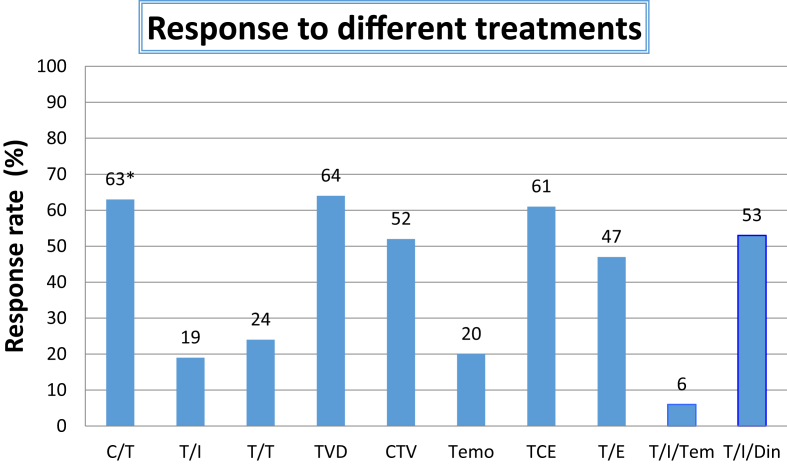
Nine studies were identified fitting the inclusion criteria. All except one were single arm cohorts, and two were retrospective database reviews from single centres. One was a multicentre randomised controlled trial. All used a version of the validated International Neuroblastoma Response Criteria with 8 recording best ever response and 1 at a specified time, and 5 had central review. The proportion of relapsed patients varied from 24 to 100% with 30-93% receiving upfront myeloablative therapy. The response rate varied from 6 to 64%; however, because of heterogeneity, studies were not directly comparable, and no single treatment emerged as the most effective re-induction therapy.
To date, there is no clear superior re-induction therapy for 1st relapse of HRNB. Randomised controlled trials with separate arms for relapsed versus refractory disease are needed to determine optimal re-induction chemotherapy to act as a backbone for testing newer targeted agents.
尽管采用了积极的多模式治疗,仍有超过 50%的高危神经母细胞瘤(HRNB)患儿复发。复发后生存的情况罕见,目前尚无关于最有效治疗方法的共识。
对复发性 HRNB 儿童再诱导化疗疗效的文献进行系统评价。
进行数据库检索,以确定研究 12 个月以上诊断为 HRNB 首次复发的儿童对一线化疗反应的研究。排除未报告 HRNB 患者单独结果或仅报告难治性患者的研究。两名独立审查员使用改良的纽卡斯尔-渥太华量表提取数据并评估研究质量。
确定了符合纳入标准的 9 项研究。除了一项之外,所有研究都是单臂队列研究,其中两项是来自单一中心的回顾性数据库研究。一项是多中心随机对照试验。所有研究均使用了经验证的国际神经母细胞瘤反应标准版本,其中 8 项记录了最佳总体反应,1 项在特定时间记录,5 项进行了中心审查。复发患者的比例从 24%到 100%不等,30%-93%的患者接受了 upfront 骨髓清除性治疗。反应率从 6%到 64%不等;然而,由于存在异质性,因此研究无法直接比较,也没有一种单一的治疗方法被确定为最有效的再诱导治疗。
迄今为止,对于 HRNB 的首次复发,尚无明确的优势再诱导治疗方法。需要进行随机对照试验,分别为复发和难治性疾病设立单独的治疗臂,以确定最佳的再诱导化疗作为新型靶向药物的基础。