Department of Pharmacology and Therapeutics, Faculty of Medicine, Collegium Medicum in Bydgoszcz, Nicolaus Copernicus University, M. Curie 9, 85-090 Bydgoszcz, Poland.
Department of Obstetrics, Gynecology and Gynecological Oncology, Faculty of Medicine, Collegium Medicum in Bydgoszcz, Nicolaus Copernicus University, Ujejskiego 75; 85-168 Bydgoszcz, Poland.
Int J Mol Sci. 2019 Feb 28;20(5):1050. doi: 10.3390/ijms20051050.
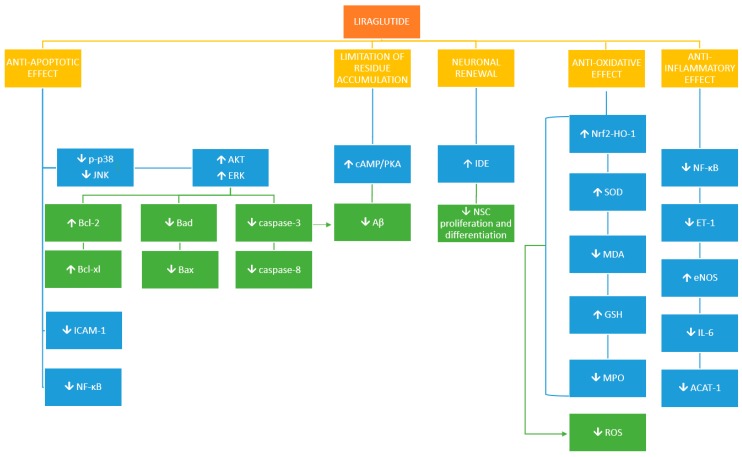
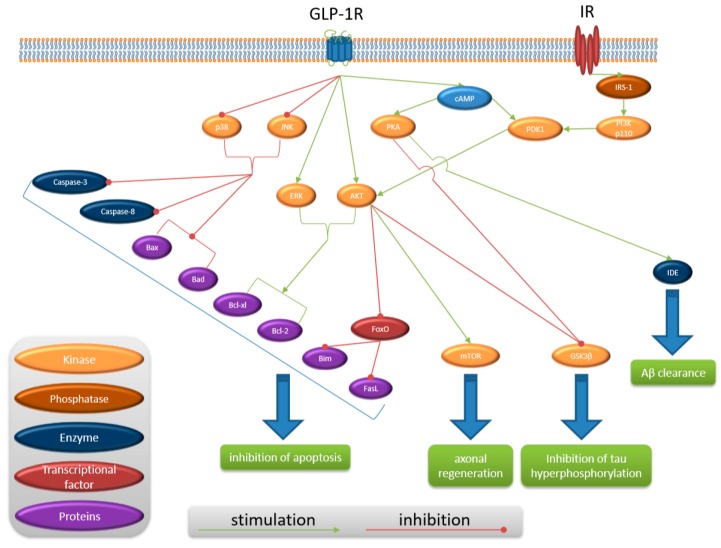
Liraglutide is a GLP-1 analog (glucagon like peptide-1) used primarily in the treatment of diabetes mellitus type 2 (DM2) and obesity. The literature starts to suggest that liraglutide may reduce the effects of ischemic stroke by activating anti-apoptotic pathways, as well as limiting the harmful effects of free radicals. The GLP-1R expression has been reported in the cerebral cortex, especially occipital and frontal lobes, the hypothalamus, and the thalamus. Liraglutide reduced the area of ischemia caused by MCAO (middle cerebral artery occlusion), limited neurological deficits, decreased hyperglycemia caused by stress, and presented anti-apoptotic effects by increasing the expression of Bcl-2 and Bcl-xl proteins and reduction of Bax and Bad protein expression. The pharmaceutical managed to decrease concentrations of proapoptotic factors, such as NF-κB (Nuclear Factor-kappa β), ICAM-1 (Intercellular Adhesion Molecule 1), caspase-3, and reduced the level of TUNEL-positive cells. Liraglutide was able to reduce the level of free radicals by decreasing the level of malondialdehyde (MDA), and increasing the superoxide dismutase level (SOD), glutathione (GSH), and catalase. Liraglutide may affect the neurovascular unit causing its remodeling, which seems to be crucial for recovery after stroke. Liraglutide may stabilize atherosclerotic plaque, as well as counteract its early formation and further development. Liraglutide, through its binding to GLP-1R (glucagon like peptide-1 receptor) and consequent activation of PI3K/MAPK (Phosphoinositide 3-kinase/mitogen associated protein kinase) dependent pathways, may have a positive impact on Aβ (amyloid beta) trafficking and clearance by increasing the presence of Aβ transporters in cerebrospinal fluid. Liraglutide seems to affect tau pathology. It is possible that liraglutide may have some stem cell stimulating properties. The effects may be connected with PKA (phosphorylase kinase A) activation. This paper presents potential mechanisms of liraglutide activity in conditions connected with neuronal damage, with special emphasis on Alzheimer's disease and cerebral ischemia.
利拉鲁肽是一种 GLP-1 类似物(胰高血糖素样肽-1),主要用于治疗 2 型糖尿病(DM2)和肥胖症。文献开始表明,利拉鲁肽通过激活抗细胞凋亡途径以及限制自由基的有害作用,可能减轻缺血性中风的影响。GLP-1R 的表达已在大脑皮层(特别是枕叶和额叶)、下丘脑和丘脑中报道。利拉鲁肽减少 MCAO(大脑中动脉闭塞)引起的缺血面积,限制神经功能缺损,降低应激引起的高血糖,并通过增加 Bcl-2 和 Bcl-xl 蛋白的表达以及降低 Bax 和 Bad 蛋白的表达来发挥抗细胞凋亡作用。该药物成功降低了促凋亡因子的浓度,如 NF-κB(核因子-κB)、ICAM-1(细胞间黏附分子 1)、caspase-3,并降低了 TUNEL 阳性细胞的水平。利拉鲁肽通过降低丙二醛(MDA)水平和增加超氧化物歧化酶(SOD)、谷胱甘肽(GSH)和过氧化氢酶水平来减少自由基的水平。利拉鲁肽可能通过影响神经血管单元来引起其重塑,这对于中风后恢复似乎至关重要。利拉鲁肽可能稳定动脉粥样硬化斑块,并对抗其早期形成和进一步发展。利拉鲁肽通过与 GLP-1R(胰高血糖素样肽-1 受体)结合并激活 PI3K/MAPK(磷酸肌醇 3-激酶/有丝分裂原相关蛋白激酶)依赖性途径,可能通过增加脑脊液中 Aβ(淀粉样蛋白-β)转运体的存在对 Aβ 的转运和清除产生积极影响。利拉鲁肽似乎会影响 tau 病理学。利拉鲁肽可能具有某些干细胞刺激特性。这些作用可能与 PKA(蛋白激酶 A)的激活有关。本文提出了利拉鲁肽在与神经元损伤相关的条件下的潜在作用机制,特别强调了阿尔茨海默病和脑缺血。