Birmingham Women's and Children's Hospital NHS Foundation Trust, Birmingham B4 6NH, UK.
Bradford Teaching Hospitals NHS Trust, Bradford BD9 6RJ, UK.
Nutrients. 2019 Feb 28;11(3):529. doi: 10.3390/nu11030529.
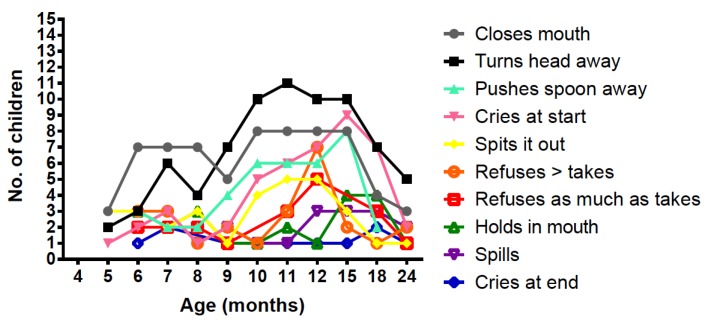
Weaning is complex for children with phenylketonuria (PKU). Breastmilk/infant formula and phenylalanine (Phe)-free infant protein-substitute (PS) are gradually replaced with equivalent amounts of Phe-containing food, a semi-solid/spoonable weaning PS and special low-protein foods. In PKU, feeding patterns/practices during weaning in PKU have not been formally evaluated. In this longitudinal, prospective, case-control study ( = 20) infants with PKU transitioning to a second-stage PS, were recruited at weaning (4⁻6 months) for a comparison of feeding practices and development with non-PKU infants. Subjects were monitored monthly to 12 months and at age 15 months, 18 months and 24 months for: feeding progression; food textures; motor skill development and self-feeding; feeding environment; gastrointestinal symptoms; and negative feeding behaviours. Children with PKU had comparable weaning progression to non-PKU infants including texture acceptance, infant formula volume and self-feeding skills. However, children with PKU had more prolonged Phe-free infant formula bottle-feeding and parental spoon feeding than controls; fewer meals/snacks per day; and experienced more flatulence ( = 0.0005), burping ( = 0.001), retching ( = 0.03); and less regurgitation ( = 0.003). Negative behaviours associated with PS at age 10⁻18 months, coincided with the age of teething. Use of semi-solid PS in PKU supports normal weaning development/progression but parents require support to manage the complexity of feeding and to normalise the social inclusivity of their child's family food environment. Further study regarding parental anxiety associated with mealtimes is required.
苯丙酮尿症(PKU)患儿的断奶较为复杂。母乳喂养/婴儿配方奶粉和无苯丙氨酸(Phe)婴儿蛋白质替代物(PS)逐渐被等量含 Phe 的食物、半固体/可勺取的断奶 PS 和特殊低蛋白食物替代。在 PKU 中,尚未对 PKU 断奶期间的喂养模式/实践进行正式评估。在这项纵向、前瞻性病例对照研究中(= 20),招募了正在过渡到第二阶段 PS 的 PKU 婴儿,在断奶期(4-6 个月)对其喂养实践和发育情况与非 PKU 婴儿进行了比较。在 12 个月和 15 个月、18 个月和 24 个月时,对参与者进行了每月监测,以评估:喂养进展;食物质地;运动技能发展和自主进食;喂养环境;胃肠道症状;以及不良喂养行为。PKU 患儿的断奶进展与非 PKU 婴儿相当,包括质地接受度、婴儿配方奶粉量和自主进食技能。然而,与对照组相比,PKU 患儿的无 Phe 婴儿配方奶瓶喂养和父母勺子喂养时间更长;每天的餐数/零食更少;并且经历了更多的胀气(= 0.0005)、打嗝(= 0.001)、呕吐(= 0.03);以及更少的反流(= 0.003)。在 10-18 个月时与 PS 相关的不良行为与出牙年龄相吻合。在 PKU 中使用半固体 PS 支持正常的断奶发育/进展,但父母需要支持来管理喂养的复杂性,并使孩子的家庭食物环境具有社会包容性。需要进一步研究与用餐时间相关的父母焦虑问题。