Barry Aissata, Behet Marije C, Nébié Issa, Lanke Kjerstin, Grignard Lynn, Ouedraogo Alphonse, Soulama Issiaka, Drakeley Chris, Sauerwein Robert, Bolscher Judith M, Dechering Koen J, Bousema Teun, Tiono Alfred B, Gonçalves Bronner P
Centre National de Recherche et de Formation sur le Paludisme, Ouagadougou, Burkina Faso.
Radboud Institute for Health Sciences, Radboud University Medical Center, Nijmegen, The Netherlands.
Wellcome Open Res. 2019 May 1;3:159. doi: 10.12688/wellcomeopenres.14932.2. eCollection 2018.
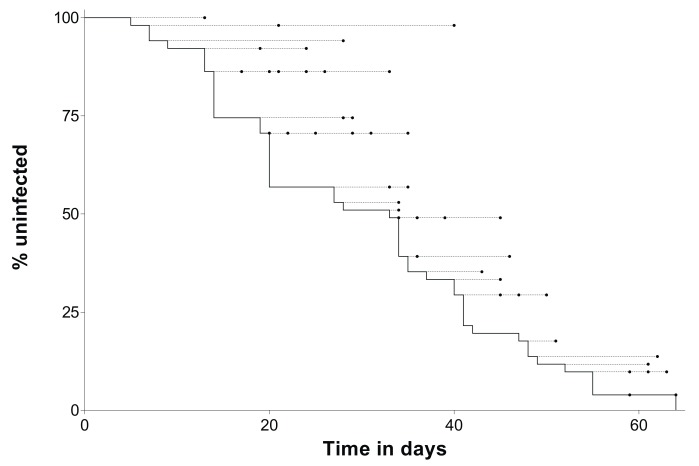
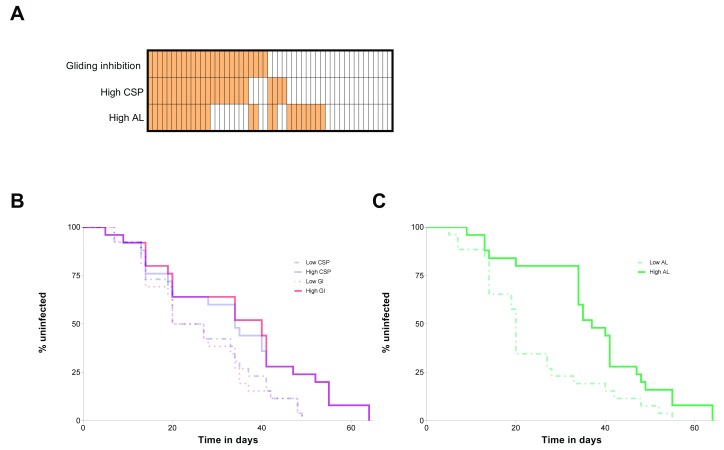
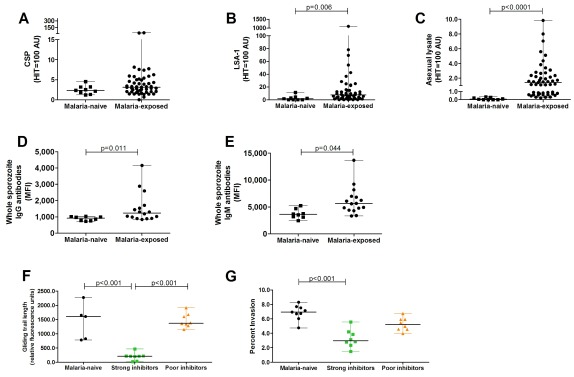
Individuals living in malaria-endemic regions develop immunity against severe malaria, but it is unclear whether immunity against pre-erythrocytic stages that blocks initiation of blood-stage infection after parasite inoculation develops following continuous natural exposure. We cleared schoolchildren living in an area (health district of Saponé, Burkina Faso) with highly endemic seasonal malaria of possible sub-patent infections and examined them weekly for incident infections by nested PCR. Plasma samples collected at enrolment were used to quantify antibodies to the pre-eryhrocytic-stage antigens circumsporozoite protein (CSP) and Liver stage antigen 1 (LSA-1). sporozoite gliding inhibition and hepatocyte invasion inhibition by naturally acquired antibodies were assessed using NF54 sporozoites. Associations between antibody responses, functional pre-erythrocytic immunity phenotypes and time to infection detected by quantitative PCR were studied. A total of 51 children were monitored. Anti-CSP antibody titres showed a positive association with sporozoite gliding motility inhibition (P<0.0001, Spearman's ρ=0.76). hepatocyte invasion was inhibited by naturally acquired antibodies (median inhibition, 19.4% [IQR 15.2-40.9%]), and there were positive correlations between invasion inhibition and gliding inhibition (P=0.005, Spearman's ρ=0.67) and between invasion inhibition and CSP-specific antibodies (P=0.002, Spearman's ρ=0.76). Survival analysis indicated longer time to infection in individuals displaying higher-than-median sporozoite gliding inhibition activity (P=0.01), although this association became non-significant after adjustment for blood-stage immunity (P = 0.06). In summary, functional antibodies against the pre-erythrocytic stages of malaria infection are acquired in children who are repeatedly exposed to parasites. This immune response does not prevent them from becoming infected during a malaria transmission season, but might delay the appearance of blood stage parasitaemia. Our approach could not fully separate the effects of pre-erythrocytic-specific and blood-stage-specific antibody-mediated immune responses ; epidemiological studies powered and designed to address this important question should become a research priority.
生活在疟疾流行地区的个体对重症疟疾产生了免疫力,但尚不清楚在持续自然暴露后,针对疟原虫接种后阻止血液阶段感染起始的前红细胞期的免疫力是否会发展。我们清除了生活在布基纳法索萨波内卫生区一个季节性疟疾高度流行地区的学童可能存在的亚临床感染,并通过巢式PCR每周对他们进行感染情况检查。入学时采集的血浆样本用于定量检测针对前红细胞期抗原环子孢子蛋白(CSP)和肝期抗原1(LSA-1)的抗体。使用NF54子孢子评估自然获得的抗体对子孢子滑行抑制和肝细胞侵袭抑制的作用。研究了抗体反应、功能性前红细胞期免疫表型与定量PCR检测到的感染时间之间的关联。共监测了51名儿童。抗CSP抗体滴度与子孢子滑行运动抑制呈正相关(P<0.0001,Spearman秩相关系数ρ=0.76)。自然获得的抗体可抑制肝细胞侵袭(中位抑制率为19.4%[四分位间距15.2-40.9%]),侵袭抑制与滑行抑制之间(P=0.005,Spearman秩相关系数ρ=0.67)以及侵袭抑制与CSP特异性抗体之间(P=0.002,Spearman秩相关系数ρ=0.76)均呈正相关。生存分析表明,子孢子滑行抑制活性高于中位数的个体感染时间更长(P=0.01),尽管在调整血液阶段免疫力后这种关联变得不显著(P = 0.06)。总之,反复接触疟原虫的儿童会获得针对疟疾感染前红细胞期的功能性抗体。这种免疫反应并不能防止他们在疟疾传播季节感染,但可能会延迟血液阶段寄生虫血症的出现。我们的方法无法完全区分前红细胞期特异性和血液阶段特异性抗体介导的免疫反应的影响;有足够能力并旨在解决这一重要问题的流行病学研究应成为研究重点。