• 文献检索
  • 文档翻译
  • 深度研究
  • 学术资讯
  • Suppr Zotero 插件Zotero 插件
  • 邀请有礼
  • 套餐&价格
  • 历史记录
应用&插件
Suppr Zotero 插件Zotero 插件浏览器插件Mac 客户端Windows 客户端微信小程序
定价
高级版会员购买积分包购买API积分包
服务
文献检索文档翻译深度研究API 文档MCP 服务
关于我们
关于 Suppr公司介绍联系我们用户协议隐私条款
关注我们

Suppr 超能文献

核心技术专利:CN118964589B侵权必究
粤ICP备2023148730 号-1Suppr @ 2026

文献检索

告别复杂PubMed语法,用中文像聊天一样搜索,搜遍4000万医学文献。AI智能推荐,让科研检索更轻松。

立即免费搜索

文件翻译

保留排版,准确专业,支持PDF/Word/PPT等文件格式,支持 12+语言互译。

免费翻译文档

深度研究

AI帮你快速写综述,25分钟生成高质量综述,智能提取关键信息,辅助科研写作。

立即免费体验

代谢组学分析揭示了鼠疫耶尔森菌非人灵长类动物模型中的脂质异常和肝功能障碍。

Metabolomic analyses reveal lipid abnormalities and hepatic dysfunction in non-human primate model for Yersinia pestis.

机构信息

US Army Center for Environmental Health Research, 568 Doughten Drive, Fort Detrick, MD, 21702, USA.

The Geneva Foundation, Fort Detrick, MD, USA.

出版信息

Metabolomics. 2018 Dec 29;15(1):2. doi: 10.1007/s11306-018-1457-2.

DOI:10.1007/s11306-018-1457-2
PMID:30830480
原文链接:https://pmc.ncbi.nlm.nih.gov/articles/PMC6311182/
Abstract

INTRODUCTION

Pneumonic plague is caused by the aerosolized form of Yersinia pestis and is a highly virulent infection with complex clinical consequences, and without treatment, the fatality rate approaches 100%. The exact mechanisms of disease progression are unclear, with limited work done using metabolite profiling to study disease progression.

OBJECTIVE

The aim of this pilot study was to profile the plasma metabolomics in an animal model of Y. pestis infection.

METHODS

In this study, African Green monkeys were challenged with the highly virulent, aerosolized Y. pestis strain CO92, and untargeted metabolomics profiling of plasma was performed using liquid and gas chromatography with mass spectrometry.

RESULTS

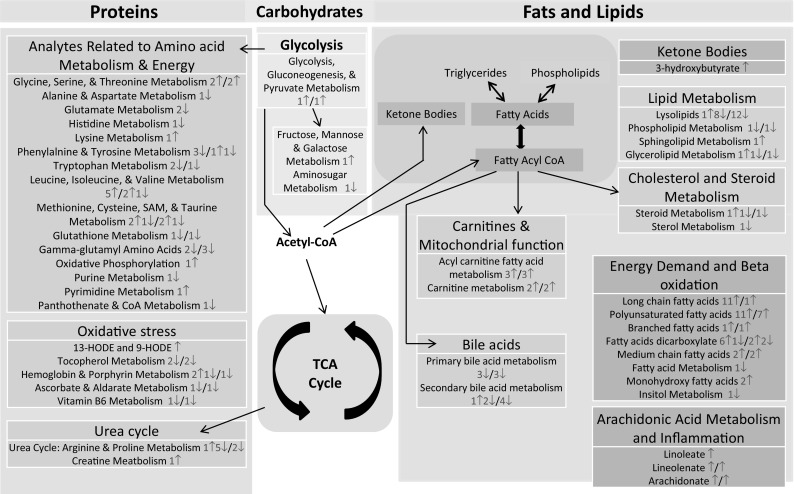
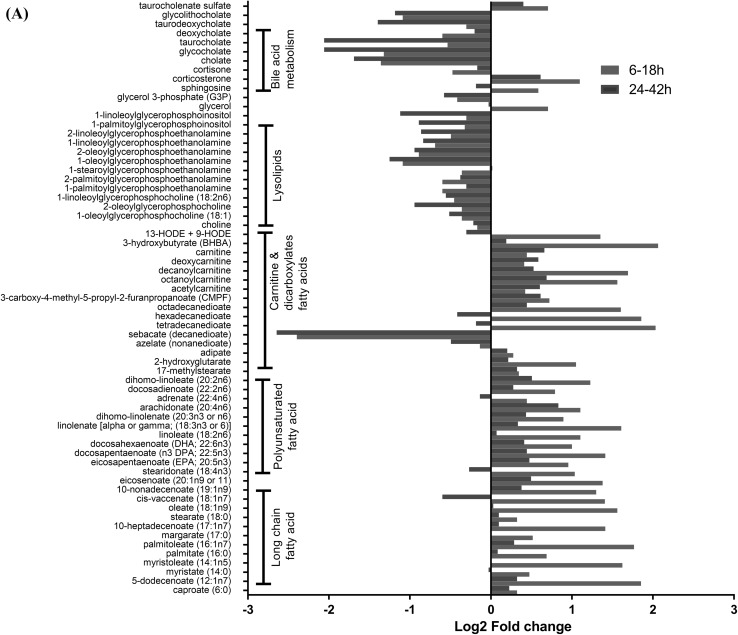
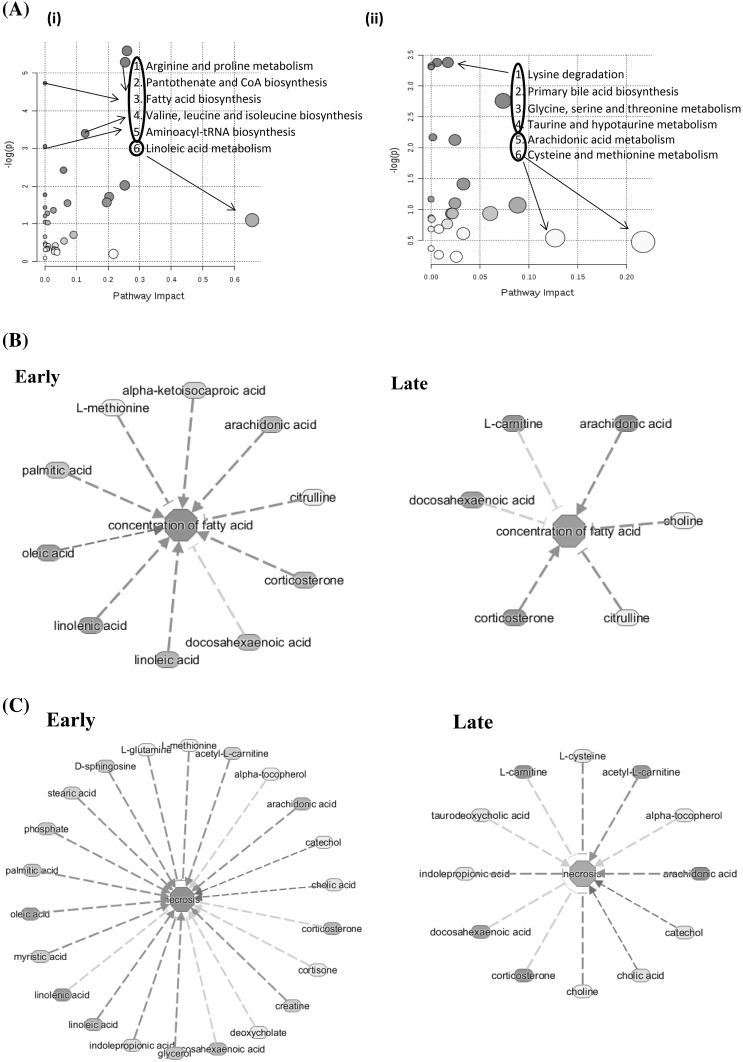
At early time points post-exposure, we found significant increases in polyunsaturated, long chain fatty acid metabolites with p values ranging from as low as 0.000001 (ratio = 1.94) for the metabolite eicosapentaenoate to 0.04 (ratio = 1.36) for the metabolite adrenate when compared to time-matched controls. Multiple acyl carnitines metabolites were increased at earlier time points and could be a result of fatty acid oxidation defects with p values ranging from as low as 0.00001 (ratio = 2.95) for the metabolite octanoylcarnitine to 0.04 (ratio = 1.33) for metabolite deoxycarnitine when compared to time-matched controls. Dicarboxylic acids are important metabolic products of fatty acids oxidation, and when compared to time matched controls, were higher at earlier time points where metabolite tetradecanedioate has a ratio of 4.09 with significant p value of 0.000002 and adipate with a ratio of 1.12 and p value of 0.004. The metabolites from lysolipids (with significant p values ranging from 0.00006 for 1-oleoylglycerophosphoethanolamine to 0.04 for 1-stearoylglycerophosphoethanolamine and a ratio of 0.47 and 0.78, respectively) and bile acid metabolism (with significant p values ranging from 0.02 for cholate to 0.04 for deoxycholate and a ratio of 0.39 and 0.66, respectively) pathways were significantly lower compared to their time-matched controls during the entire course of infection. Metabolite levels from amino acid pathways were disrupted, and a few from the leucine, isoleucine and valine pathway were significantly higher (p values ranging from 0.002 to 0.04 and ratios ranging from 1.3 to 1.5, respectively), whereas metabolites from the urea cycle, arginine and proline pathways were significantly lower (p values ranging from 0.00008 to 0.02 and ratios ranging from 0.5 to 0.7, respectively) during the course of infection.

CONCLUSIONS

The involvement of several lipid pathways post-infection suggested activation of pathways linked to inflammation and oxidative stress. Metabolite data further showed increased energy demand, and multiple metabolites indicated potential hepatic dysfunction. Integration of blood metabolomics and transcriptomics data identified linoleate as a core metabolite with cross-talk with multiple genes from various time points. Collectively, the data from this study provided new insights into the mechanisms of Y. pestis pathogenesis that may aid in development of therapeutics.

摘要

简介

肺鼠疫是由耶尔森氏鼠疫杆菌的气溶胶形式引起的,是一种具有复杂临床后果的高毒力感染,如果不治疗,死亡率接近 100%。疾病进展的确切机制尚不清楚,使用代谢物分析来研究疾病进展的工作有限。

目的

本初步研究的目的是对 Y. pestis 感染动物模型的血浆代谢组进行分析。

方法

在这项研究中,非洲绿猴受到高毒力、气溶胶化的 Y. pestis 菌株 CO92 的挑战,并使用液相和气相色谱-质谱联用对血浆进行非靶向代谢组学分析。

结果

在暴露后的早期时间点,我们发现多不饱和、长链脂肪酸代谢物的水平显著增加,与时间匹配的对照相比,最低 p 值低至 0.000001(代谢物二十碳五烯酸的比值为 1.94),最高 p 值为 0.04(代谢物肾上腺醇的比值为 1.36)。多种酰基辅酶 A 代谢物在早期时间点增加,可能是脂肪酸氧化缺陷的结果,与时间匹配的对照相比,最低 p 值低至 0.00001(代谢物辛酰基辅酶 A 的比值为 2.95),最高 p 值为 0.04(代谢物脱氧辅氨酸的比值为 1.33)。二羧酸是脂肪酸氧化的重要代谢产物,与时间匹配的对照相比,在早期时间点更高,其中十四烷二酸的比值为 4.09,具有显著的 p 值 0.000002,而己二酸的比值为 1.12,p 值为 0.004。来自溶血磷脂的代谢物(具有显著的 p 值,范围从 1-油酰基甘油磷酸乙醇胺的 0.00006 到 1-硬脂酰基甘油磷酸乙醇胺的 0.04,比值分别为 0.47 和 0.78)和胆汁酸代谢途径(具有显著的 p 值,范围从胆酸盐的 0.02 到脱氧胆酸盐的 0.04,比值分别为 0.39 和 0.66)在整个感染过程中与时间匹配的对照相比明显降低。氨基酸途径的代谢物水平受到干扰,亮氨酸、异亮氨酸和缬氨酸途径的几种代谢物水平显著升高(p 值范围从 0.002 到 0.04,比值范围从 1.3 到 1.5),而尿素循环、精氨酸和脯氨酸途径的代谢物水平显著降低(p 值范围从 0.00008 到 0.02,比值范围从 0.5 到 0.7)在感染过程中。

结论

感染后几种脂质途径的参与表明炎症和氧化应激相关途径的激活。代谢物数据进一步表明能量需求增加,多种代谢物表明潜在的肝功能障碍。血液代谢组学和转录组学数据的整合确定了亚油酸作为具有跨多个时间点与来自各种途径的多个基因相互作用的核心代谢物。总的来说,这项研究的数据提供了鼠疫耶尔森氏菌发病机制的新见解,可能有助于治疗方法的开发。
https://cdn.ncbi.nlm.nih.gov/pmc/blobs/0e62/6311182/263c9ae1b563/11306_2018_1457_Fig5_HTML.jpg
https://cdn.ncbi.nlm.nih.gov/pmc/blobs/0e62/6311182/bad100013abe/11306_2018_1457_Fig1_HTML.jpg
https://cdn.ncbi.nlm.nih.gov/pmc/blobs/0e62/6311182/416b67bb437e/11306_2018_1457_Fig2a_HTML.jpg
https://cdn.ncbi.nlm.nih.gov/pmc/blobs/0e62/6311182/d82fea534f95/11306_2018_1457_Fig3_HTML.jpg
https://cdn.ncbi.nlm.nih.gov/pmc/blobs/0e62/6311182/5df84c567fd7/11306_2018_1457_Fig4a_HTML.jpg
https://cdn.ncbi.nlm.nih.gov/pmc/blobs/0e62/6311182/263c9ae1b563/11306_2018_1457_Fig5_HTML.jpg
https://cdn.ncbi.nlm.nih.gov/pmc/blobs/0e62/6311182/bad100013abe/11306_2018_1457_Fig1_HTML.jpg
https://cdn.ncbi.nlm.nih.gov/pmc/blobs/0e62/6311182/416b67bb437e/11306_2018_1457_Fig2a_HTML.jpg
https://cdn.ncbi.nlm.nih.gov/pmc/blobs/0e62/6311182/d82fea534f95/11306_2018_1457_Fig3_HTML.jpg
https://cdn.ncbi.nlm.nih.gov/pmc/blobs/0e62/6311182/5df84c567fd7/11306_2018_1457_Fig4a_HTML.jpg
https://cdn.ncbi.nlm.nih.gov/pmc/blobs/0e62/6311182/263c9ae1b563/11306_2018_1457_Fig5_HTML.jpg

相似文献

1
Metabolomic analyses reveal lipid abnormalities and hepatic dysfunction in non-human primate model for Yersinia pestis.代谢组学分析揭示了鼠疫耶尔森菌非人灵长类动物模型中的脂质异常和肝功能障碍。
Metabolomics. 2018 Dec 29;15(1):2. doi: 10.1007/s11306-018-1457-2.
2
An experimentally-supported genome-scale metabolic network reconstruction for Yersinia pestis CO92.鼠疫耶尔森氏菌CO92的一个经实验支持的全基因组规模代谢网络重建。
BMC Syst Biol. 2011 Oct 13;5:163. doi: 10.1186/1752-0509-5-163.
3
Characterization of the rat pneumonic plague model: infection kinetics following aerosolization of Yersinia pestis CO92.大鼠肺鼠疫模型的特征:鼠疫耶尔森菌CO92雾化后的感染动力学
Microbes Infect. 2009 Feb;11(2):205-14. doi: 10.1016/j.micinf.2008.11.009. Epub 2008 Dec 3.
4
Braun lipoprotein (Lpp) contributes to virulence of yersiniae: potential role of Lpp in inducing bubonic and pneumonic plague.Braun脂蛋白(Lpp)有助于耶尔森氏菌的毒力:Lpp在引发腺鼠疫和肺鼠疫中的潜在作用
Infect Immun. 2008 Apr;76(4):1390-409. doi: 10.1128/IAI.01529-07. Epub 2008 Jan 28.
5
Determination of the virulence of the pigmentation-deficient and pigmentation-/plasminogen activator-deficient strains of Yersinia pestis in non-human primate and mouse models of pneumonic plague.鼠疫耶尔森氏菌色素缺乏型及色素/纤溶酶原激活剂缺乏型菌株在非人类灵长类动物和肺鼠疫小鼠模型中的毒力测定
Vaccine. 2002 May 22;20(17-18):2206-14. doi: 10.1016/s0264-410x(02)00119-6.
6
Tn-Seq Analysis Identifies Genes Important for Yersinia pestis Adherence during Primary Pneumonic Plague.Tn-Seq 分析鉴定出鼠疫耶尔森菌在原发性肺鼠疫感染过程中黏附的重要基因。
mSphere. 2020 Aug 5;5(4):e00715-20. doi: 10.1128/mSphere.00715-20.
7
Yersinia pestis endowed with increased cytotoxicity is avirulent in a bubonic plague model and induces rapid protection against pneumonic plague.具有增强细胞毒性的鼠疫耶尔森菌在腺鼠疫模型中无毒力,并能诱导对肺鼠疫的快速保护。
PLoS One. 2009 Jun 16;4(6):e5938. doi: 10.1371/journal.pone.0005938.
8
Characterization of a mouse model of plague after aerosolization of Yersinia pestis CO92.鼠疫耶尔森氏菌CO92雾化后鼠疫小鼠模型的特征
Microbiology (Reading). 2008 Jul;154(Pt 7):1939-1948. doi: 10.1099/mic.0.2008/017335-0.
9
Temporal Progression of Pneumonic Plague in Blood of Nonhuman Primate: A Transcriptomic Analysis.非人灵长类动物血液中肺鼠疫的时间进程:一项转录组学分析
PLoS One. 2016 Mar 22;11(3):e0151788. doi: 10.1371/journal.pone.0151788. eCollection 2016.
10
Transcriptional profiling of a mice plague model: insights into interaction between Yersinia pestis and its host.小鼠鼠疫模型的转录谱分析:对鼠疫耶尔森菌与其宿主间相互作用的见解
J Basic Microbiol. 2009 Feb;49(1):92-9. doi: 10.1002/jobm.200800027.

引用本文的文献

1
Mendelian randomization analysis of blood metabolites and immune cell mediators in relation to GVHD and relapse.与移植物抗宿主病和复发相关的血液代谢物和免疫细胞介质的孟德尔随机化分析。
BMC Med. 2025 Apr 7;23(1):201. doi: 10.1186/s12916-025-04026-w.
2
Enteric bacterial infection stimulates remodelling of bile metabolites to promote intestinal homeostasis.肠细菌感染刺激胆汁代谢物重塑,以促进肠道内稳态。
Nat Microbiol. 2024 Dec;9(12):3376-3390. doi: 10.1038/s41564-024-01862-z. Epub 2024 Nov 20.
3
Advances in Mass Spectrometry-Based Blood Metabolomics Profiling for Non-Cancer Diseases: A Comprehensive Review.

本文引用的文献

1
Differentiating the biological effects of linoleic acid from arachidonic acid in health and disease.区分亚油酸和花生四烯酸在健康和疾病中的生物学效应。
Prostaglandins Leukot Essent Fatty Acids. 2018 Aug;135:1-4. doi: 10.1016/j.plefa.2018.05.004. Epub 2018 Jun 8.
2
Glutathionylation of LcrV and Its Effects on Plague Pathogenesis.LcrV 的谷胱甘肽化及其对鼠疫发病机制的影响。
mBio. 2017 May 16;8(3):e00646-17. doi: 10.1128/mBio.00646-17.
3
Plasma metabolomics for the diagnosis and prognosis of H1N1 influenza pneumonia.血浆代谢组学在 H1N1 流感肺炎诊断和预后中的应用。
基于质谱的非癌症疾病血液代谢组学分析进展:综述
Metabolites. 2024 Jan 14;14(1):54. doi: 10.3390/metabo14010054.
4
Human Archaeological Dentin as Source of Polar and Less Polar Metabolites for Untargeted Metabolomic Research: The Case of .人类考古牙本质作为非靶向代谢组学研究中极性和低极性代谢物的来源:以……为例
Metabolites. 2023 Apr 24;13(5):588. doi: 10.3390/metabo13050588.
5
Pulmonary embolism and 529 human blood metabolites: genetic correlation and two-sample Mendelian randomization study.肺栓塞与 529 个人类血液代谢物:遗传关联和两样本 Mendelian 随机化研究。
BMC Genom Data. 2022 Aug 29;23(1):69. doi: 10.1186/s12863-022-01082-6.
6
Deprenyl reduces inflammation during acute SIV infection.司来吉兰可减轻急性SIV感染期间的炎症反应。
iScience. 2022 Apr 6;25(5):104207. doi: 10.1016/j.isci.2022.104207. eCollection 2022 May 20.
Crit Care. 2017 Apr 19;21(1):97. doi: 10.1186/s13054-017-1672-7.
4
Plague Vaccine Development: Current Research and Future Trends.鼠疫疫苗研发:当前研究与未来趋势。
Front Immunol. 2016 Dec 14;7:602. doi: 10.3389/fimmu.2016.00602. eCollection 2016.
5
COX-2 Inhibition Reduces Bacterial Burden in Draining Lymph Nodes.环氧化酶-2抑制可减轻引流淋巴结中的细菌负荷。
Front Microbiol. 2016 Dec 12;7:1987. doi: 10.3389/fmicb.2016.01987. eCollection 2016.
6
Host transcriptomic responses to pneumonic plague reveal that Yersinia pestis inhibits both the initial adaptive and innate immune responses in mice.宿主对肺鼠疫的转录组反应表明,鼠疫耶尔森菌抑制小鼠的初始适应性免疫反应和先天性免疫反应。
Int J Med Microbiol. 2017 Jan;307(1):64-74. doi: 10.1016/j.ijmm.2016.11.002. Epub 2016 Nov 14.
7
Metabolomics enables precision medicine: "A White Paper, Community Perspective".代谢组学助力精准医学:“白皮书,社区视角”
Metabolomics. 2016;12(10):149. doi: 10.1007/s11306-016-1094-6. Epub 2016 Sep 2.
8
Using MetaboAnalyst 3.0 for Comprehensive Metabolomics Data Analysis.使用MetaboAnalyst 3.0进行综合代谢组学数据分析。
Curr Protoc Bioinformatics. 2016 Sep 7;55:14.10.1-14.10.91. doi: 10.1002/cpbi.11.
9
Clinical Metabolomics: The New Metabolic Window for Inborn Errors of Metabolism Investigations in the Post-Genomic Era.临床代谢组学:后基因组时代先天性代谢缺陷研究的新代谢窗口
Int J Mol Sci. 2016 Jul 20;17(7):1167. doi: 10.3390/ijms17071167.
10
Neutrophils mediate Salmonella Typhimurium clearance through the GBP4 inflammasome-dependent production of prostaglandins.中性粒细胞通过 GBP4 炎性小体依赖性前列腺素的产生介导鼠伤寒沙门氏菌清除。
Nat Commun. 2016 Jul 1;7:12077. doi: 10.1038/ncomms12077.