Centre for Infectious Disease Control, National Institute for Public Health and the Environment (RIVM), Bilthoven, The Netherlands.
Department of Epidemiology & Biostatistics, Amsterdam UMC, location VUmc, Vrije Universiteit Amsterdam, Amsterdam, The Netherlands.
PLoS Med. 2019 Mar 4;16(3):e1002756. doi: 10.1371/journal.pmed.1002756. eCollection 2019 Mar.
Men who have sex with men (MSM) are at high risk for anal cancer, primarily related to human papillomavirus genotype 16 (HPV16) infections. At 8.5 per 100,000 per year, the incidence rate of anal cancer among MSM is similar to that of cervical cancer among adult women in the Netherlands. However, MSM are not included in most HPV vaccination programs. We explored the potential effectiveness of prophylactic immunization in reducing anogenital HPV16 transmission among MSM in the Netherlands.
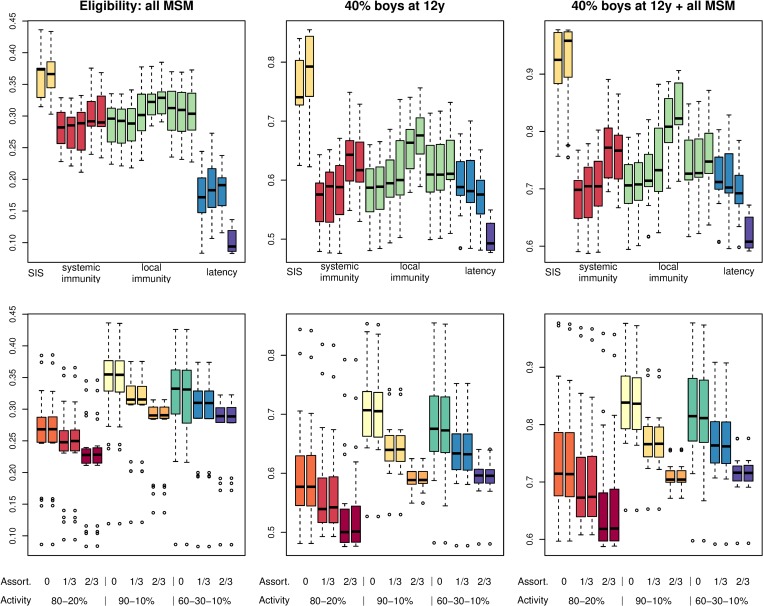
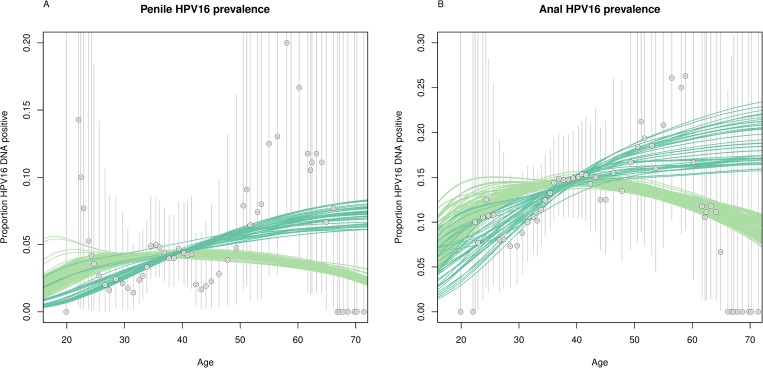
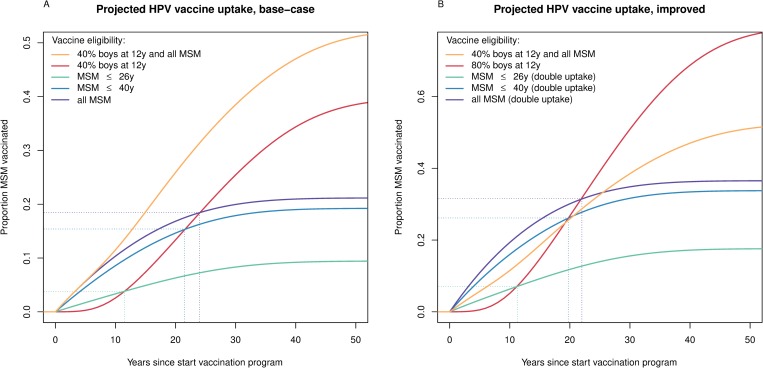
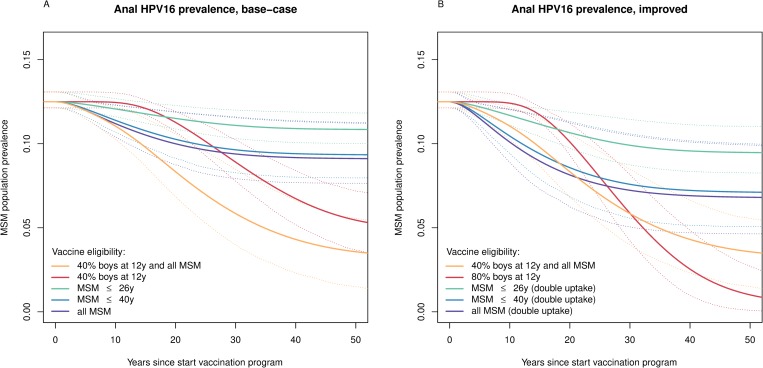
We developed a range of mathematical models for penile-anal HPV16 transmission, varying in sexual contact structure and natural history of infection, to provide robust and plausible predictions about the effectiveness of targeted vaccination. Models were informed by an observational cohort study among MSM in Amsterdam, 2010-2013. Parameters on sexual behavior and HPV16 infections were obtained by fitting the models to data from 461 HIV-negative study participants, considered representative of the local MSM population. We assumed 85% efficacy of vaccination against future HPV16 infections as reported for HIV-negative MSM, and age-specific uptake rates similar to those for hepatitis B vaccination among MSM in the Netherlands. Targeted vaccination was contrasted with vaccination of 12-year-old boys at 40% uptake in base-case scenarios, and we also considered the effectiveness of a combined strategy. Offering vaccine to MSM without age restrictions resulted in a model-averaged 27.3% reduction (90% prediction interval [PI] 11.9%-37.5%) in prevalence of anal HPV16 infections, assuming similar uptake among MSM as achieved for hepatitis B vaccination. The predicted reduction improved to 46.1% (90% PI 21.8%-62.4%) if uptake rates among MSM were doubled. The reductions in HPV16 infection prevalence were mostly achieved within 30 years of a targeted immunization campaign, during which they exceeded those induced by vaccinating 40% of preadolescent boys, if started simultaneously. The reduction in anal HPV16 prevalence amounted to 74.8% (90% PI 59.8%-93.0%) under a combined vaccination strategy. HPV16 prevalence reductions mostly exceeded vaccine coverage projections among MSM, illustrating the efficiency of prophylactic immunization even when the HPV vaccine is given after sexual debut. Mode of protection was identified as the key limitation to potential effectiveness of targeted vaccination, as the projected reductions were strongly reduced if we assumed no protection against future infections in recipients with prevalent infection or infection-derived immunity at the time of immunization. Unverified limitations of our study include the sparsity of data to inform the models, the omission of oral sex in transmission to the penile or anal site, and the restriction that our modeling results apply primarily to HIV-negative MSM.
Our findings suggest that targeted vaccination may generate considerable reductions in anogenital HPV16 infections among MSM, and has the potential to accelerate anal cancer prevention, especially when combined with sex-neutral vaccination in preadolescence.
男男性行为者(MSM)发生肛门癌的风险很高,主要与人类乳头瘤病毒基因型 16(HPV16)感染有关。在荷兰,每年每 10 万人中有 8.5 例肛门癌,MSM 的发病率与成年女性宫颈癌的发病率相似。然而,大多数 HPV 疫苗接种计划都不包括 MSM。我们探讨了预防性免疫接种在降低荷兰 MSM 肛门生殖器 HPV16 传播方面的潜在有效性。
我们为阴茎肛门 HPV16 传播开发了一系列数学模型,这些模型在性接触结构和感染自然史方面存在差异,从而对有针对性的疫苗接种的有效性提供了稳健且合理的预测。模型以阿姆斯特丹的 MSM 进行的一项观察性队列研究为依据,研究时间为 2010 年至 2013 年。通过将模型拟合到 461 名 HIV 阴性研究参与者的数据中,获得了性行为和 HPV16 感染方面的参数,这些参与者被认为代表了当地 MSM 人群。我们假设疫苗对未来 HPV16 感染的有效性为 85%,与荷兰 MSM 中乙型肝炎疫苗接种的年龄特异性接种率相似。在基本情况下,将疫苗接种与 12 岁男孩接种(接种率为 40%)进行了对比,我们还考虑了联合策略的有效性。为无年龄限制的 MSM 提供疫苗接种,假设 MSM 接种率与乙型肝炎疫苗接种相似,模型平均可降低肛门 HPV16 感染率 27.3%(90%预测区间 [PI] 11.9%-37.5%)。如果 MSM 中的接种率提高一倍,则预测的减少量可提高至 46.1%(90%PI 21.8%-62.4%)。HPV16 感染率的降低主要在有针对性的免疫接种活动开始后的 30 年内实现,在此期间,如果同时开始对 40%的青春期前男孩进行疫苗接种,则降低幅度超过了这种疫苗接种。在联合疫苗接种策略下,HPV16 流行率降低了 74.8%(90%PI 59.8%-93.0%)。在 MSM 中,HPV16 流行率的降低大多超过了疫苗接种覆盖率的预测,这表明预防性免疫接种的效率很高,即使 HPV 疫苗是在性活跃期之后接种的。保护模式被确定为有针对性的疫苗接种潜在有效性的关键限制因素,因为如果我们假设在免疫接种时,具有现有感染或感染衍生免疫力的受种者对未来感染没有保护作用,则预计的减少幅度将大大降低。我们研究的未经证实的局限性包括为模型提供信息的数据稀疏,在向阴茎或肛门部位传播时忽略了口交,以及我们的建模结果主要适用于 HIV 阴性 MSM。
我们的研究结果表明,有针对性的疫苗接种可能会在 MSM 中减少肛门生殖器 HPV16 感染,并且具有加速预防肛门癌的潜力,特别是与青春期前的中性疫苗接种相结合时。