Kenya Medical Research Institute-Wellcome Trust Research Programme, Centre for Geographic Medicine Research- Coast, Kilifi.
Nuffield Department of Clinical Medicine, University of Oxford, United Kingdom.
Clin Infect Dis. 2019 Aug 16;69(5):751-759. doi: 10.1093/cid/ciy976.
Infections caused by extended-spectrum β-lactamase-producing Enterobacterales (ESBL-E) among hospitalized neonates in sub-Saharan Africa pose significant clinical challenges. Data on prevalence and acquisition of ESBL-E carriage among hospitalized neonates in the region are few, and risk factors for transmission are not clearly defined.
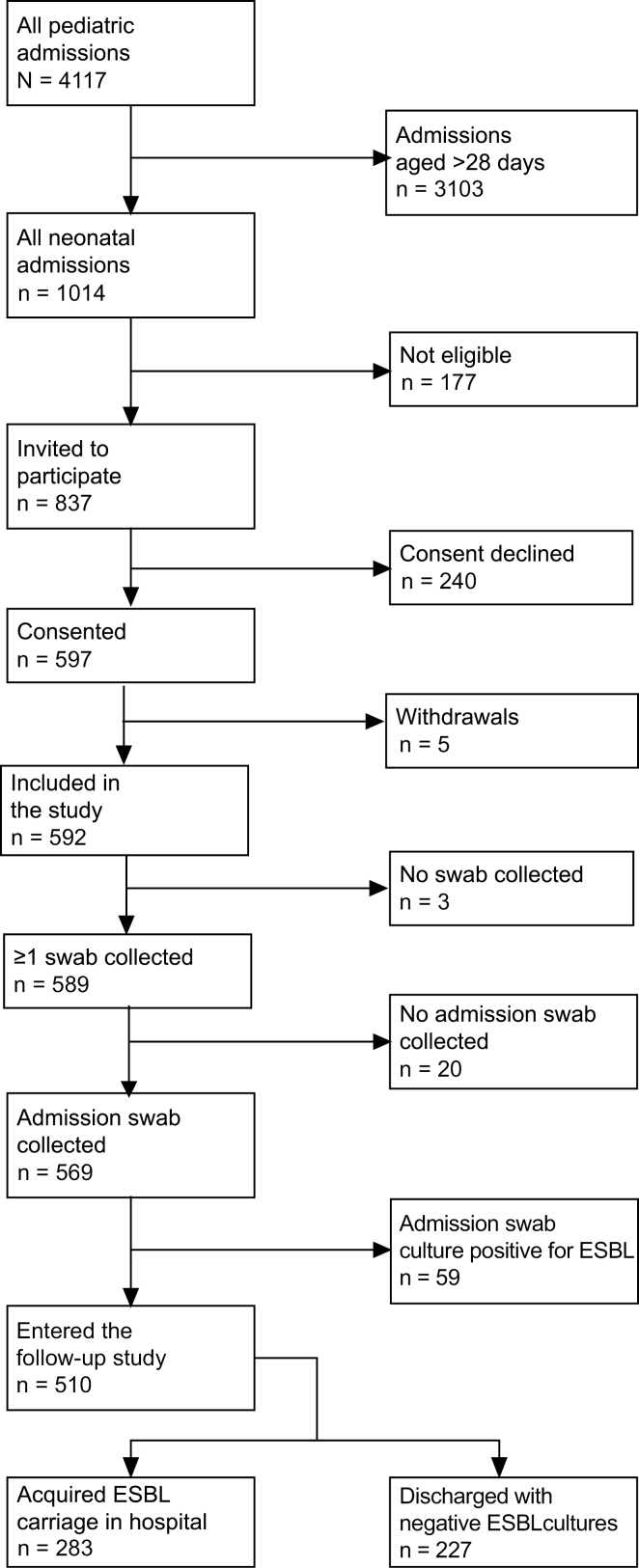
In a cohort study of consecutive neonatal admissions to Kilifi County Hospital from July 2013 through August 2014, we estimated ESBL-E carriage prevalence on admission using rectal swab cultures and identified risk factors using logistic regression. Using twice-weekly follow-up swabs, we estimated the incidence and identified risk factors for ESBL-E acquisition in hospital using Poisson regression.
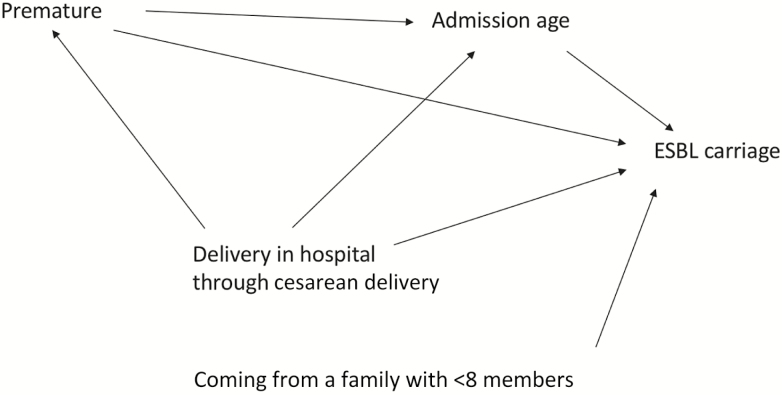
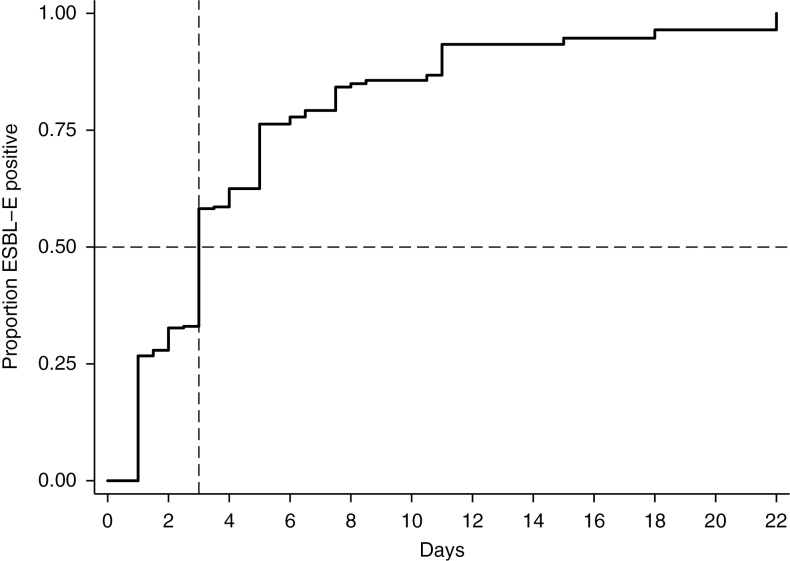
The prevalence of ESBL-E carriage at admission was 10% (59/569). Cesarean delivery, older neonatal age, and smaller household size were significant risk factors. Of the 510 infants admitted without ESBL-E carriage, 238 (55%) acquired carriage during their hospital stay. The incidence of acquisition was 21.4% (95% confidence interval, 19.0%-24.0%) per day. The rate was positively associated with the number of known neonatal ESBL-E carriers and with the total number of neonates on the same ward.
Carriage of ESBL-E was common among neonates on admission, and in-hospital acquisition was rapid. The dissemination and selection of ESBL-E appears to be driven by hospital exposures, operative delivery, and neonatal ward patient density. Further attention to infection control, patient crowding, and carriage surveillance is warranted.
在撒哈拉以南非洲,住院新生儿中由产超广谱β-内酰胺酶肠杆菌科(ESBL-E)引起的感染带来了重大的临床挑战。该地区住院新生儿中 ESBL-E 带菌率的相关数据很少,且传播的危险因素尚未明确。
在 2013 年 7 月至 2014 年 8 月对肯尼亚基利菲县医院连续收治的新生儿进行的一项队列研究中,我们通过直肠拭子培养来估计入院时 ESBL-E 带菌率,并使用逻辑回归来确定危险因素。通过每周两次的随访拭子,我们使用泊松回归来估计院内 ESBL-E 获得的发生率和确定危险因素。
入院时 ESBL-E 带菌率为 10%(59/569)。剖宫产分娩、新生儿年龄较大和家庭规模较小是显著的危险因素。在 510 名入院时无 ESBL-E 带菌的婴儿中,有 238 名(55%)在住院期间获得了带菌。获得带菌的发生率为每天 21.4%(95%置信区间,19.0%-24.0%)。该比率与已知的新生儿 ESBL-E 带菌者数量以及同一病房的新生儿总数呈正相关。
入院时,ESBL-E 的携带很常见,院内获得性感染迅速。ESBL-E 的传播和选择似乎是由医院暴露、剖宫产分娩和新生儿病房患者密度驱动的。需要进一步关注感染控制、患者拥挤和带菌监测。