School of Reliability and Systems Engineering, Beihang University, 37 Xueyuan Rd., Haidian Dist., Beijing 100191, China.
School of Energy and Power Engineering, Beihang University, 37 Xueyuan Rd., Haidian Dist., Beijing 100191, China.
Sensors (Basel). 2019 Mar 1;19(5):1056. doi: 10.3390/s19051056.
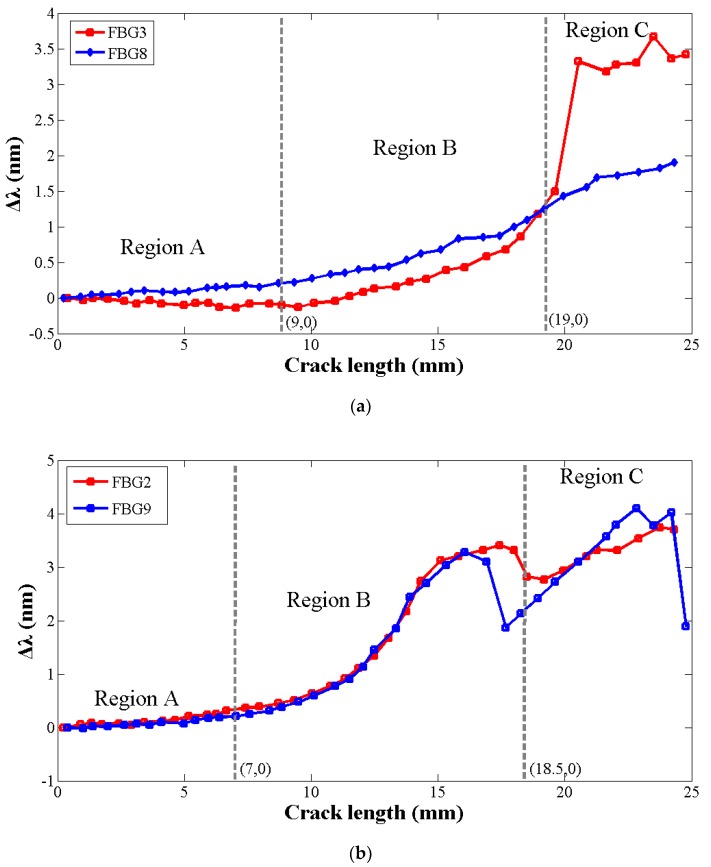
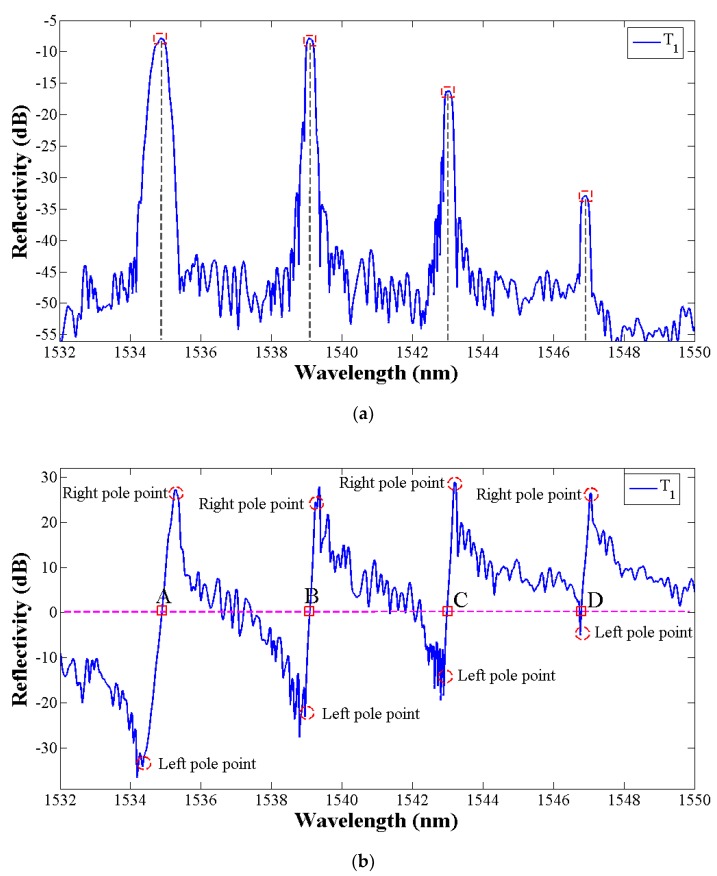
We propose a peak seeking algorithm to extract the damage characteristic-variation of central wavelength to monitor the crack damage status in aluminum alloy plates using surface bonded fiber Bragg grating (FBG) sensors. The FBG sensors are sensitive to the uniform and non-uniform strain distribution along their longitudinal direction, and the effect appears in the power spectrum of the reflected light from the gauge section. In this paper, we propose a fast-self-adaptive multi-peak seeking algorithm to detect the central wavelength shifting of the FBG reflection spectrum with the crack propagation. The proposed peak searching algorithm results point to a significant improvement compared to other conventional methods. Then the central wavelength shifting is applied to explain the crack propagation behavior of the aluminum plates under quasi-static tensile test conditions. The different damages feature changing intervals which are associated with the crack position and the FBGs location, demonstrating that central wavelength shifting performs as an indicator to detect structural crack damage.
我们提出了一种峰值搜索算法,以提取损伤特征-中心波长的变化,使用表面粘贴光纤布拉格光栅(FBG)传感器监测铝合金板的裂纹损伤状态。FBG 传感器对其纵向的均匀和非均匀应变分布敏感,这种效应出现在传感器测量段反射光的功率谱中。在本文中,我们提出了一种快速自适应多峰搜索算法,以检测 FBG 反射光谱的中心波长随裂纹扩展的移动。与其他传统方法相比,所提出的峰值搜索算法的结果有了显著的改进。然后将中心波长的移动应用于解释在准静态拉伸试验条件下铝合金板的裂纹扩展行为。不同的损伤特征变化区间与裂纹位置和 FBG 位置有关,这表明中心波长的移动可以作为检测结构裂纹损伤的指标。