Świercz Rafał, Oniszczuk-Świercz Dorota
Institute of Manufacturing Technology, Warsaw University of Technology, 00-661 Warsaw, Poland.
Nanomaterials (Basel). 2019 Mar 2;9(3):335. doi: 10.3390/nano9030335.
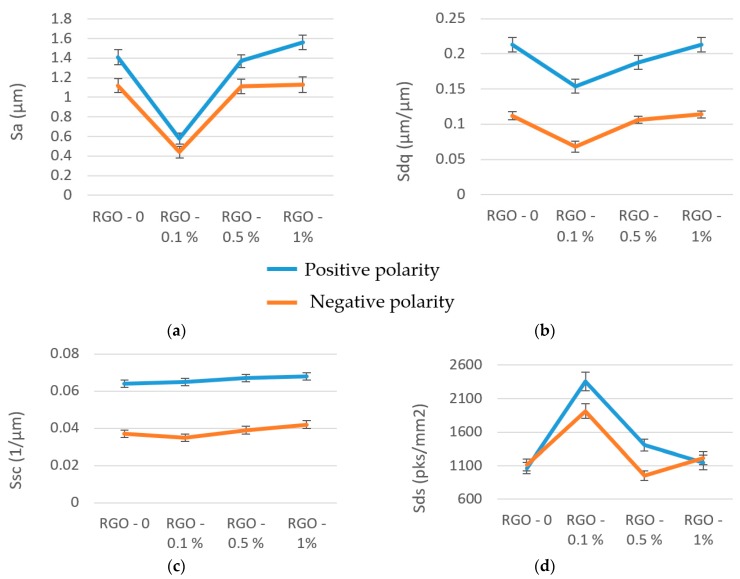
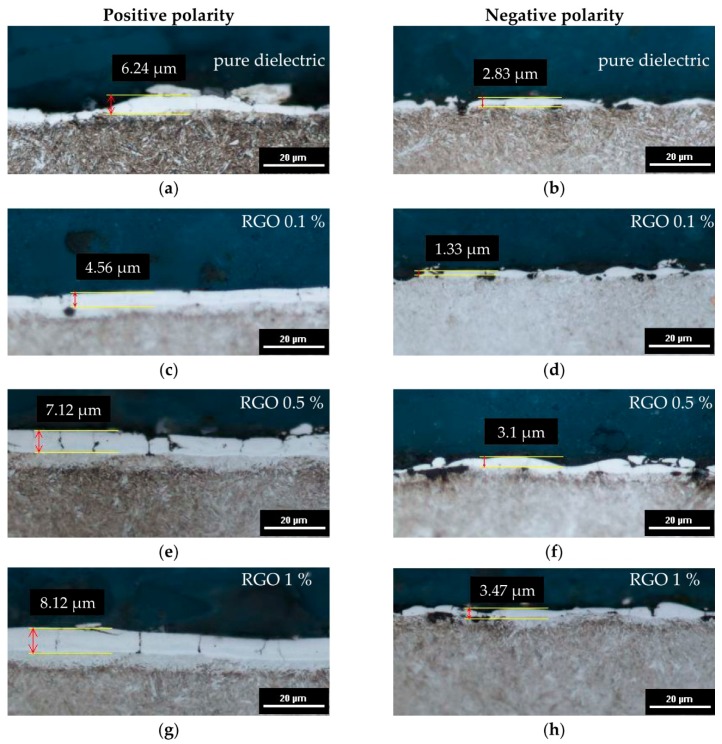
Electrical discharge machining (EDM) is a nonconventional technology that is frequently used in manufacturing for difficult-to-cut conductive materials. Drawbacks to using EDM include the resulting surface roughness and integrity. One of the recent innovations for improving surface integrity with EDM is the use of a powder mixed dielectric. The aim of this study is to analyze the influence of having reduced graphene oxide (RGO) in the dielectric on the ionization of the plasma channel and the dispersion of electrical discharges. The main goal is to improve the surface integrity of the tool steel 55NiCrMoV7 during finishing machining. To achieve this goal, an experimental investigation was carried out to establish the smallest possible values of discharge current and pulse time at which it is possible to initiate an electric discharge, which causes material removal. Next, the effect of the direction of the electric discharges (electrode polarity) and the concentration (percentage) of RGO in the dielectric on surface integrity was investigated. The results of this experiment indicate that during EDM with RGO, the discharges are dispersed on the RGO flakes. This leads to a multiplication of the discharges during a single pulse, and this strongly affects the surface integrity. The obtained results indicate that it is possible to reduce surface roughness and thickness of the recast layer by approximately 2.5 times compared with conventional EDM.
电火花加工(EDM)是一种非常规技术,常用于制造难切削的导电材料。使用电火花加工的缺点包括产生的表面粗糙度和表面完整性。最近,利用电火花加工改善表面完整性的一项创新是使用粉末混合电介质。本研究的目的是分析电介质中还原氧化石墨烯(RGO)对等离子体通道电离和放电分散的影响。主要目标是在精加工过程中提高55NiCrMoV7工具钢的表面完整性。为实现这一目标,进行了一项实验研究,以确定能够引发导致材料去除的放电的最小放电电流和脉冲时间值。接下来,研究了放电方向(电极极性)和电介质中RGO的浓度(百分比)对表面完整性的影响。该实验结果表明,在使用RGO的电火花加工过程中,放电分散在RGO薄片上。这导致单个脉冲期间放电次数增加,这对表面完整性有很大影响。所得结果表明,与传统电火花加工相比,可将表面粗糙度和重铸层厚度降低约2.5倍。