Strathclyde Institute of Pharmacy and Biomedical Sciences, University of Strathclyde, 40 Taylor Street, Robertson Trust Wing, Glasgow, G4 0RE, UK.
Information Services Division, NHS National Services Scotland, Gyle Square, 1 South Gyle Crescent, Edinburgh, EH12 9EB, UK.
Implement Sci. 2019 Mar 4;14(1):21. doi: 10.1186/s13012-019-0867-5.
To meet emergent healthcare needs, innovations need to be implemented into routine clinical practice. Community pharmacy is increasingly considered a setting through which innovations can be implemented to achieve positive service and clinical outcomes. Small-scale pilot programmes often need scaled up nation-wide to affect population level change. This systematic review aims to identify facilitators and barriers to the national implementation of community pharmacy innovations.
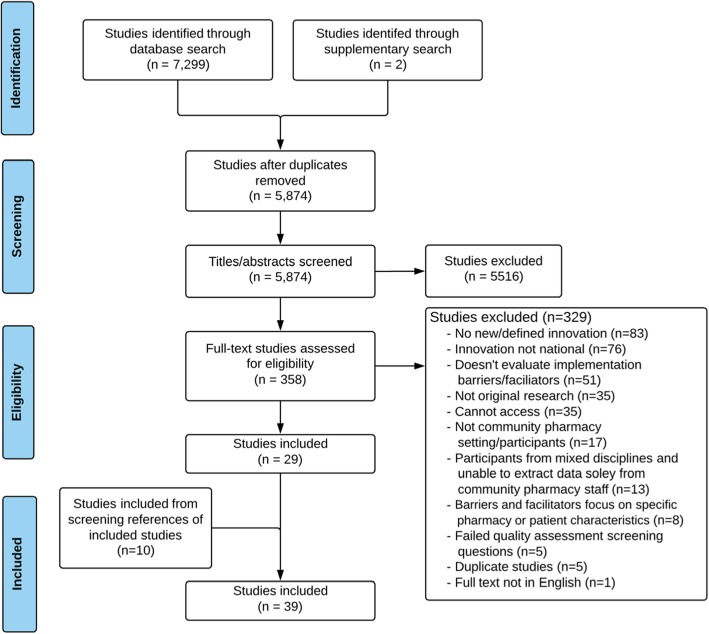
A systematic review exploring pharmacy staff perspectives of the barriers and facilitators to implementing innovations at a national level was conducted. The databases Medline, EMBASE, PsycINFO, CINAHL, and Open Grey were searched and supplemented with additional search mechanisms such as Zetoc alerts. Eligible studies underwent quality assessment, and a directed content analysis approach to data extraction was conducted and aligned to the Consolidated Framework for Implementation Research (CFIR) to facilitate narrative synthesis.
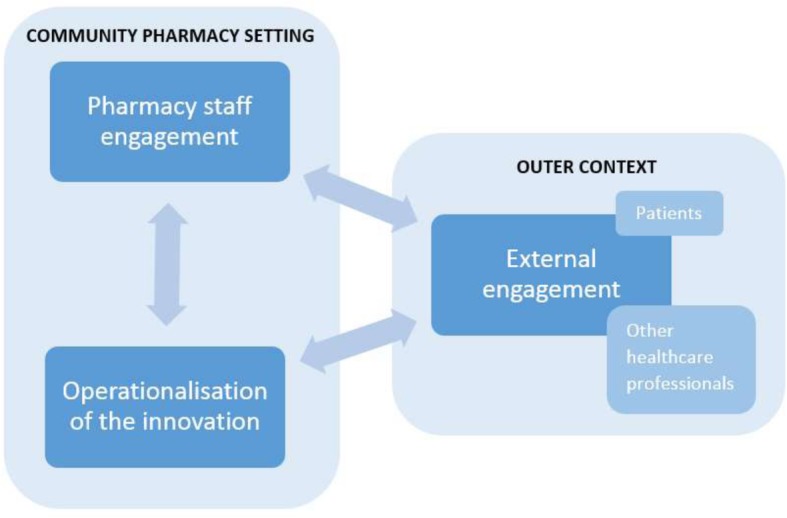
Thirty-nine studies were included: 16 were qualitative, 21 applied a questionnaire design, and 2 were mixed methods. Overarching thematic areas spanning across the CFIR domains were pharmacy staff engagement (e.g. their positive and negative perceptions), operationalisation of innovations (e.g. insufficient resources and training), and external engagement (e.g. the perceptions of patients and other healthcare professionals, and their relationship with the community pharmacy). Study participants commonly suggested improvements in the training offered, in the engagement strategies adopted, and in the design and quality of innovations.
This study's focus on national innovations resulted in high-level recommendations to facilitate the development of successful national implementation strategies. These include (1) more robust piloting of innovations, (2) improved engagement strategies to increase awareness and acceptance of innovations, (3) promoting whole-team involvement within pharmacies to overcome time constraints, and (4) sufficient pre-implementation evaluation to gauge acceptance and appropriateness of innovations within real-world settings. The findings highlight the international challenge of balancing the professional, clinical, and commercial obligations within community pharmacy practice. A preliminary theory of how salient factors influence national implementation in the community pharmacy setting has been developed, with further research necessary to understand how the influence of these factors may differ within varying contexts.
A protocol for this systematic review was developed and uploaded onto the PROSPERO international prospective register of systematic reviews database (Registration number: CRD42016038876 ).
为了满足紧急的医疗保健需求,需要将创新实施到常规临床实践中。社区药房越来越被认为是一种可以实施创新以实现积极的服务和临床结果的环境。小规模试点项目通常需要在全国范围内扩大规模,以影响人口层面的变化。本系统评价旨在确定在全国范围内实施社区药房创新的促进因素和障碍。
本系统评价旨在探索药房工作人员对在全国范围内实施创新的障碍和促进因素的看法。检索了 Medline、EMBASE、PsycINFO、CINAHL 和 Open Grey 数据库,并辅以 Zetoc 警报等其他搜索机制。合格的研究进行了质量评估,并采用定向内容分析方法提取数据,并与实施研究综合框架(CFIR)对齐,以促进叙述性综合。
共纳入 39 项研究:16 项为定性研究,21 项采用问卷调查设计,2 项为混合方法。跨越 CFIR 领域的总体主题领域包括药房工作人员的参与度(例如他们的积极和消极看法)、创新的运作(例如资源和培训不足)以及外部参与度(例如患者和其他医疗保健专业人员的看法及其与社区药房的关系)。研究参与者通常建议改进提供的培训、采用的参与策略,以及创新的设计和质量。
本研究侧重于国家创新,提出了促进成功的国家实施策略的高层次建议。这些建议包括:(1)更严格地试点创新,(2)改进参与策略以提高对创新的认识和接受度,(3)促进药房内整个团队的参与,以克服时间限制,(4)在实施前进行充分评估,以衡量创新在现实环境中的接受程度和适宜性。研究结果突显了在社区药房实践中平衡专业、临床和商业义务的国际挑战。已经初步提出了一个关于突出因素如何影响社区药房设置中国家实施的理论,需要进一步研究以了解这些因素的影响在不同背景下可能会有何不同。
本系统评价的方案已制定并上传至 PROSPERO 国际前瞻性系统评价注册数据库(注册号:CRD42016038876)。