Division of Research, Kaiser Permanente Northern California, Pleasanton, CA, USA.
The Permanente Medical Group, Pleasanton, CA, USA.
BMC Health Serv Res. 2024 Nov 21;24(1):1446. doi: 10.1186/s12913-024-11803-5.
Broad-scale, rapid health care change is critically needed to improve value-based, effective health care. Health care providers and systems need to address common barriers and facilitators across the evidence to implementation pathway, across diverse specialties. However, most evidence translation / implementation research evaluates single topic areas, and may be of limited value for informing comprehensive efforts. This project's objective was to identify, characterize, and illustrate common trans-topic facilitators and barriers of translating new health care evidence results to clinical implementation across multiple medical specialties.
This study was an evaluation of all evidence-based innovation projects completed during 2019-2021. Each project was created with medical group clinical leaders and was intended to inform clinical care. The evaluation took place in a large community-based integrated health care system, and an embedded delivery science and applied research program. Clinical investigators, scientific investigators, and clinical operational leaders received structured questionnaires regarding barriers and facilitators for the operational implementation of new research findings for each project. Responses were mapped to the Consolidated Framework for Implementation Research to identify perceived implementation barriers and facilitators.
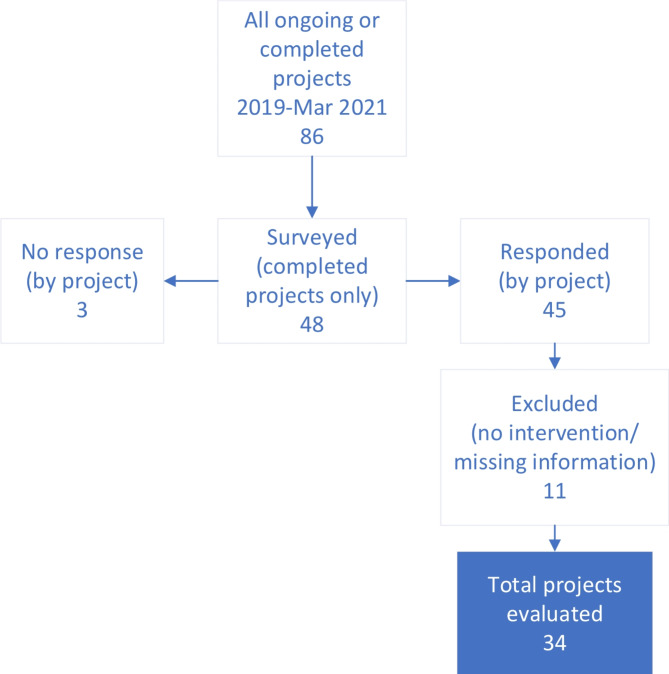
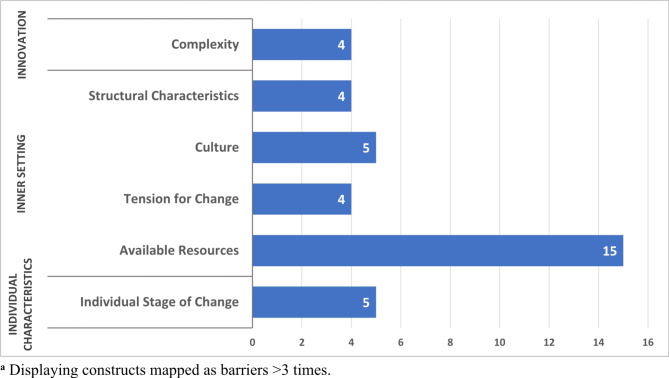
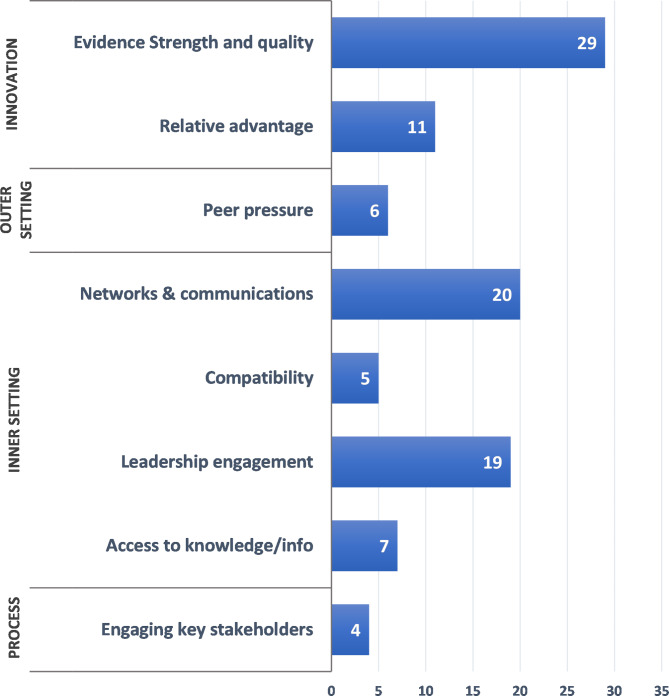
All 48 projects completed between 2019 and 2021 were evaluated; responses were received for 45 (94%) and 34 had comments mappable to framework domains. Potential barriers and facilitators to clinical implementation of new research results were identified across all five framework domains and, within these, the 38 constructs or sub-constructs. Among 245 total comments, the most commonly cited facilitators were how the new research evidence generated, compelled change (n = 29), specialty communication networks for disseminating results and initiating change (n = 20), leadership engagement in the project (n = 19), and the innovation's relative advantage over existing practices (n = 11). The most commonly cited barriers were inadequate resource commitment for next-step implementation (n = 15), insufficient learning/implementation culture (n = 5), and insufficient individual-level willingness/ability for change (n = 5).
A novel large-scale evaluation of barriers and facilitators across the evidence to implementation pathway identified common factors across multiple topic areas and specialties. These common potentially replicable facilitators and modifiable barriers can focus health systems and leaders pursuing large-volume evidence-to-implementation initiatives on those areas with the likely greatest benefit-for-effort, for accelerating health care change.
为了改善基于价值的有效医疗保健,迫切需要大规模、快速的医疗保健变革。医疗保健提供者和系统需要解决整个证据实施途径中不同专业的常见障碍和促进因素。然而,大多数证据转化/实施研究评估单一主题领域,对于全面努力的信息可能价值有限。本项目的目标是确定、描述和说明将新的医疗保健证据结果转化为跨多个医学专业的临床实施的跨主题促进因素和障碍。
本研究是对 2019-2021 年期间完成的所有循证创新项目的评估。每个项目都是由医疗集团临床领导者创建的,旨在为临床护理提供信息。评估发生在一个大型社区综合医疗保健系统中,以及一个嵌入式交付科学和应用研究计划中。临床研究人员、科学研究人员和临床运营领导者收到了关于每个项目新研究结果的运营实施的障碍和促进因素的结构化问卷。回复被映射到整合实施研究框架,以确定感知到的实施障碍和促进因素。
评估了 2019 年至 2021 年期间完成的所有 48 个项目;收到了 45 个(94%)的回复,34 个回复有可映射到框架域的评论。在所有五个框架域内,以及这些域内的 38 个构建体或子构建体中,都确定了新研究结果临床实施的潜在障碍和促进因素。在 245 条总计评论中,最常被引用的促进因素是新研究证据的产生如何促使变革(n=29),用于传播结果和发起变革的专业沟通网络(n=20),项目中的领导参与(n=19),以及创新相对于现有实践的相对优势(n=11)。最常被引用的障碍是下一阶段实施的资源承诺不足(n=15),学习/实施文化不足(n=5),以及个人层面的变革意愿/能力不足(n=5)。
对证据实施途径中障碍和促进因素的一项新颖的大规模评估确定了多个主题领域和专业的共同因素。这些常见的潜在可复制促进因素和可修改障碍可以使卫生系统和领导者专注于那些最有可能获得最大效益的领域,从而加速医疗保健变革。