Centre for Research and Development of Medical Diagnostic Laboratories, Faculty of Associated Medical Sciences, Khon Kaen University, Khon Kaen, 40002, Thailand.
Biomedical Sciences, Graduate School, Khon Kaen University, Khon Kaen, 40002, Thailand.
Clin Epigenetics. 2019 Mar 4;11(1):39. doi: 10.1186/s13148-019-0634-0.
Cholangiocarcinoma (CCA) is a fatal cancer of the bile duct epithelial cell lining. The misdiagnosis of CCA and other biliary diseases may occur due to the similarity of clinical manifestations and blood tests resulting in inappropriate or delayed treatment. Thus, an accurate and less-invasive method for differentiating CCA from other biliary diseases is inevitable.
We quantified methylation of OPCML, HOXA9, and HOXD9 in serum cell-free DNA (cfDNA) of CCA patients and other biliary diseases using methylation-sensitive high-resolution melting (MS-HRM). Their potency as differential biomarkers between CCA and other biliary diseases was also evaluated by using receiver operating characteristic (ROC) curves.
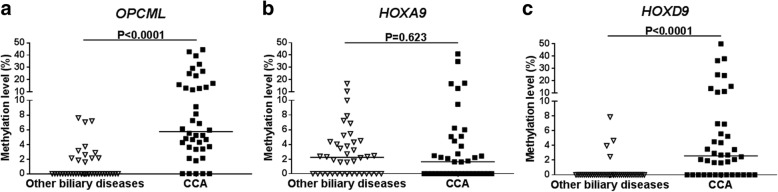
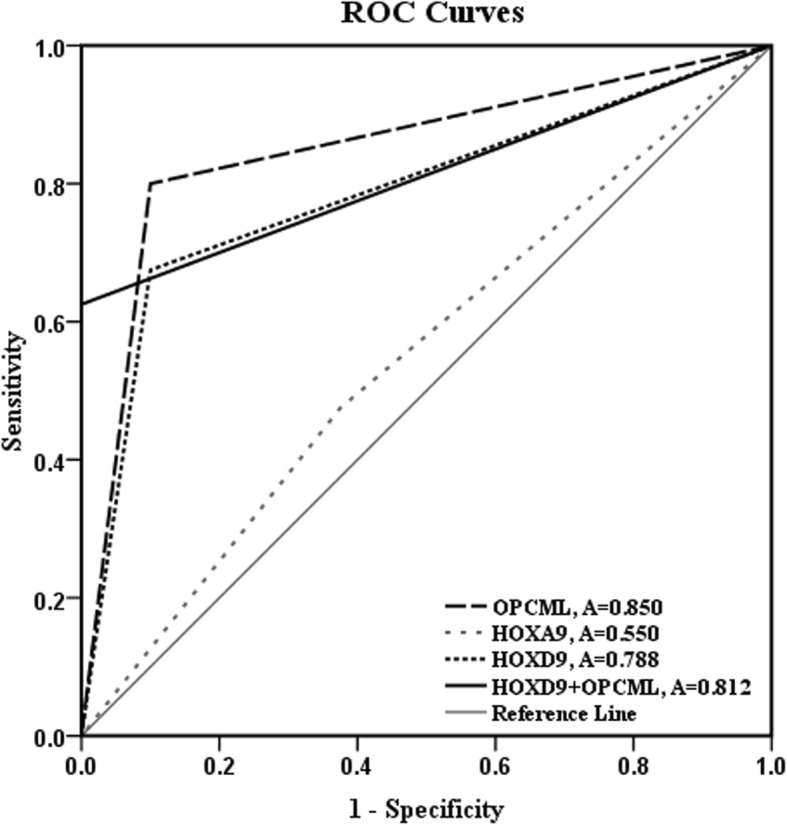
The significant difference of methylation levels of OPCML and HOXD9 was observed in serum cfDNA of CCA compared to other biliary diseases. Assessment of serum cfDNA methylation of OPCML and HOXD9 as differential biomarkers of CCA and other biliary diseases showed the area under curve (AUC) of 0.850 (0.759-0.941) for OPCML which sensitivity, specificity, positive predictive value (PPV), negative predictive value (NPV), and accuracy were 80.00%, 90.00%, 88.88%, 81.81%, and 85.00%, respectively. The AUC of HOXD9 was 0.789 (0.686-0.892) with sensitivity, specificity, PPV, NPV, and accuracy of 67.50%, 90.00%, 87.09%, 73.46%, and 78.75%, respectively. The combined marker between OPCML and HOXD9 showed sensitivity, specificity, PPV, and NPV of 62.50%, 100%, 100%, and 72.72%, respectively, which may be helpful to prevent a misdiagnosis between CCA and other biliary diseases.
Our findings suggest the application of serum cfDNA methylation of OPCML and HOXD9 for differential diagnosis of CCA and other biliary diseases due to its less invasiveness and clinically practical method which may benefit the patients by preventing the misdiagnosis of CCA and avoiding unnecessary surgical intervention.
胆管癌(CCA)是一种致命的胆管上皮细胞癌。由于临床表现和血液检查的相似性,CCA 和其他胆道疾病可能会误诊,导致治疗不当或延误。因此,需要一种准确且微创的方法来区分 CCA 与其他胆道疾病。
我们使用甲基化敏感性高分辨率熔解(MS-HRM)定量分析 CCA 患者和其他胆道疾病患者血清无细胞 DNA(cfDNA)中的 OPCML、HOXA9 和 HOXD9 的甲基化。通过接受者操作特征(ROC)曲线评估它们作为 CCA 与其他胆道疾病之间差异生物标志物的潜力。
CCA 患者血清 cfDNA 中 OPCML 和 HOXD9 的甲基化水平与其他胆道疾病有显著差异。评估 OPCML 和 HOXD9 作为 CCA 和其他胆道疾病差异生物标志物的血清 cfDNA 甲基化显示,OPCML 的曲线下面积(AUC)为 0.850(0.759-0.941),灵敏度、特异性、阳性预测值(PPV)、阴性预测值(NPV)和准确性分别为 80.00%、90.00%、88.88%、81.81%和 85.00%。HOXD9 的 AUC 为 0.789(0.686-0.892),灵敏度、特异性、PPV、NPV 和准确性分别为 67.50%、90.00%、87.09%、73.46%和 78.75%。OPCML 和 HOXD9 的组合标志物的灵敏度、特异性、PPV 和 NPV 分别为 62.50%、100%、100%和 72.72%,这可能有助于防止 CCA 和其他胆道疾病之间的误诊。
我们的研究结果表明,由于其微创性和临床实用方法,血清 cfDNA 中 OPCML 和 HOXD9 的甲基化可用于 CCA 和其他胆道疾病的鉴别诊断,通过防止 CCA 的误诊和避免不必要的手术干预,使患者受益。