Laboratory of Human Carcinogenesis, Center for Cancer Research, National Cancer Institute, Bethesda, Maryland, United States.
Department of Surgery, Division of Surgical Research, Thomas Jefferson University, Philadelphia, PA, United States.
Sci Rep. 2019 Mar 4;9(1):3369. doi: 10.1038/s41598-019-39727-9.
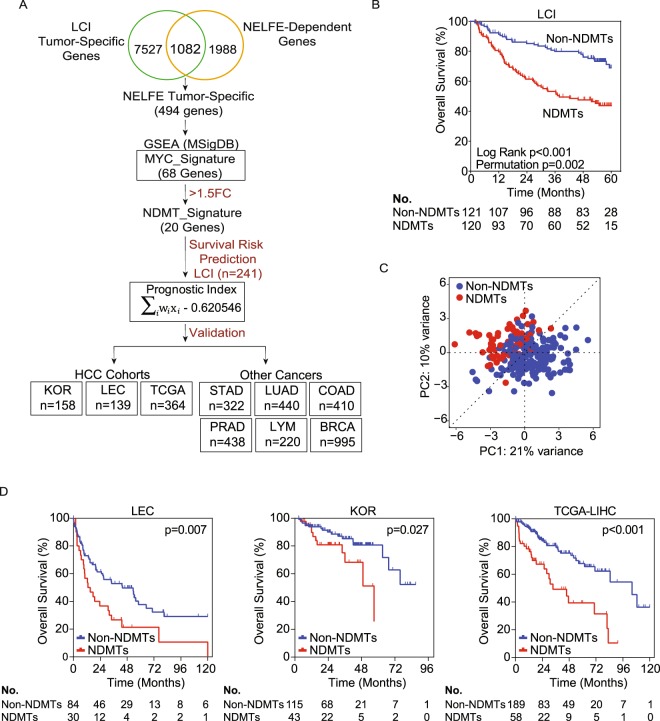
The MYC oncogene is dysregulated in approximately 30% of liver cancer. In an effort to exploit MYC as a therapeutic target, including in hepatocellular carcinoma (HCC), strategies have been developed on the basis of MYC amplification or gene translocation. Due to the failure of these strategies to provide accurate diagnostics and prognostic value, we have developed a Negative Elongation Factor E (NELFE)-Dependent MYC Target (NDMT) gene signature. This signature, which consists of genes regulated by MYC and NELFE, an RNA binding protein that enhances MYC-induced hepatocarcinogenesis, is predictive of NELFE/MYC-driven tumors that would otherwise not be identified by gene amplification or translocation alone. We demonstrate the utility of the NDMT gene signature to predict a unique subtype of HCC, which is associated with a poor prognosis in three independent cohorts encompassing diverse etiologies, demographics, and viral status. The application of gene signatures, such as the NDMT signature, offers patients access to personalized risk assessments, which may be utilized to direct future care.
MYC 癌基因在大约 30%的肝癌中失调。为了将 MYC 作为治疗靶点进行利用,包括在肝细胞癌 (HCC) 中,已经基于 MYC 扩增或基因易位开发了各种策略。由于这些策略未能提供准确的诊断和预后价值,我们开发了一种依赖于负延伸因子 E (NELFE) 的 MYC 靶标 (NDMT) 基因特征。该特征由 MYC 和 NELFE 调节的基因组成,NELFE 是一种 RNA 结合蛋白,可增强 MYC 诱导的肝癌发生,可预测 NELFE/MYC 驱动的肿瘤,如果仅通过基因扩增或易位则无法识别这些肿瘤。我们证明了 NDMT 基因特征在预测 HCC 的独特亚型方面的效用,该亚型与三个独立队列中的不良预后相关,这些队列涵盖了不同的病因、人口统计学和病毒状态。基因特征的应用,如 NDMT 特征,可以为患者提供个性化的风险评估,这可能用于指导未来的治疗。