Institute of Medical Statistics and Computational Biology, Faculty of Medicine, University of Cologne, Kerpener Straße 62, 50937 Cologne, Germany.
CRI - Clinical Research International Ltd., Genter Str. 7, 50672 Cologne, Germany.
Biomed Res Int. 2019 Jan 31;2019:7945091. doi: 10.1155/2019/7945091. eCollection 2019.
This study investigated an inhalation solution containing ectoine, a bacterial-derived extremolyte, for the treatment of acute bronchitis and acute respiratory infections in comparison with saline inhalation solution.
This prospective, controlled, observational study comprised an inclusion visit (day 1), a final visit (day 7), and a follow-up questionnaire (day 17). The treatment itself was administered from day 1 to day 7. The Bronchitis Severity Score, patients' general health, general effectiveness of the treatment, tolerability, and adverse events were compared between two groups.
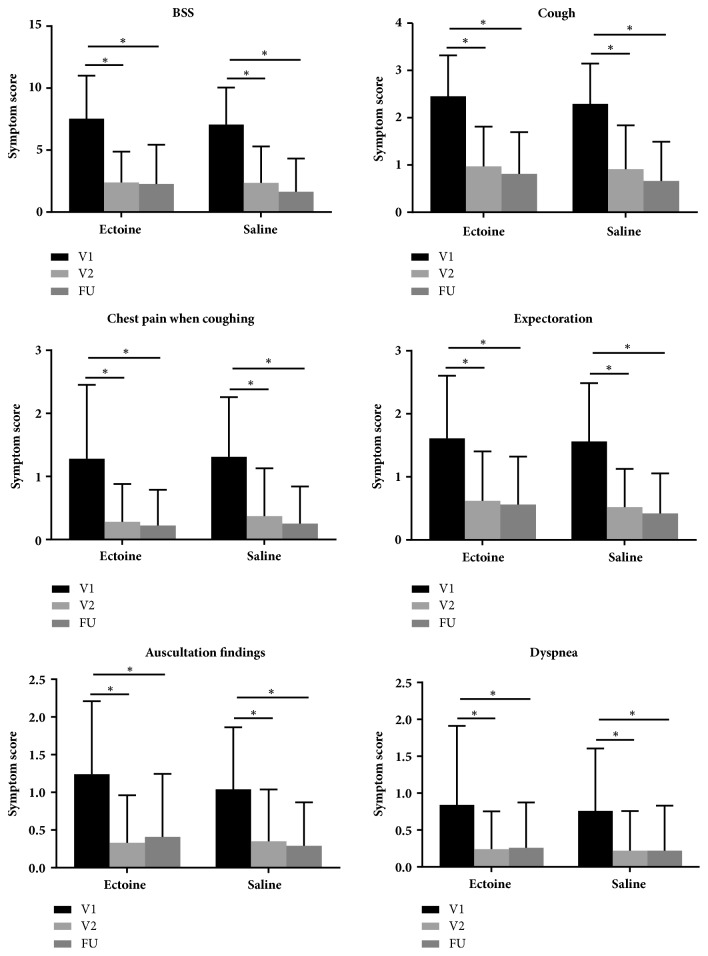
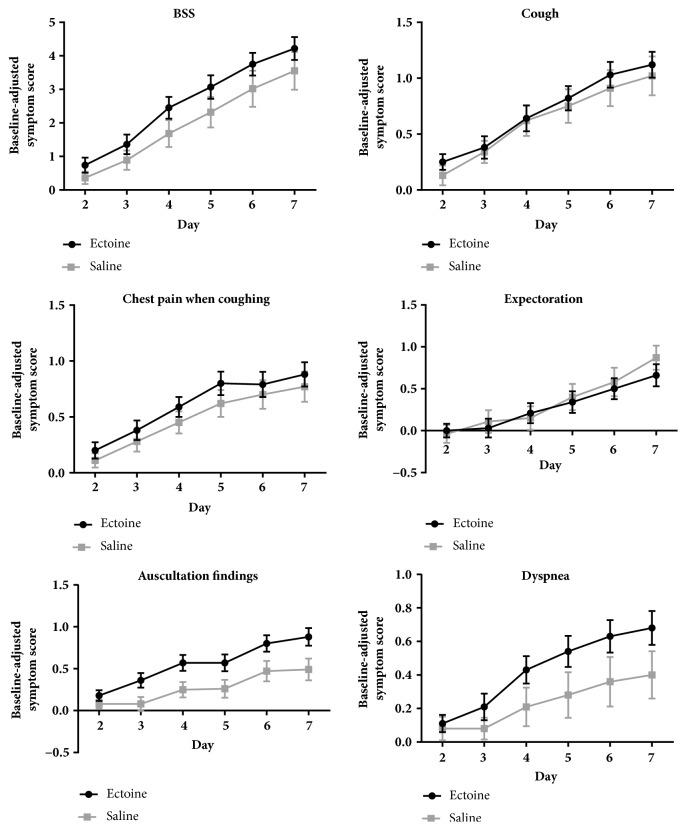
In total, 135 patients were recruited; 79 patients received ectoine inhalation solution and 56 saline inhalation solution. After treatment, symptom scores decreased significantly in both groups ( < 0.05); the reduction in symptom scores was slightly greater in the ectoine group than in the saline group. The first significant reduction in symptom scores ( < 0.05) occurred earlier in the ectoine group than in the saline group. The differences in the area under the curve for the symptoms of dyspnea and auscultation findings were significant in favor of ectoine ( < 0.05). After treatment, more patients and physicians in the ectoine group assessed their or their patients' condition as "completely recovered" or "greatly improved" than those in the saline group. Almost all patients and physicians assessed the tolerability of both treatments as "good" or "very good".
Ectoine inhalation solution seems to be slightly more effective than saline inhalation solution for the treatment of acute bronchitis and acute respiratory infections.
本研究调查了一种含有海藻糖的吸入溶液,这是一种细菌衍生的极端溶质,用于治疗急性支气管炎和急性呼吸道感染,并与盐水吸入溶液进行比较。
这是一项前瞻性、对照、观察性研究,包括纳入访问(第 1 天)、最终访问(第 7 天)和随访问卷(第 17 天)。治疗本身从第 1 天到第 7 天进行。比较两组患者的支气管炎严重程度评分、一般健康状况、治疗总体效果、耐受性和不良事件。
共有 135 名患者入选,79 名患者接受海藻糖吸入溶液治疗,56 名患者接受盐水吸入溶液治疗。治疗后,两组症状评分均显著下降(<0.05);海藻糖组的症状评分下降幅度略大于盐水组。在海藻糖组,症状评分的首次显著下降(<0.05)早于盐水组。在呼吸困难症状和听诊结果的曲线下面积方面,海藻糖组的差异具有统计学意义(<0.05)。治疗后,海藻糖组有更多的患者和医生评估其或其患者的病情为“完全恢复”或“大大改善”,而盐水组则较少。几乎所有患者和医生都将两种治疗方法的耐受性评估为“良好”或“非常好”。
海藻糖吸入溶液在治疗急性支气管炎和急性呼吸道感染方面似乎比盐水吸入溶液略有效。