Research Department, Shriners Hospitals for Children - Cincinnati, Cincinnati, Ohio, United States of America.
Department of Surgery, University of Cincinnati College of Medicine, Cincinnati, Ohio, United States of America.
PLoS One. 2019 Mar 5;14(3):e0213325. doi: 10.1371/journal.pone.0213325. eCollection 2019.
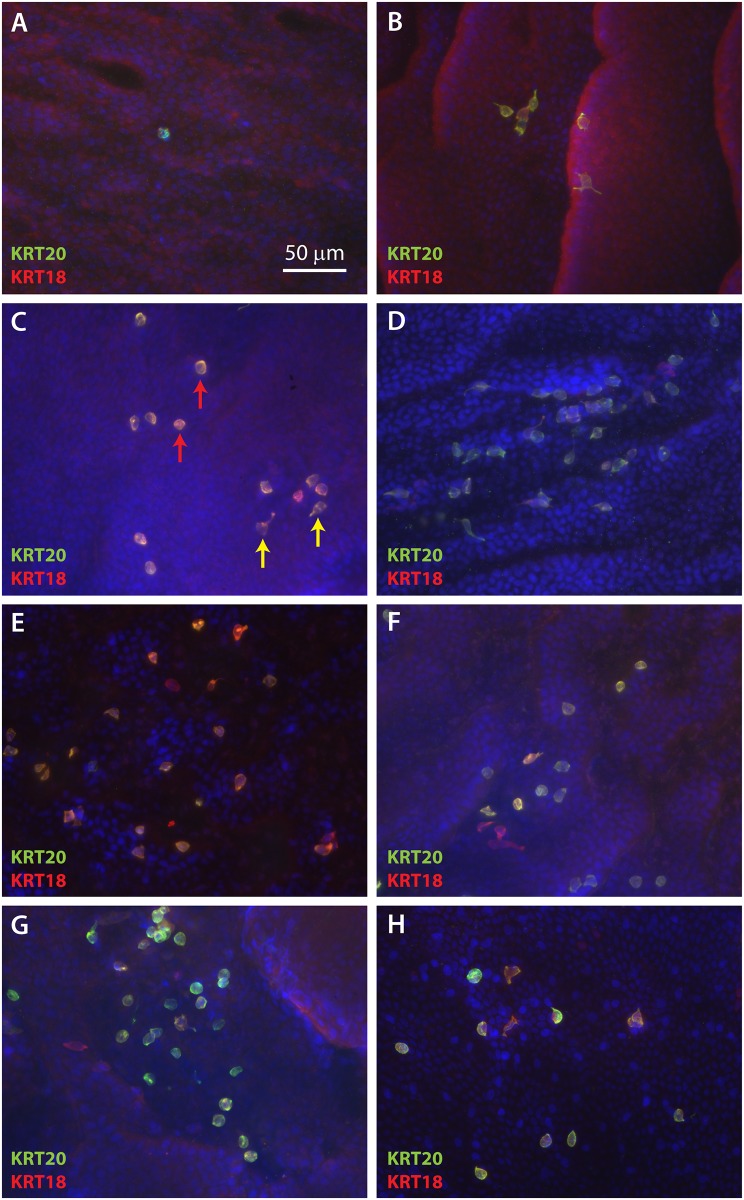
Engineered skin substitutes (ESS), prepared using primary human fibroblasts and keratinocytes with a biopolymer scaffold, were shown to provide stable closure of excised burns, but relatively little is known about innervation of ESS after grafting. This study investigated innervation of ESS and, specifically, whether Merkel cells are present in healed grafts. Merkel cells are specialized neuroendocrine cells required for fine touch sensation in skin. We discovered cells positive for keratin 20 (KRT20), a general marker for Merkel cells, in the basal epidermis of ESS after transplantation to mice, suggesting the presence of Merkel cells. Cells expressing KRT20 were not observed in ESS in vitro. However, widely separated KRT20-positive cells were observed in basal epidermis of ESS by 2 weeks after grafting. By 4 weeks, these cells increased in number and expressed keratins 18 and 19, additional Merkel cells markers. Putative Merkel cell numbers increased further between weeks 6 and 14; their densities varied widely and no specific pattern of organization was observed, similar to Merkel cell localization in human skin. KRT20-positive cells co-expressed epidermal markers E-cadherin and keratin 15, suggesting derivation from the epidermal lineage, and neuroendocrine markers synaptophysin and chromogranin A, consistent with their identification as Merkel cells. By 4 weeks after grafting, some Merkel cells in engineered skin were associated with immature afferents expressing neurofilament-medium. By 8 weeks, Merkel cells were complexed with more mature neurons expressing neurofilament-heavy. Positive staining for human leukocyte antigen demonstrated that the Merkel cells in ESS were derived from grafted human cells. The results identify, for the first time, Merkel cell-neurite complexes in engineered skin in vivo. This suggests that fine touch sensation may be restored in ESS after grafting, although this must be confirmed with future functional studies.
工程化皮肤替代物(ESS),使用原代人成纤维细胞和角蛋白细胞与生物聚合物支架制备,已被证明可稳定闭合切除的烧伤,但相对而言,对于移植物后 ESS 的神经支配知之甚少。本研究调查了 ESS 的神经支配,特别是在愈合移植物中是否存在 Merkel 细胞。Merkel 细胞是皮肤精细触觉所必需的特殊神经内分泌细胞。我们发现,在移植到小鼠后的 ESS 基底表皮中,存在对角蛋白 20(KRT20)呈阳性的细胞,KRT20 是 Merkel 细胞的一般标志物,这表明存在 Merkel 细胞。在体外的 ESS 中未观察到表达 KRT20 的细胞。然而,在移植物后 2 周,在 ESS 的基底表皮中观察到广泛分离的 KRT20 阳性细胞。到第 4 周,这些细胞数量增加,并表达角蛋白 18 和 19,这是 Merkel 细胞的另外两个标志物。假定的 Merkel 细胞数量在第 6 周到第 14 周之间进一步增加;它们的密度差异很大,没有观察到特定的组织模式,类似于 Merkel 细胞在人皮肤中的定位。KRT20 阳性细胞共表达表皮标志物 E-钙黏蛋白和角蛋白 15,提示来源于表皮谱系,以及神经内分泌标志物突触素和嗜铬粒蛋白 A,与它们作为 Merkel 细胞的鉴定一致。在移植物后 4 周,工程化皮肤中的一些 Merkel 细胞与表达神经丝中等的未成熟传入纤维相关。到第 8 周,Merkel 细胞与表达神经丝重的更成熟神经元结合。人类白细胞抗原的阳性染色表明,ESS 中的 Merkel 细胞源自移植的人类细胞。研究结果首次在体内工程化皮肤中鉴定出 Merkel 细胞-神经突复合物。这表明,移植物后 ESS 中的精细触觉可能得到恢复,但这必须通过未来的功能研究来证实。