Meng Qing-Yuan, Schirmer Tobias E, Katou Kousuke, König Burkhard
Institute of Organic Chemistry, Faculty of Chemistry and Pharmacy, University of Regensburg, 93040, Regensburg, Germany.
Institute of Transformative Bio-Molecules (WPI-ITbM) and Department of Molecular and Macromolecular Chemistry, Graduate School of Engineering, Nagoya University, Nagoya, 464-8601, Japan.
Angew Chem Int Ed Engl. 2019 Apr 16;58(17):5723-5728. doi: 10.1002/anie.201900849. Epub 2019 Mar 26.
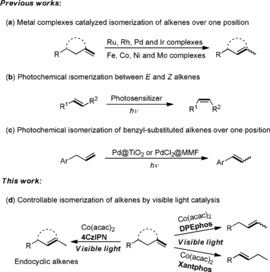
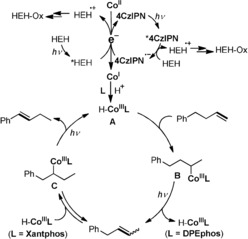
We report herein that thermodynamic and kinetic isomerization of alkenes can be accomplished by the combination of visible light with Co catalysis. Utilizing Xantphos as the ligand, the most stable isomers are obtained, while isomerizing terminal alkenes over one position can be selectively controlled by using DPEphos as the ligand. The presence of the donor-acceptor dye 4CzIPN accelerates the reaction further. Transformation of exocyclic alkenes into the corresponding endocyclic products could be efficiently realized by using 4CzIPN and Co(acac) in the absence of any additional ligands. Spectroscopic and spectroelectrochemical investigations indicate Co being involved in the generation of a Co hydride, which subsequently adds to alkenes initiating the isomerization.
我们在此报告,烯烃的热力学和动力学异构化可通过可见光与钴催化相结合来实现。使用Xantphos作为配体可得到最稳定的异构体,而使用DPEphos作为配体则可选择性地控制末端烯烃在一个位置上的异构化。给体-受体染料4CzIPN的存在进一步加速了反应。在不存在任何额外配体的情况下,使用4CzIPN和Co(acac)可有效地实现环外烯烃向相应环内产物的转化。光谱和光谱电化学研究表明,钴参与了钴氢化物的生成,随后钴氢化物加成到烯烃上引发异构化。