1 School of Biological Sciences, The University of Queensland , St Lucia, Queensland 4072 , Australia.
2 King Abdullah University of Science and Technology (KAUST), Red Sea Research Center (RSRC) , Thuwal 23955-6900 , Saudi Arabia.
Biol Lett. 2019 Mar 29;15(3):20180781. doi: 10.1098/rsbl.2018.0781.
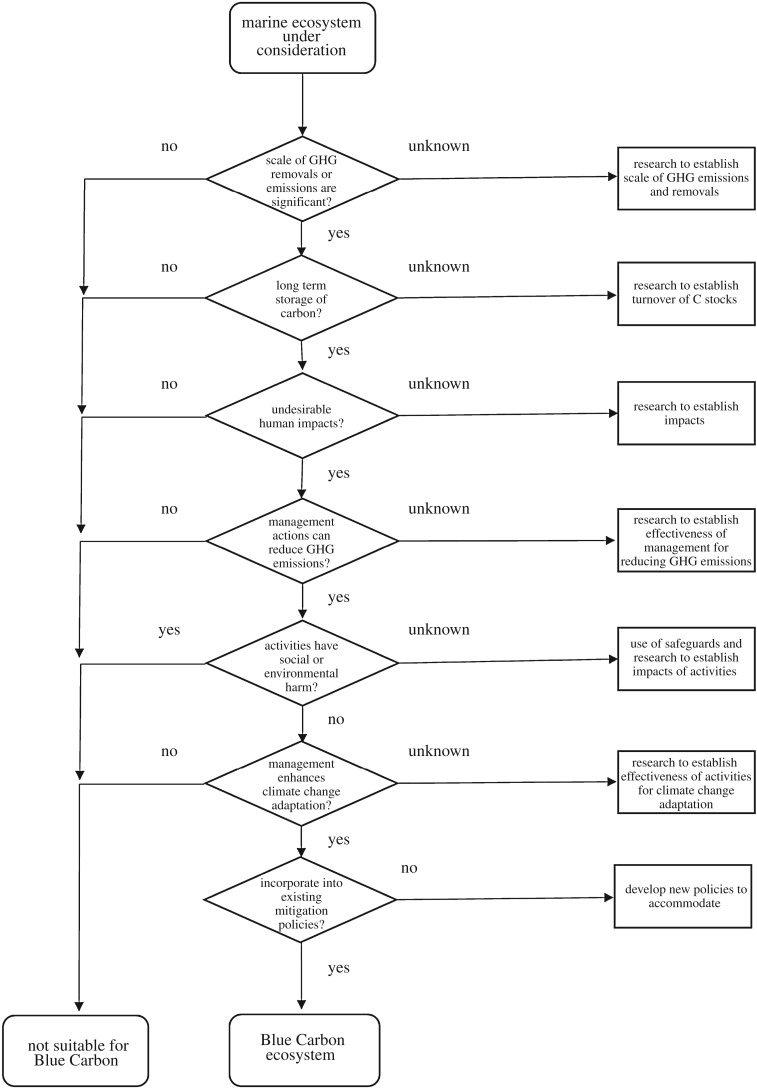
Blue Carbon is a term coined in 2009 to draw attention to the degradation of marine and coastal ecosystems and the need to conserve and restore them to mitigate climate change and for the other ecosystem services they provide. Blue Carbon has multiple meanings, which we aim to clarify here, which reflect the original descriptions of the concept including (1) all organic matter captured by marine organisms, and (2) how marine ecosystems could be managed to reduce greenhouse gas emissions and thereby contribute to climate change mitigation and conservation. The multifaceted nature of the Blue Carbon concept has led to unprecedented collaboration across disciplines, where scientists, conservationists and policy makers have interacted intensely to advance shared goals. Some coastal ecosystems (mangroves, tidal marshes and seagrass) are established Blue Carbon ecosystems as they often have high carbon stocks, support long-term carbon storage, offer the potential to manage greenhouse gas emissions and support other adaptation policies. Some marine ecosystems do not meet key criteria for inclusion within the Blue Carbon framework (e.g. fish, bivalves and coral reefs). Others have gaps in scientific understanding of carbon stocks or greenhouse gas fluxes, or currently there is limited potential for management or accounting for carbon sequestration (macroalgae and phytoplankton), but may be considered Blue Carbon ecosystems in the future, once these gaps are addressed.
蓝碳是一个 2009 年提出的术语,旨在引起人们对海洋和沿海生态系统退化的关注,并强调保护和恢复这些生态系统以缓解气候变化和提供其他生态系统服务的必要性。蓝碳有多种含义,我们旨在在这里澄清这些含义,这些含义反映了该概念的原始描述,包括 (1) 海洋生物捕获的所有有机物,以及 (2) 如何管理海洋生态系统以减少温室气体排放,从而为气候变化缓解和保护做出贡献。蓝碳概念的多方面性质导致了跨学科的前所未有的合作,科学家、保护主义者和政策制定者之间进行了激烈的互动,以推进共同的目标。一些沿海生态系统(红树林、潮汐沼泽和海草床)是建立的蓝碳生态系统,因为它们通常具有高碳储量,支持长期碳储存,具有管理温室气体排放和支持其他适应政策的潜力。一些海洋生态系统不符合蓝碳框架纳入的关键标准(例如鱼类、双壳类动物和珊瑚礁)。其他生态系统在碳储量或温室气体通量方面的科学认识存在差距,或者目前对碳封存的管理或核算潜力有限(大型藻类和浮游植物),但一旦这些差距得到解决,它们可能在未来被视为蓝碳生态系统。