Plant Pathology & Plant-Microbe Biology Section, School of Integrative Plant Science, Cornell University, Ithaca, New York, USA.
College of Plant Sciences, Jilin University, Changchun, China.
mBio. 2019 Mar 5;10(2):e02805-18. doi: 10.1128/mBio.02805-18.
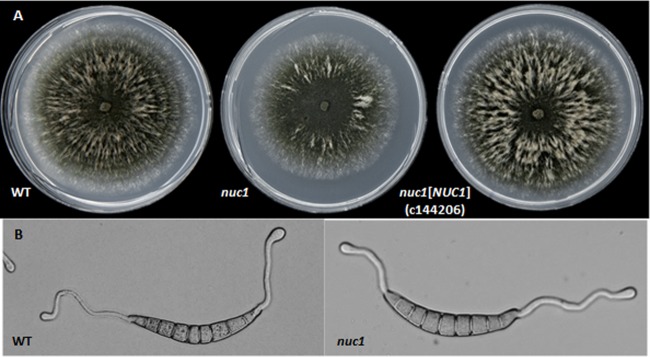
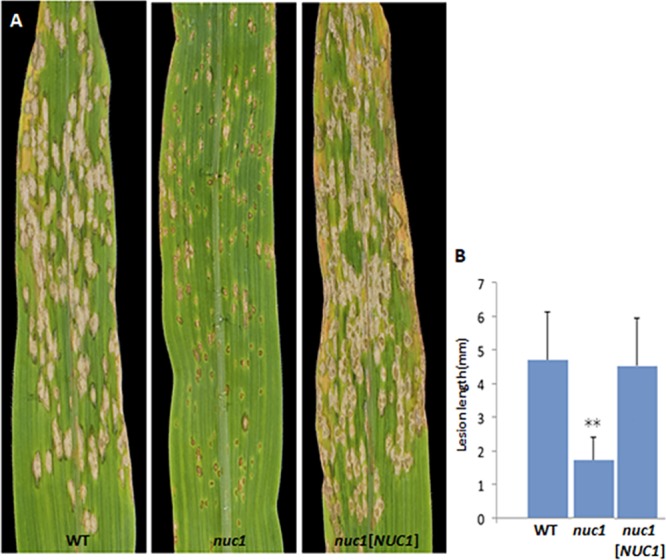
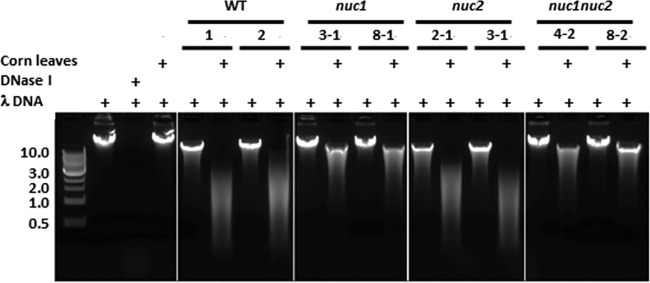
Histone-linked extracellular DNA (exDNA) is a component of neutrophil extracellular traps (NETs). NETs have been shown to play a role in immune response to bacteria, fungi, viruses, and protozoan parasites. Mutation of genes encoding group A extracellular DNases (exDNases) results in reduced virulence in animals, a finding that implies that exDNases are deployed as counter defense against host DNA-containing NETs. Is the exDNA/exDNase mechanism also relevant to plants and their pathogens? It has been demonstrated previously that exDNA is a component of a matrix secreted from plant root caps and that plants also carry out an extracellular trapping process. Treatment with DNase I destroys root tip resistance to infection by fungi, the most abundant plant pathogens. We show that the absence of a single gene encoding a candidate exDNase results in significantly reduced virulence of a fungal plant pathogen to its host on leaves, the known infection site, and on roots. Mg-dependent exDNase activity was demonstrated in fungal culture filtrates and induced when host leaf material was present. It is speculated that the enzyme functions to degrade plant-secreted DNA, a component of a complex matrix akin to neutrophil extracellular traps of animals. We document that the absence of a single gene encoding a DNase in a fungal plant pathogen results in significantly reduced virulence to a plant host. We compared a wild-type strain of the maize pathogen and an isogenic mutant lacking a candidate secreted DNase-encoding gene and demonstrated that the mutant is reduced in virulence on leaves and on roots. There are no previous reports of deletion of such a gene from either an animal or plant fungal pathogen accompanied by comparative assays of mutants and wild type for alterations in virulence. We observed DNase activity, in fungal culture filtrates, that is Mg dependent and induced when plant host leaf material is present. Our findings demonstrate not only that fungi use extracellular DNases (exDNases) for virulence, but also that the relevant molecules are deployed in above-ground leaves as well as below-ground plant tissues. Overall, these data provide support for a common defense/counter defense virulence mechanism used by animals, plants, and their fungal and bacterial pathogens and suggest that components of the mechanism might be novel targets for the control of plant disease.
组 A 细胞外 DNA 酶(exDNases)基因编码突变会导致动物毒力降低,这一发现表明 exDNases 被用作对抗宿主含有 DNA 的 NETs 的防御手段。该 exDNA/exDNase 机制是否也与植物及其病原体相关?先前已经证明,exDNA 是植物根冠分泌的基质的组成部分,植物也进行细胞外捕获过程。用 DNA 酶 I 处理会破坏真菌(最丰富的植物病原体)感染根尖的抵抗力。我们发现,单个候选 exDNase 基因的缺失会显著降低真菌植物病原体对其宿主叶片(已知感染部位)和根部的毒力。在真菌培养液滤液中检测到 Mg 依赖性 exDNase 活性,并在存在宿主叶片材料时诱导产生。推测该酶的功能是降解植物分泌的 DNA,这是一种类似于动物中性粒细胞细胞外陷阱的复杂基质的组成部分。我们记录到,真菌植物病原体中单个编码 DNase 的基因缺失会导致对植物宿主的毒力显著降低。我们比较了玉米病原体的野生型菌株和一个缺乏候选分泌型 DNase 编码基因的同基因突变体,并证明该突变体在叶片和根部的毒力降低。以前没有报道过从动物或植物真菌病原体中删除这样的基因,并对突变体和野生型进行比较分析,以评估毒力的变化。我们观察到真菌培养液滤液中的 DNase 活性,该活性依赖于 Mg,并且在存在植物宿主叶片材料时被诱导。我们的研究结果不仅表明真菌利用细胞外 DNA 酶(exDNases)进行毒力,而且还表明相关分子在地上叶片以及地下植物组织中都被部署。总的来说,这些数据不仅为动物、植物及其真菌和细菌病原体使用的共同防御/对抗防御毒力机制提供了支持,还表明该机制的成分可能是控制植物疾病的新靶标。