Pacific Northwest National Laboratory, Richland, WA, 99352, USA.
Department of Geology and Geophysics, King Saud University, Riyadh 11451, Saudi Arabia.
Nat Commun. 2019 Mar 5;10(1):1046. doi: 10.1038/s41467-019-08909-4.
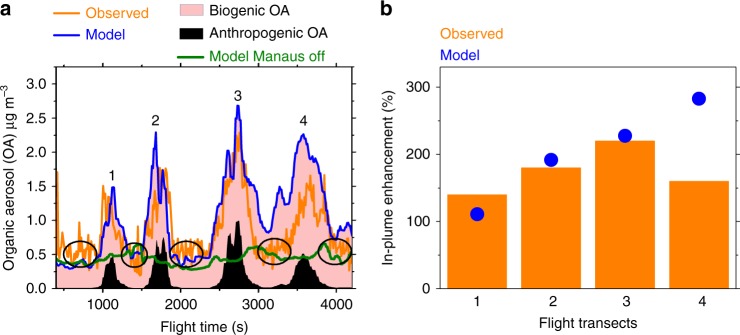
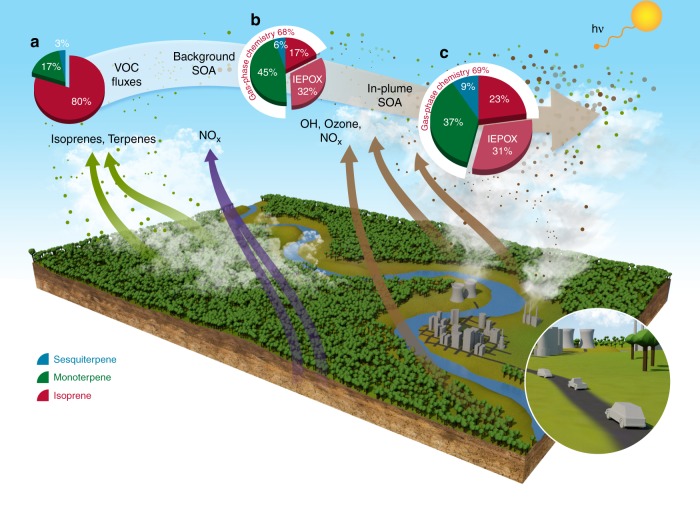
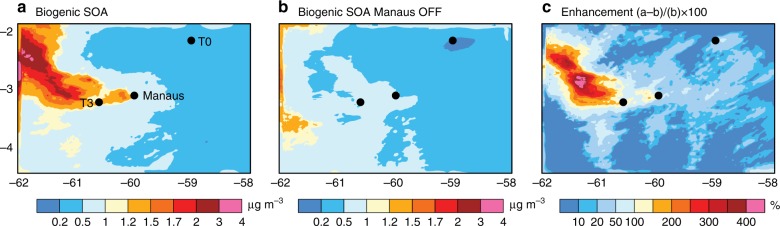
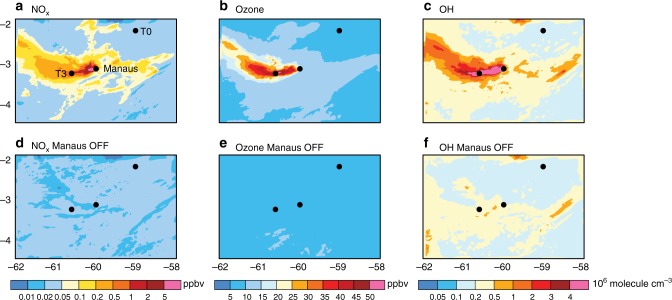
One of the least understood aspects in atmospheric chemistry is how urban emissions influence the formation of natural organic aerosols, which affect Earth's energy budget. The Amazon rainforest, during its wet season, is one of the few remaining places on Earth where atmospheric chemistry transitions between preindustrial and urban-influenced conditions. Here, we integrate insights from several laboratory measurements and simulate the formation of secondary organic aerosols (SOA) in the Amazon using a high-resolution chemical transport model. Simulations show that emissions of nitrogen-oxides from Manaus, a city of ~2 million people, greatly enhance production of biogenic SOA by 60-200% on average with peak enhancements of 400%, through the increased oxidation of gas-phase organic carbon emitted by the forests. Simulated enhancements agree with aircraft measurements, and are much larger than those reported over other locations. The implication is that increasing anthropogenic emissions in the future might substantially enhance biogenic SOA in pristine locations like the Amazon.
大气化学中最不为人理解的方面之一是城市排放如何影响自然有机气溶胶的形成,而自然有机气溶胶会影响地球的能量平衡。在雨季,亚马逊雨林是地球上为数不多的仍然处于工业化前和受城市影响之间的过渡状态的地区之一。在这里,我们综合了几个实验室测量的结果,并使用高分辨率化学输送模型模拟了亚马逊地区的二次有机气溶胶(SOA)的形成。模拟结果表明,来自拥有约 200 万人口的马瑙斯市的氮氧化物排放通过增加森林排放的气相有机碳的氧化作用,平均使生物 SOA 的生成增加了 60-200%,最高可达 400%。模拟增强与飞机测量结果一致,且比其他地区报道的增强幅度大得多。这意味着,未来人为排放的增加可能会大大增强亚马逊等原始地区的生物 SOA。