Department of Interdisciplinary Environment, Graduate School of Human and Environmental Sciences, Kyoto University, Yoshidanihonmatsucho, Sakyo-ku, Kyoto, Japan.
Graduate School of Biomedical Sciences, Hiroshima University, Kasumi1-2-3, Minamiku, Hiroshima, Japan.
J Radiat Res. 2019 May 1;60(3):281-288. doi: 10.1093/jrr/rry114.
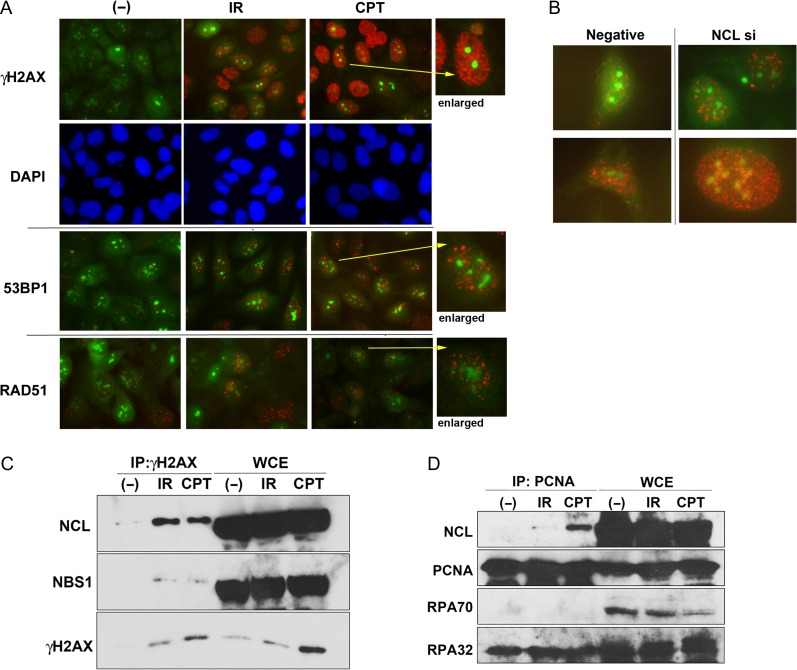
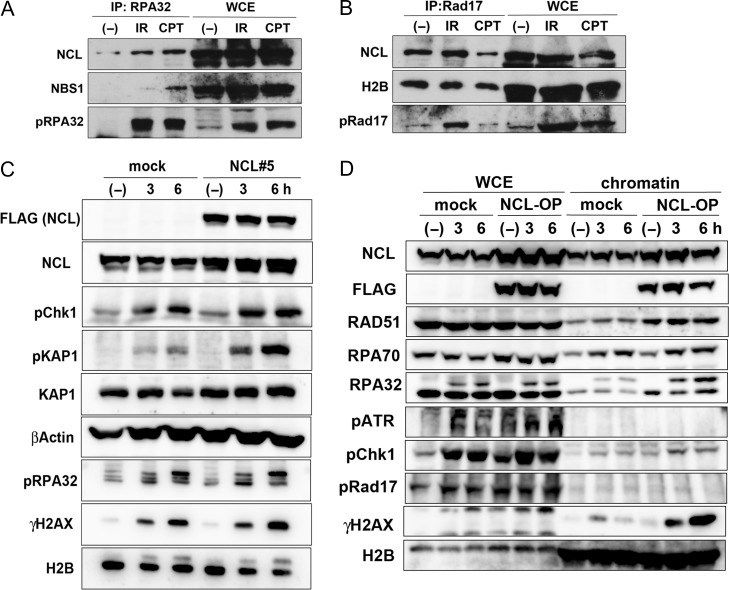
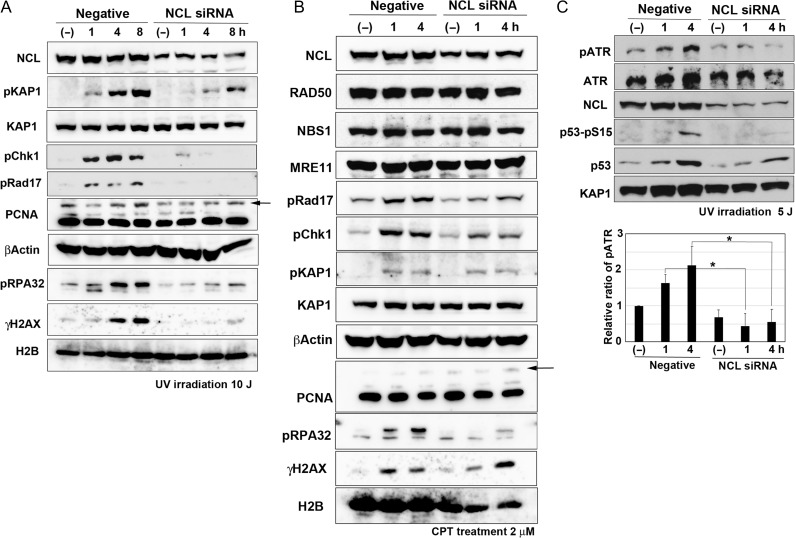
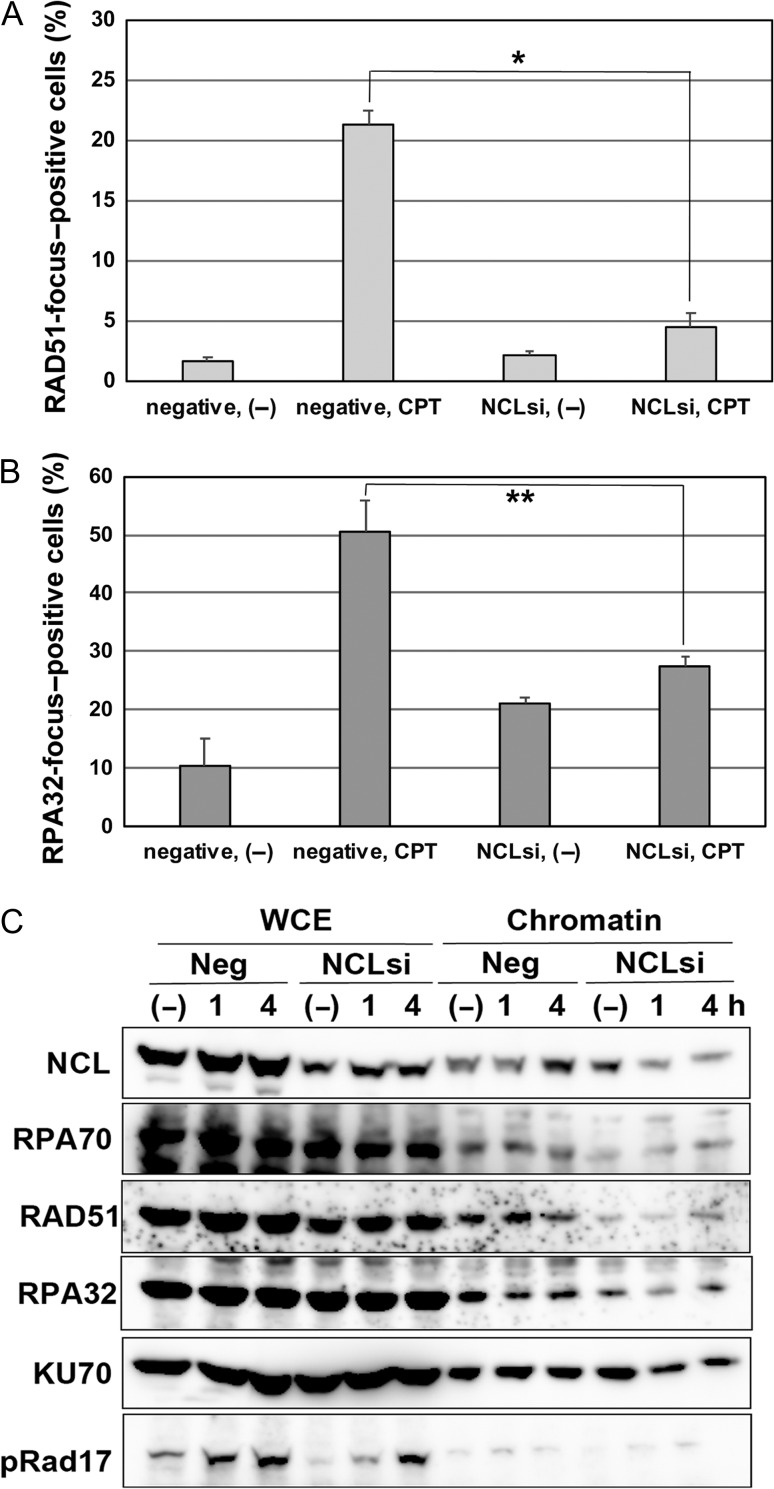
The nucleolus contains multiple copies of ribosomal (r)DNA, which indicate sites of frequent replication stress and suggest the existence of a mechanism to prevent replication stress-related rDNA instability and the possibility that such a mechanism contributes to the whole genomic stability against replication stress. We have previously reported that nucleolin, a major nucleolar protein, is involved in ionizing radiation-induced DNA damage responses (DDRs) such as ataxia telangiectasia mutated (ATM)-dependent cell cycle checkpoints and homologous recombination (HR) repair. Here, we investigated the role of nucleolin in DDR due to replication stress. The results indicate that following replication stress, nucleolin interacted with the histone γH2AX, proliferating cell nuclear antigen (PCNA), and replication protein A (RPA)32, suggesting that it may be recruited to DNA damage sites on the replication fork. Furthermore, the knockdown of nucleolin by siRNA reduced the activation of ATM and RAD3-related (ATR) kinase and the formation of RAD51 and RPA32 foci after replication stress due to UV or camptothecin exposure, whereas nucleolin overexpression augmented ATR-dependent phosphorylation and RAD51 and RPA accumulation on chromatin. Moreover, these overexpressing cells seemed to increase repair activity and resistance to replication stress. Our results indicate that nucleolin plays an important role in replication stress-induced DDRs such as ATR activation and HR repair. Given that nucleolin overexpression is often observed in many types of cancer cells, our findings suggest that nucleolin is involved in the regulation of resistance to replication stress that may otherwise lead to tumorigenesis and it could be a possible target for chemotherapy and radiotherapy.
核仁包含多个核糖体 (r)DNA 拷贝,这表明存在频繁复制应激的位点,并提示存在一种防止与复制应激相关的 rDNA 不稳定性的机制,以及这种机制可能有助于整个基因组抵抗复制应激的稳定性。我们之前报道过,核仁蛋白核仁素参与电离辐射诱导的 DNA 损伤反应 (DDRs),如共济失调毛细血管扩张突变 (ATM) 依赖性细胞周期检查点和同源重组 (HR) 修复。在这里,我们研究了核仁素在复制应激引起的 DDR 中的作用。结果表明,在复制应激后,核仁素与组蛋白 γH2AX、增殖细胞核抗原 (PCNA) 和复制蛋白 A (RPA)32 相互作用,表明它可能被招募到复制叉上的 DNA 损伤部位。此外,siRNA 敲低核仁素会减少 ATM 和 RAD3 相关 (ATR) 激酶的激活以及 RAD51 和 RPA32 焦点的形成,这是由于 UV 或喜树碱暴露引起的复制应激,而核仁素过表达则增强了 ATR 依赖性磷酸化以及 RAD51 和 RPA 在染色质上的积累。此外,这些过表达的细胞似乎增加了修复活性并对复制应激具有抗性。我们的研究结果表明,核仁素在复制应激诱导的 DDRs 中发挥重要作用,如 ATR 的激活和 HR 修复。鉴于核仁素过表达在许多类型的癌细胞中经常观察到,我们的研究结果表明核仁素参与了对复制应激的抗性的调节,否则可能导致肿瘤发生,并且它可能成为化疗和放疗的一个潜在靶点。