Xu Lei, Rahmani Mohsen, Zangeneh Kamali Khosro, Lamprianidis Aristeidis, Ghirardini Lavinia, Sautter Jürgen, Camacho-Morales Rocio, Chen Haitao, Parry Matthew, Staude Isabelle, Zhang Guoquan, Neshev Dragomir, Miroshnichenko Andrey E
1School of Engineering and Information Technology, University of New South Wales, Canberra, ACT 2600 Australia.
2Nonlinear Physics Centre, The Australian National University, Canberra, ACT 2601 Australia.
Light Sci Appl. 2018 Jul 25;7:44. doi: 10.1038/s41377-018-0051-8. eCollection 2018.
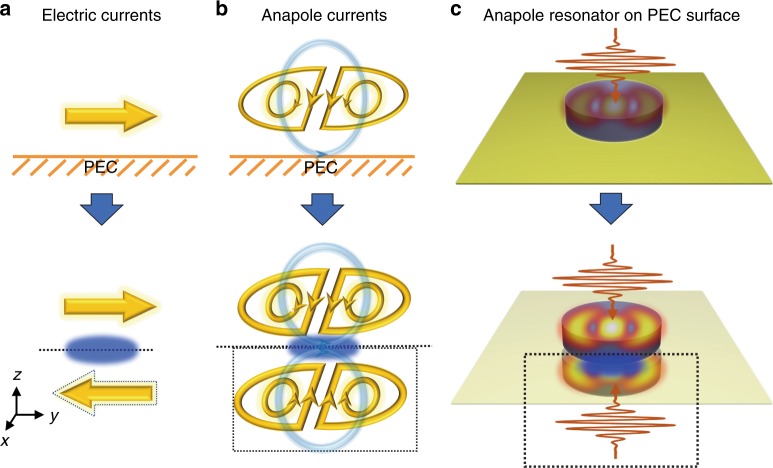
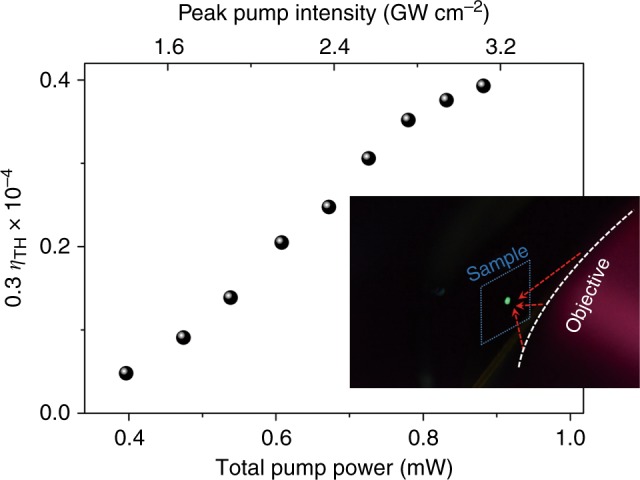
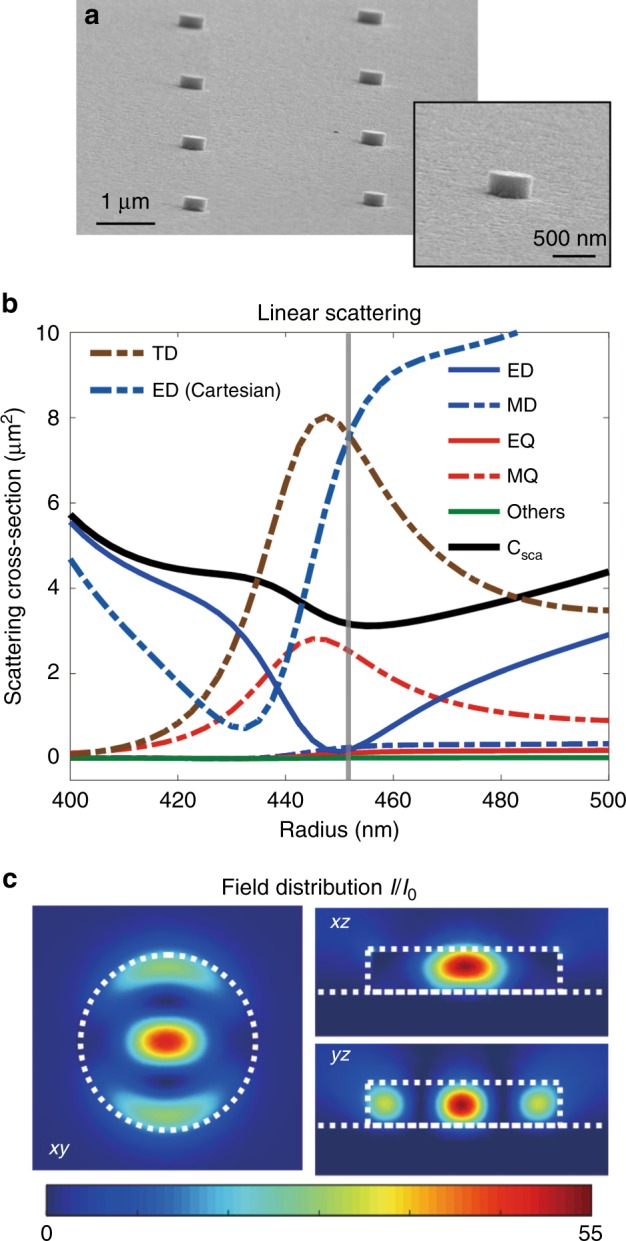
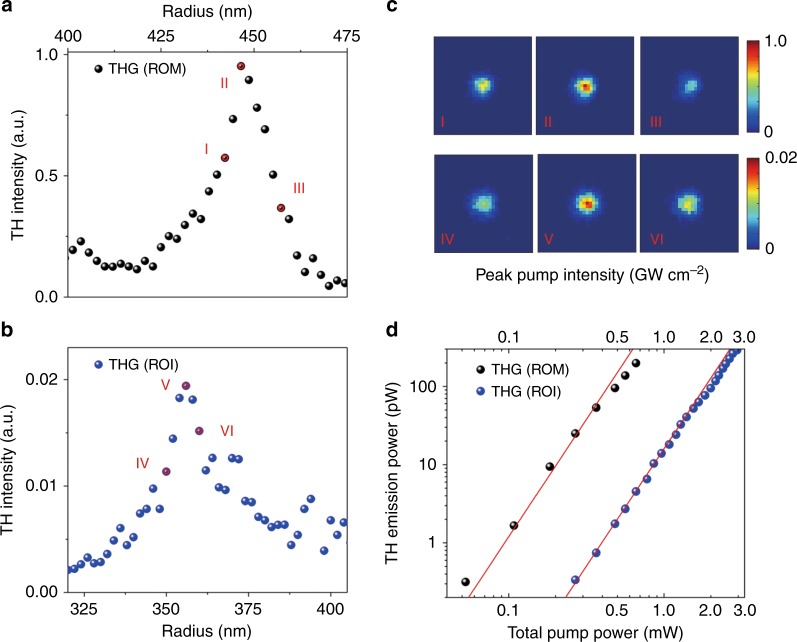
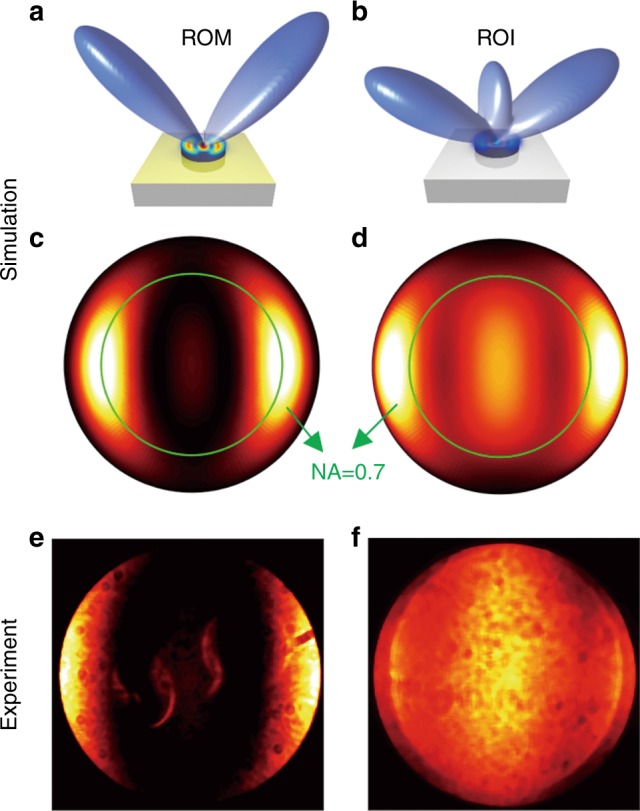
We demonstrate that a dielectric anapole resonator on a metallic mirror can enhance the third harmonic emission by two orders of magnitude compared to a typical anapole resonator on an insulator substrate. By employing a gold mirror under a silicon nanodisk, we introduce a novel characteristic of the anapole mode through the spatial overlap of resonantly excited Cartesian electric and toroidal dipole modes. This is a remarkable improvement on the early demonstrations of the anapole mode in which the electric and toroidal modes interfere off-resonantly. Therefore, our system produces a significant near-field enhancement, facilitating the nonlinear process. Moreover, the mirror surface boosts the nonlinear emission via the free-charge oscillations within the interface, equivalent to producing a mirror image of the nonlinear source and the pump beneath the interface. We found that these improvements result in an extremely high experimentally obtained efficiency of 0.01%.
我们证明,与绝缘体衬底上的典型非偶极谐振器相比,金属镜上的介电非偶极谐振器可将三次谐波发射增强两个数量级。通过在硅纳米盘下方使用金镜,我们通过共振激发的笛卡尔电偶极和环形偶极模式的空间重叠引入了非偶极模式的新特性。这是对早期非偶极模式演示的显著改进,在早期演示中,电偶极和环形模式发生非共振干涉。因此,我们的系统产生了显著的近场增强,促进了非线性过程。此外,镜面通过界面内的自由电荷振荡增强了非线性发射,相当于在界面下方产生了非线性源和泵浦的镜像。我们发现,这些改进导致实验获得的效率极高,达到了0.01%。