Mohnen Sigrid M, Schneider Sven, Droomers Mariël
National Institute for Public Health and the Environment (RIVM), Centre for Nutrition, Prevention, and Health Services, PO Box 1, 3720, BA, Bilthoven, The Netherlands.
Mannheim Institute of Public Health, Social and Preventive Medicine (MIPH), Heidelberg University, Mannheim, Germany.
Health Econ Rev. 2019 Mar 6;9(1):7. doi: 10.1186/s13561-019-0226-x.
We propose using neighborhood characteristics as demand-related morbidity adjusters to improve prediction models such as the risk equalization model.
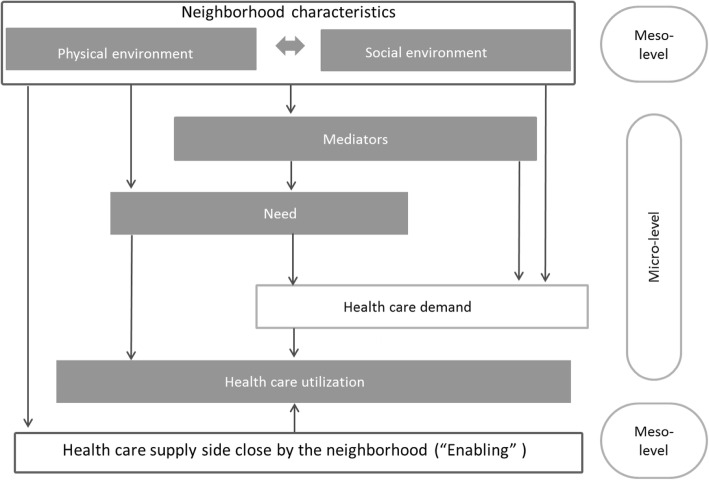
Since the neighborhood has no explicit 'place' in healthcare demand models, we have developed the "Neighborhood and healthcare utilization model" to show how neighborhoods matter in healthcare utilization. Neighborhood may affect healthcare utilization via (1) the supply-side, (2) need, and (3) demand for healthcare - irrespective of need. Three pathways are examined in detail to explain how neighborhood characteristics influence healthcare utilization via need: the physiological, psychological and behavioral pathways. We underpin this theoretical model with literature on all relevant neighborhood characteristics relating to health and healthcare utilization.
Potential neighborhood characteristics for the risk equalization model include the degree of urbanization, public and open space, resources and facilities, green and blue space, environmental noise, air pollution, social capital, crime and violence, socioeconomic status, stability, and ethnic composition. Air pollution has already been successfully tested as an important predictive variable in a healthcare risk equalization model, and it might be opportune to add more neighborhood characteristics.
我们建议使用社区特征作为与需求相关的发病率调整因素,以改进诸如风险均等化模型等预测模型。
由于社区在医疗保健需求模型中没有明确的“位置”,我们开发了“社区与医疗保健利用模型”,以展示社区在医疗保健利用中的重要性。社区可能通过(1)供应方、(2)需求以及(3)对医疗保健的需求(与需求无关)来影响医疗保健利用。详细研究了三条途径,以解释社区特征如何通过需求影响医疗保健利用:生理、心理和行为途径。我们用关于所有与健康和医疗保健利用相关的社区特征的文献来支撑这个理论模型。
风险均等化模型潜在的社区特征包括城市化程度、公共和开放空间、资源与设施、绿色和蓝色空间、环境噪音、空气污染、社会资本、犯罪与暴力、社会经济地位、稳定性以及种族构成。空气污染已经在医疗保健风险均等化模型中作为一个重要的预测变量成功进行了测试,增加更多的社区特征可能是合适的。