UCLA David Geffen School of Medicine, Department of Family Medicine, Center for Behavioral & Addiction Medicine, Los Angeles, CA (WL); Indivior Inc., Richmond, VA (VRN, SML, CH); Pharmerit International, Bethesda, MD (CTS); RTI Health Solutions, Research Triangle Park, NC (NAR); Pharmerit International, Newton, MA (YCY); Artemis Institute for Clinical Research, San Diego, CA (VM).
J Addict Med. 2019 Nov/Dec;13(6):442-449. doi: 10.1097/ADM.0000000000000517.
Opioid use disorder (OUD) is associated with physical, social, psychological, and economic burden. This analysis assessed the effects of RBP-6000, referred to as BUP-XR (extended-release buprenorphine), a subcutaneously injected, monthly buprenorphine treatment for OUD compared with placebo on patient-centered outcomes measuring meaningful life changes.
Patient-centered outcomes were collected in a 24-week, phase 3, placebo-controlled study assessing the efficacy, safety, and tolerability of BUP-XR 300/300 mg (6 × 300 mg) and 300/100 mg (2 × 300 mg followed by 4 × 100 mg) injections in treatment-seeking participants with moderate-to-severe OUD. Measures included the EQ-5D-5L, SF-36v2, Medication Satisfaction Questionnaire, employment/insurance status, and healthcare resource utilization (HCRU). Changes from baseline to end of study were compared across treatment arms, using mixed models for repeated measures.
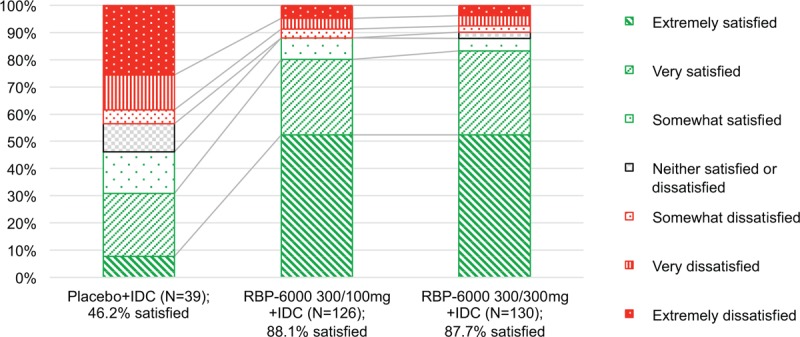
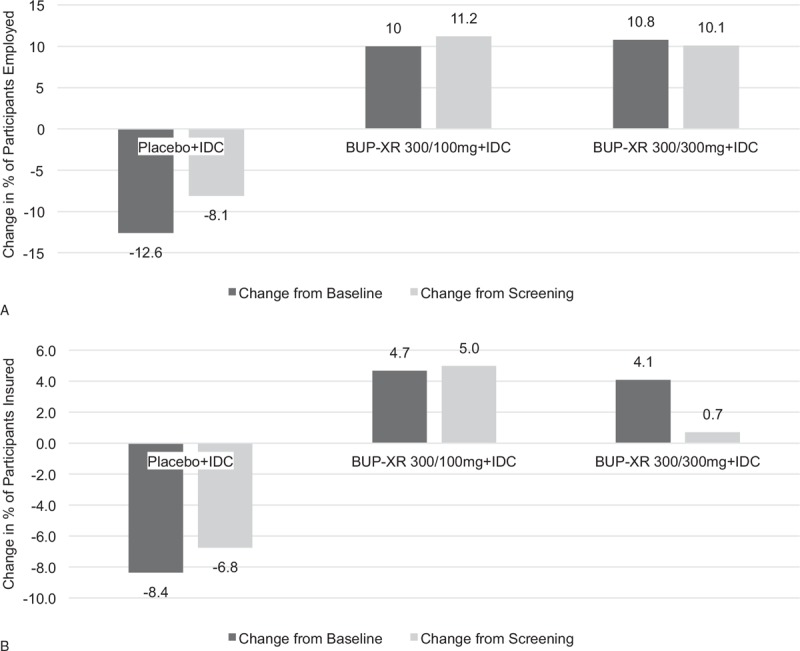
Participants receiving BUP-XR (n = 389) versus placebo (n = 98) had significantly greater changes from baseline on the EQ-5D-5L index (300/300 mg: difference = 0.0636, P = 0.003), EQ-5D-5L visual analog scale (300/300 mg: difference = 5.9, P = 0.017; 300/100 mg: difference = 7.7, P = 0.002), and SF-36v2 physical component summary score (300/300 mg: difference = 3.8, P < 0.001; 300/100 mg: difference = 3.2, P = 0.002). Satisfaction was significantly higher for participants receiving BUP-XR 300/300 mg (88%, P < 0.001) and 300/100 mg (88%, P < 0.001) than placebo (46%). Employment and percentage of insured participants increased by 10.8% and 4.1% with BUP-XR 300/300 mg and 10.0% and 4.7% with 300/100 mg but decreased by 12.6% and 8.4% with placebo. Participants receiving BUP-XR compared with placebo had significantly fewer hospital days per person-year observed.
These results show the feasibility of measuring patient-centered life changes in substance use disorder clinical studies. Participants receiving up to 6 monthly injections of BUP-XR, compared with placebo, reported better health, increased medication satisfaction, increased employment, and decreased healthcare utilization.
阿片类药物使用障碍(OUD)与身体、社会、心理和经济负担有关。本分析评估了 RBP-6000(称为 BUP-XR,即丁丙诺啡的皮下注射延长释放制剂)与安慰剂相比,对 OUD 患者的以患者为中心的生活变化的影响。
在一项为期 24 周的、安慰剂对照的 3 期研究中,评估了 BUP-XR 300/300mg(6×300mg)和 300/100mg(2×300mg 后加 4×100mg)注射剂治疗中度至重度 OUD 患者的疗效、安全性和耐受性。患者报告的结果包括 EQ-5D-5L、SF-36v2、药物满意度问卷、就业/保险状况以及医疗保健资源利用(HCRU)。使用重复测量混合模型比较各治疗组从基线到研究结束时的变化。
与安慰剂组(n=98)相比,接受 BUP-XR 治疗的患者(n=389)在 EQ-5D-5L 指数(BUP-XR 300/300mg:差值=0.0636,P=0.003)、EQ-5D-5L 视觉模拟量表(BUP-XR 300/300mg:差值=5.9,P=0.017;BUP-XR 300/100mg:差值=7.7,P=0.002)和 SF-36v2 生理成分综合评分(BUP-XR 300/300mg:差值=3.8,P<0.001;BUP-XR 300/100mg:差值=3.2,P=0.002)方面的变化更大。接受 BUP-XR 300/300mg(88%,P<0.001)和 300/100mg(88%,P<0.001)治疗的患者的满意度明显高于安慰剂组(46%)。接受 BUP-XR 治疗的患者中,就业和参保比例分别增加了 10.8%和 4.1%(BUP-XR 300/300mg)和 10.0%和 4.7%(BUP-XR 300/100mg),而安慰剂组则分别下降了 12.6%和 8.4%。与安慰剂组相比,接受 BUP-XR 治疗的患者人均年住院天数明显减少。
这些结果表明,在物质使用障碍的临床研究中,测量以患者为中心的生活变化是可行的。与安慰剂相比,接受多达 6 次每月 BUP-XR 注射的患者报告了更好的健康状况、更高的药物满意度、更高的就业率和更低的医疗保健利用率。