Center for Vaccine Innovation and Access, PATH, Geneva, Switzerland.
The Comparative Health Outcomes, Policy, and Economics (CHOICE) Institute, University of Washington, Seattle.
Clin Infect Dis. 2019 Mar 7;68(Suppl 2):S154-S160. doi: 10.1093/cid/ciy1076.
The World Health Organization (WHO) released a position paper in March 2018 calling for integration of a novel typhoid conjugate vaccine (TCV) into routine immunization along with catch-up campaigns for children up to age 15. Gavi, the Vaccine Alliance, has committed funding to help resource-constrained countries introduce this vaccine. In this article, the Typhoid Vaccine Acceleration Consortium forecasts demand if WHO recommendations are followed.
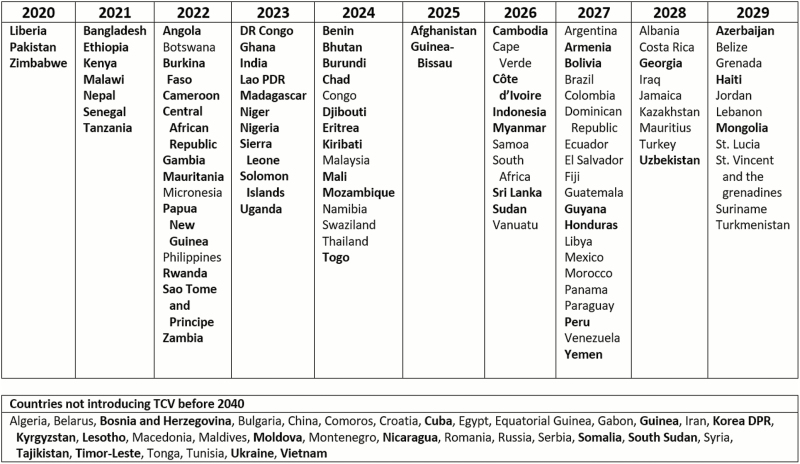
We built a model of global TCV introductions between 2020 and 2040 to estimate the demand of the vaccine for 133 countries. We estimated each country's year of introduction by examining its estimated incidence of typhoid fever, its history of introducing new vaccines, and any knowledge we have of its engagement with typhoid prevention, including intention to apply for Gavi funding. Our model predicted use in routine infant vaccination as well as campaigns targeting varying proportions of the unvaccinated population up to 15 years of age.
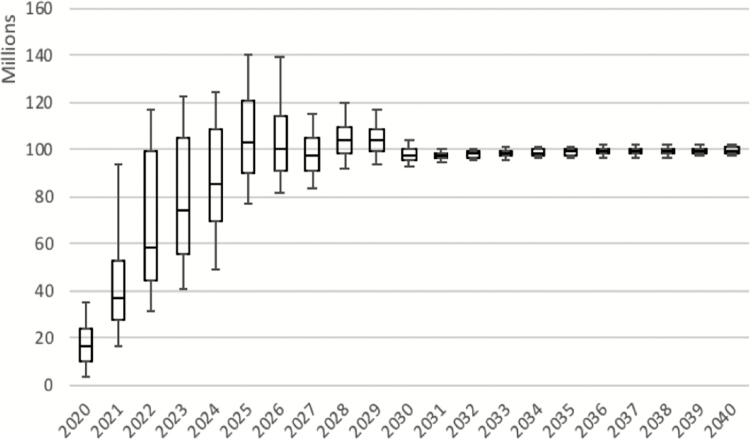
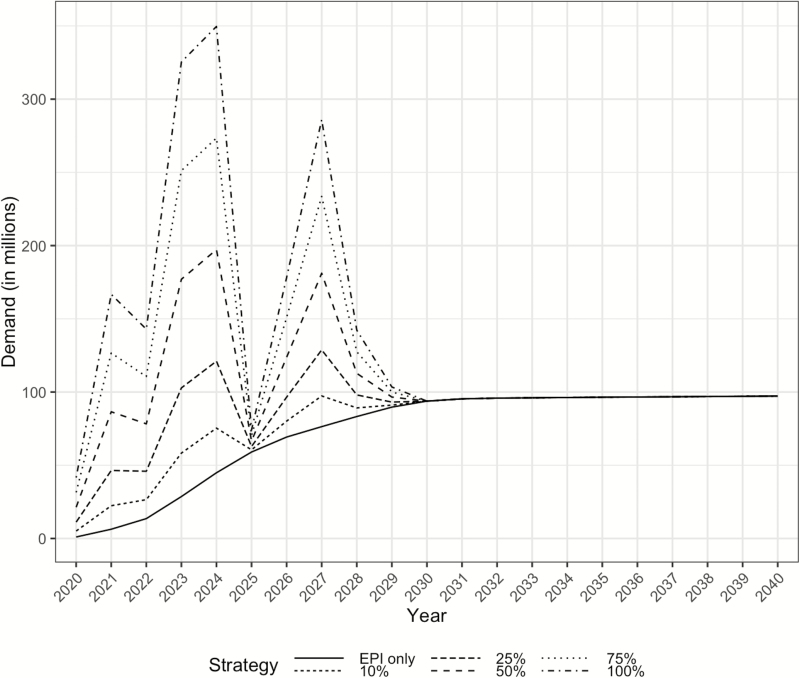
Between 2020 and 2025, demand will predominantly come from African countries, many receiving Gavi support. After that, Asian countries generate most demand until 2030, when campaigns are estimated to end. Demand will then track the birth cohort of participating countries, suggesting an annual routine demand between 90 and 100 million doses. Peak demand is likely to occur between 2023 and 2026, approaching 300 million annual doses if campaign implementation is high.
In our analysis, target population for catch-up campaigns is the main driver of uncertainty. At peak demand, there is some risk of exceeding presently estimated peak production capacity. Therefore, it will be important to carefully coordinate introductions, especially when accompanied by campaigns targeting large proportions of the eligible population.
世界卫生组织(WHO)在 2018 年 3 月发布了一份立场文件,呼吁将一种新型伤寒结合疫苗(TCV)纳入常规免疫接种,并为 15 岁以下儿童开展补种运动。疫苗联盟 Gavi 已承诺提供资金,帮助资源有限的国家引进这种疫苗。在本文中,伤寒疫苗加速联盟(Typhoid Vaccine Acceleration Consortium)预测了遵循世卫组织建议的情况下疫苗的需求情况。
我们建立了一个全球 TCV 引入模型,用于预测 2020 年至 2040 年期间 133 个国家对该疫苗的需求。我们通过检查每个国家的伤寒发病率、引入新疫苗的历史以及我们对其参与伤寒预防的了解,包括申请 Gavi 资金的意向,来估计每个国家的引入年份。我们的模型预测了该疫苗在常规婴儿接种以及针对 15 岁以下未接种人群的不同比例的接种运动中的使用情况。
在 2020 年至 2025 年期间,需求主要来自非洲国家,其中许多国家得到了 Gavi 的支持。此后,亚洲国家的需求最大,直到 2030 年接种运动预计结束。然后,需求将跟踪参与国家的出生队列,这表明每年常规需求在 9000 万至 1 亿剂之间。如果接种运动实施得很高,需求峰值可能出现在 2023 年至 2026 年之间,每年接近 3 亿剂。
在我们的分析中,补种运动的目标人群是不确定性的主要驱动因素。在需求高峰期,可能存在超过目前估计的最高生产能力的风险。因此,仔细协调引入工作非常重要,特别是当接种运动针对符合条件的人群中的大部分人群时。