Epigenetics of Stem Cells, Department of Developmental and Stem Cell Biology, Equipe Labellisée LIGUE Contre le Cancer, Institut Pasteur, CNRS UMR3738, 25 rue du Docteur Roux, 75015, Paris, France.
Sorbonne Université Collège Doctoral, F-75005, Paris, France.
Nat Commun. 2019 Mar 7;10(1):1109. doi: 10.1038/s41467-019-09041-z.
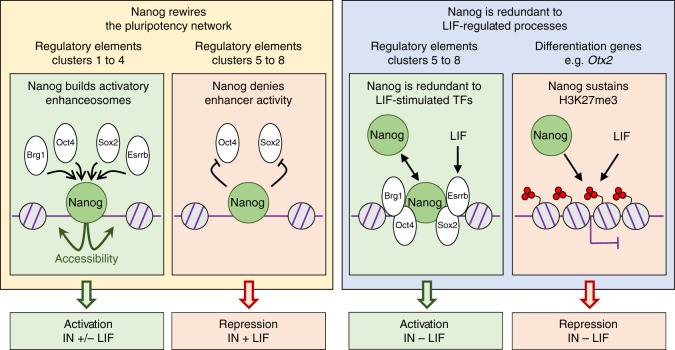
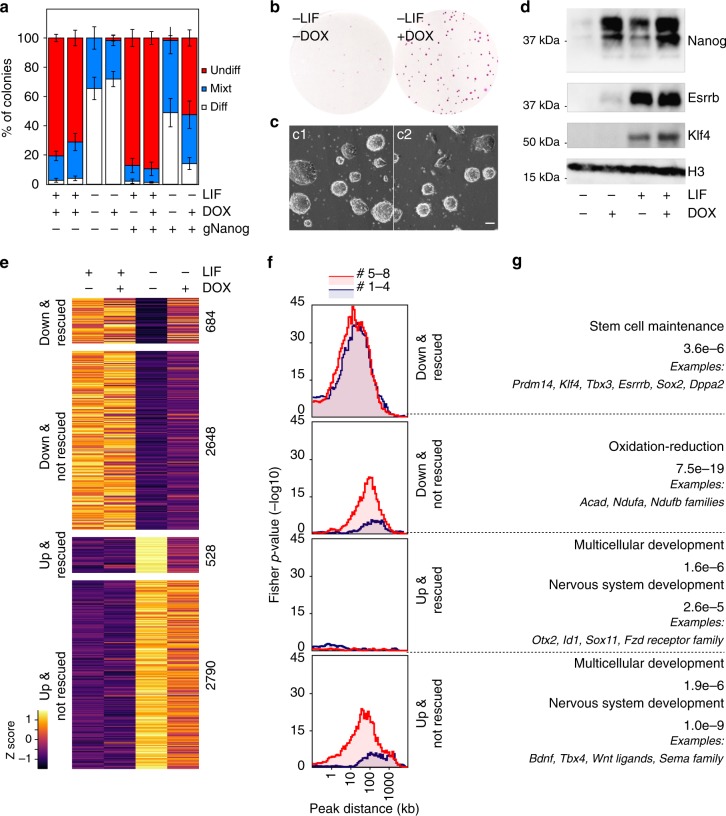
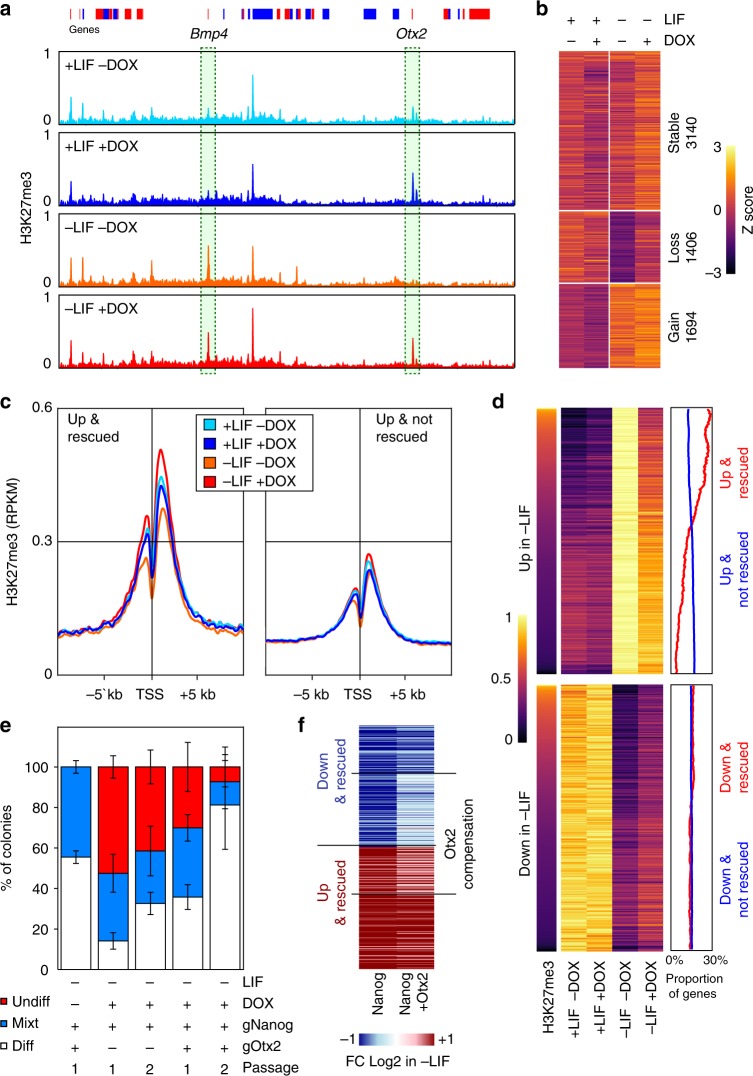
Transcription factor networks, together with histone modifications and signalling pathways, underlie the establishment and maintenance of gene regulatory architectures associated with the molecular identity of each cell type. However, how master transcription factors individually impact the epigenomic landscape and orchestrate the behaviour of regulatory networks under different environmental constraints is only partially understood. Here, we show that the transcription factor Nanog deploys multiple distinct mechanisms to enhance embryonic stem cell self-renewal. In the presence of LIF, which fosters self-renewal, Nanog rewires the pluripotency network by promoting chromatin accessibility and binding of other pluripotency factors to thousands of enhancers. In the absence of LIF, Nanog blocks differentiation by sustaining H3K27me3, a repressive histone mark, at developmental regulators. Among those, we show that the repression of Otx2 plays a preponderant role. Our results underscore the versatility of master transcription factors, such as Nanog, to globally influence gene regulation during developmental processes.
转录因子网络与组蛋白修饰和信号通路一起,为与每种细胞类型的分子特征相关的基因调控结构的建立和维持提供了基础。然而,主转录因子如何单独影响表观基因组景观,并在不同的环境限制下协调调控网络的行为,这在很大程度上还不为人知。在这里,我们表明转录因子 Nanog 利用多种不同的机制来增强胚胎干细胞的自我更新能力。在促进自我更新的 LIF 存在的情况下,Nanog 通过促进染色质可及性和其他多能性因子与数千个增强子的结合,重新构建多能性网络。在没有 LIF 的情况下,Nanog 通过在发育调节剂处维持 H3K27me3(一种抑制性组蛋白标记)来阻止分化。我们表明,Otx2 的抑制作用起着主导作用。我们的研究结果强调了主转录因子(如 Nanog)的多功能性,它们可以在发育过程中全局影响基因调控。