Wolf Science Center, Domestication Lab, Konrad Lorenz Institute of Ethology, University of Veterinary Medicine, Vienna, Savoyenstraße 1a, A-1160, Vienna, Austria.
Comparative Cognition, Messerli Research Institute, University of Veterinary Medicine, Vienna, Medical University of Vienna, University of Vienna, Veterinärplatz 1, 1210, Vienna, Austria.
Sci Rep. 2019 Mar 7;9(1):3796. doi: 10.1038/s41598-019-40468-y.
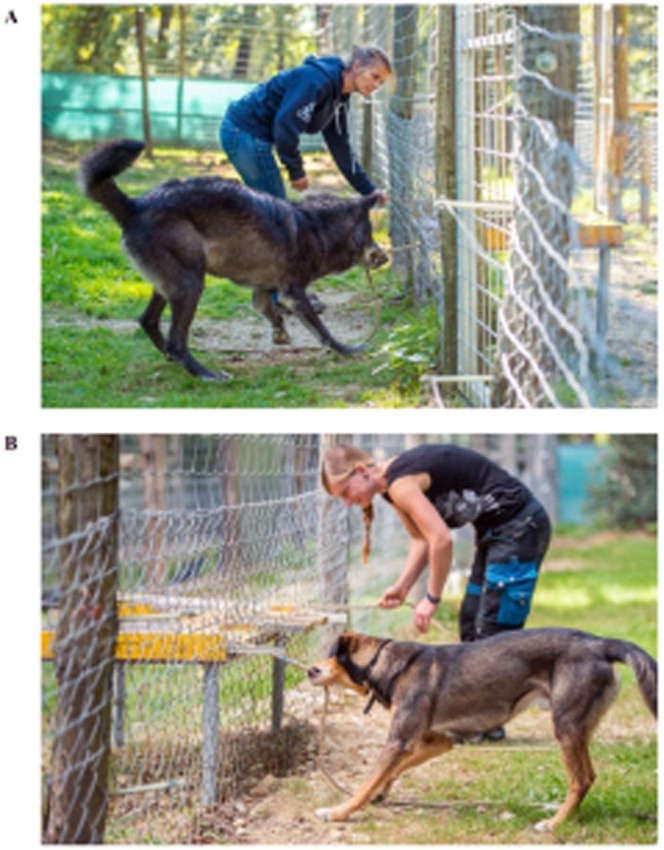
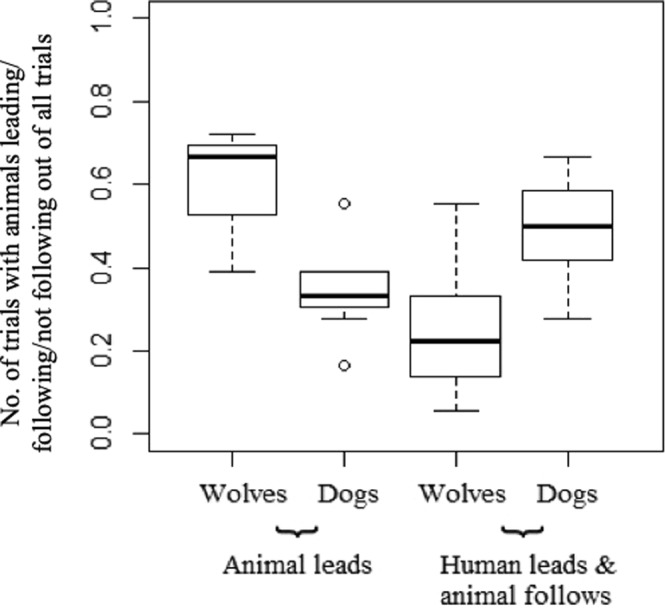
Due to their convergent evolution, dogs have been suggested as a good model for the evolution of human social skills, such as tolerance and cooperativeness. However, recent studies have revealed that wolves (dogs' closest undomesticated relatives) are more tolerant and cooperative with conspecifics than dogs. It is still possible, though, that selection during domestication enhanced cooperative inclinations specifically towards humans, predicting better cooperation with humans in dogs than in wolves. We tested this hypothesis by comparing similarly human-raised wolves and dogs when cooperating with a familiar human partner in a string-pulling task. Both dogs and wolves were highly successful with the human partner, highlighting that dog-human cooperation could have evolved based on wolves' social skills. However, wolves and dogs differed in how they cooperated with their human partners with wolves being more likely to initiate movement leading the interaction with humans, whereas dogs were more likely to wait for the human to initiate action and then follow. Accordingly, we propose that during the course of domestication, after an initial reduction in fear of humans, dogs were selected for increased submissive inclinations (Deferential Behaviour Hypothesis) in order to minimize conflicts over resources, to ensure safe co-habitation and co-working in a way that humans lead and dogs follow.
由于趋同进化,狗被认为是研究人类社交技能(如容忍和合作)进化的良好模型。然而,最近的研究表明,狼(狗的近亲)比狗更能容忍和合作同类。不过,在驯化过程中,选择可能会增强对人类的合作倾向,这意味着狗比狼更有可能与人类合作。我们通过比较在拉绳任务中与熟悉的人类伙伴合作时,同样由人类抚养的狼和狗,来验证这一假设。狗和狼都与人类伙伴合作得非常成功,这表明狗与人类的合作可能是基于狼的社交技能而进化的。然而,狼和狗在与人类伙伴的合作方式上存在差异,狼更有可能主动发起互动,而狗则更有可能等待人类发起行动,然后跟随。因此,我们提出,在驯化过程中,狗在最初减少对人类的恐惧之后,可能会被选择具有更强的顺从倾向(顺从行为假说),以最小化资源冲突,确保安全的共同居住和合作,以人类为主导,狗跟随。